







Question: please write a summary (at least 4 sentences) explaining Zinssers main points in this section of the book. Then, find one or two quotes that
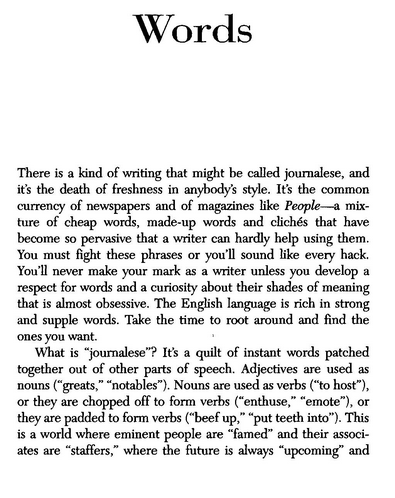
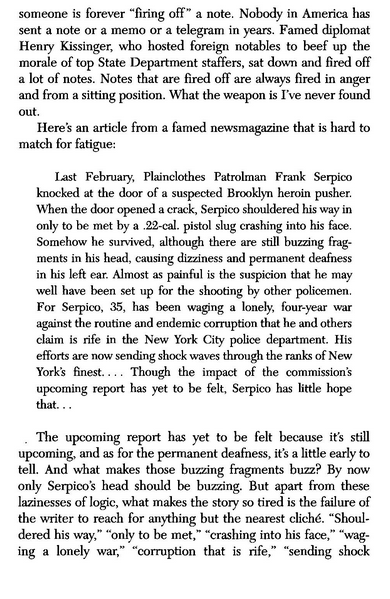
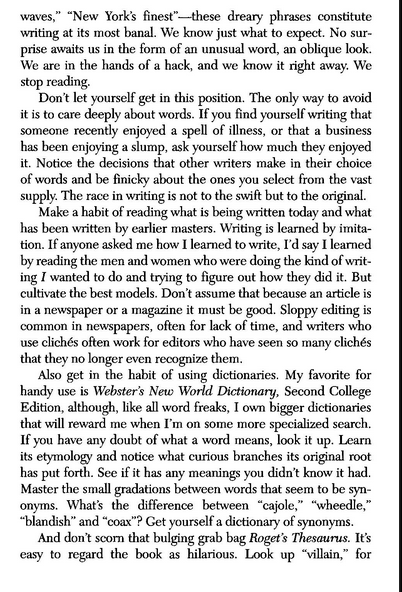
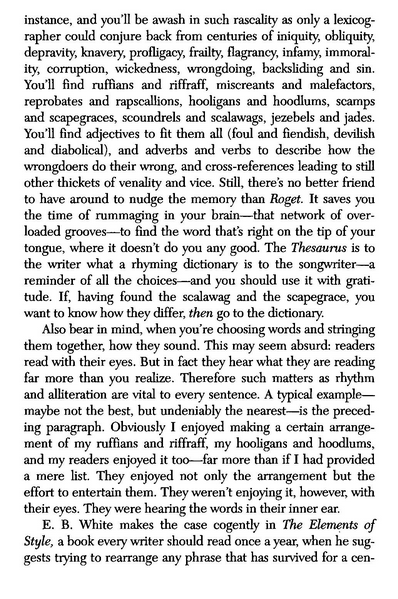
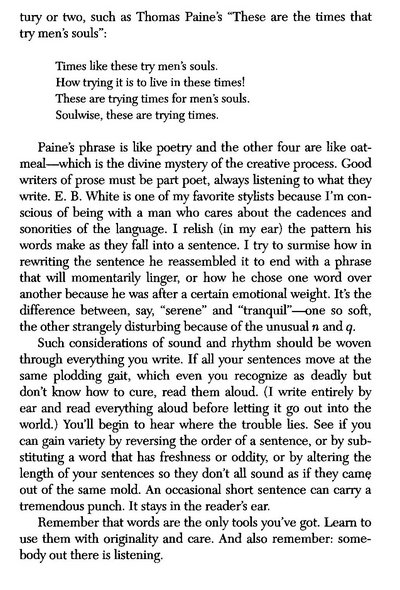
please write a summary (at least 4 sentences) explaining Zinssers main points in this section of the book. Then, find one or two quotes that stood out to you as particularly important writing advice and directly transcribe them into your response. Follow your quote(s) with an explanation of what you think it means and how you plan to apply this advice to your own writing. Your answer should be specific and detailed, and you should demonstrate that you have closely read the material. thank you!
Words There is a kind of writing that might be called journalese, and it's the death of freshness in anybody's style. It's the common currency of newspapers and of magazines like Peoplea mix- ture of cheap words, made-up words and clichs that have become so pervasive that a writer can hardly help using them. You must fight these phrases or you'll sound like every hack. You'll never make your mark as a writer unless you develop a respect for words and a curiosity about their shades of meaning that is almost obsessive. The English language is rich in strong and supple words. Take the time to root around and find the ones you want What is "journalese"? It's a quilt of instant words patched together out of other parts of speech. Adjectives are used as nouns ("greats, " "notables). Nouns are used as verbs ("to host"), or they are chopped off to form verbs ("enthuse," "emote"), or they are padded to form verbs ("beef up," "put teeth into"). This is a world where eminent people are "famed" and their associ- ates are "staffers," where the future is always "upcoming" and someone is forever "firing off" a note. Nobody in America has sent a note or a memo or a telegram in years. Famed diplomat Henry Kissinger, who hosted foreign notables to beef up the morale of top State Department staffers, sat down and fired off a lot of notes. Notes that are fired off are always fired in anger and from a sitting position. What the weapon is I've never found out. Here's an article from a famed newsmagazine that is hard to match for fatigue: Last February, Plainclothes Patrolman Frank Serpico knocked at the door of a suspected Brooklyn heroin pusher. When the door opened a crack, Serpico shouldered his way in only to be met by a 22-cal. pistol slug crashing into his face. Somehow he survived, although there are still buzzing frag- ments in his head, causing dizziness and permanent deafness in his left ear. Almost as painful is the suspicion that he may well have been set up for the shooting by other policemen. For Serpico, 35, has been waging a lonely, four-year war against the routine and endemic corruption that he and others claim is rife in the New York City police department. His efforts are now sending shock waves through the ranks of New York's finest.... Though the impact of the commission's upcoming report has yet to be felt, Serpico has little hope that... The upcoming report has yet to be felt because it's still upcoming, and as for the permanent deafness, it's a little early to tell. And what makes those buzzing fragments buzz? By now only Serpico's head should be buzzing. But apart from these lazinesses of logic, what makes the story so tired is the failure of the writer to reach for anything but the nearest clich. "Shoul- dered his way," "only to be met," "crashing into his face," "wag- ing a lonely war," "corruption that is rife," "sending shock waves," "New York's finest"these dreary phrases constitute writing at its most banal. We know just what to expect. No sur- prise awaits us in the form of an unusual word, an oblique look. We are in the hands of a hack, and we know it right away. We stop reading Don't let yourself get in this position. The only way to avoid it is to care deeply about words. If you find yourself writing that someone recently enjoyed a spell of illness, or that a business has been enjoying a slump, ask yourself how much they enjoyed it. Notice the decisions that other writers make in their choice of words and be finicky about the ones you select from the vast supply. The race in writing is not to the swift but to the original. Make a habit of reading what is being written today and what has been written by earlier masters. Writing is learned by imita- tion. If anyone asked me how I learned to write, I'd say I learned by reading the men and women who were doing the kind of writ- ing I wanted to do and trying to figure out how they did it. But cultivate the best models. Don't assume that because an article is in a newspaper or a magazine it must be good. Sloppy editing is common in newspapers, often for lack of time, and writers who use clichs often work for editors who have seen so many clichs that they no longer even recognize them. Also get in the habit of using dictionaries. My favorite for handy use is Webster's New World Dictionary, Second College Edition, although, like all word freaks, I own bigger dictionaries that will reward me when I'm on some more specialized search. If you have any doubt of what a word means, look it up. Learn its etymology and notice what curious branches its original root has put forth. See if it has any meanings you didn't know it had. Master the small gradations between words that seem to be syn- onyms. What's the difference between cajole," "wheedle," "blandish" and "coax"? Get yourself a dictionary of synonyms. And don't scom that bulging grab bag Roget's Thesaurus. It's easy to regard the book as hilarious. Look up "villain," for instance, and you'll be awash in such rascality as only a lexicog- rapher could conjure back from centuries of iniquity, obliquity, depravity, knavery, profligacy, frailty, flagrancy, infamy, immoral- ity, corruption, wickedness, wrongdoing, backsliding and sin. You'll find ruffians and riffraff, miscreants and malefactors, reprobates and rapscallions, hooligans and hoodlums, scamps and scapegraces, scoundrels and scalawags, jezebels and jades. You'll find adjectives to fit them all (foul and fiendish, devilish and diabolical), and adverbs and verbs to describe how the wrongdoers do their wrong, and cross-references leading to still other thickets of venality and vice. Still, there's no better friend to have around to nudge the memory than Roget. It saves you the time of rummaging in your brain-that network of over- loaded grooves--to find the word that's right on the tip of your tongue, where it doesn't do you any good. The Thesaurus is to the writer what a rhyming dictionary is to the songwriter-a reminder of all the choices-and you should use it with grati- tude. If, having found the scalawag and the scapegrace, you want to know how they differ, then go to the dictionary. Also bear in mind, when you're choosing words and stringing them together, how they sound. This may seem absurd: readers read with their eyes. But in fact they hear what they are reading far more than you realize. Therefore such matters as rhythm and alliteration are vital to every sentence. A typical example, maybe not the best, but undeniably the nearestis the preced- ing paragraph. Obviously I enjoyed making a certain arrange- ment of my ruffians and riffraff, my hooligans and hoodlums, and my readers enjoyed it too-far more than if I had provided a mere list. They enjoyed not only the arrangement but the effort to entertain them. They weren't enjoying it, however, with their eyes. They were hearing the words in their inner ear. E. B. White makes the case cogently in The Elements of Style, a book every writer should read once a year, when he sug- gests trying to rearrange any phrase that has survived for a cen- tury or two, such as Thomas Paine's "These are the times that try men's souls": Times like these try men's souls. How trying it is to live in these times! These are trying times for men's souls. Soulwise, these are trying times. Paine's phrase is like poetry and the other four are like oat- mealwhich is the divine mystery of the creative process. Good writers of prose must be part poet, always listening to what they write. E. B. White is one of my favorite stylists because I'm con- scious of being with a man who cares about the cadences and sonorities of the language. I relish (in my ear) the pattern his words make as they fall into a sentence. I try to surmise how in rewriting the sentence he reassembled it to end with a phrase that will momentarily linger, or how he chose one word over another because he was after a certain emotional weight. It's the difference between, say, "serene" and "tranquilone so soft, the other strangely disturbing because of the unusual n and q. Such considerations of sound and rhythm should be woven through everything you write. If all your sentences move at the same plodding gait, which even you recognize as deadly but don't know how to cure, read them aloud. (I write entirely by ear and read everything aloud before letting it go out into the world.) You'll begin to hear where the trouble lies. See if you can gain variety by reversing the order of a sentence, or by sub- stituting a word that has freshness or oddity, or by altering the length of your sentences so they don't all sound as if they came out of the same mold. An occasional short sentence can carry a tremendous punch. It stays in the reader's ear. Remember that words are the only tools you've got. Learn to use them with originality and care. And also remember: some- body out there is listeningStep by Step Solution
There are 3 Steps involved in it
1 Expert Approved Answer
Step: 1 Unlock

Question Has Been Solved by an Expert!
Get step-by-step solutions from verified subject matter experts
Step: 2 Unlock
Step: 3 Unlock
 Study Help