







Question: PLS ANSWER QUICKLY I WILL UPVOTE a). The Gauss-Markov Theorem states that the OLS estimators are BLUE if some of the main OLS assumptions are
PLS ANSWER QUICKLY I WILL UPVOTE 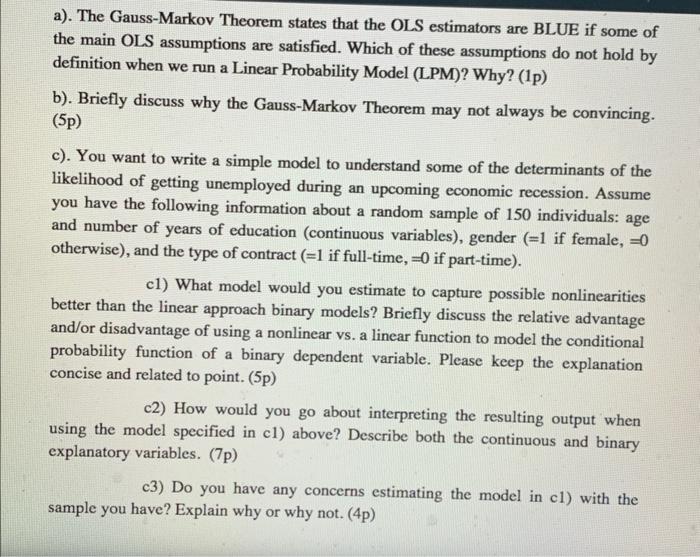
a). The Gauss-Markov Theorem states that the OLS estimators are BLUE if some of the main OLS assumptions are satisfied. Which of these assumptions do not hold by definition when we run a Linear Probability Model (LPM)? Why? (1p) b). Briefly discuss why the Gauss-Markov Theorem may not always be convincing. (5p) c). You want to write a simple model to understand some of the determinants of the likelihood of getting unemployed during an upcoming economic recession. Assume you have the following information about a random sample of 150 individuals: age and number of years of education (continuous variables), gender (=1 if female, =0 otherwise), and the type of contract ( =1 if full-time, =0 if part-time). c1) What model would you estimate to capture possible nonlinearities better than the linear approach binary models? Briefly discuss the relative advantage and/or disadvantage of using a nonlinear vs. a linear function to model the conditional probability function of a binary dependent variable. Please keep the explanation concise and related to point. (5p) c2) How would you go about interpreting the resulting output when using the model specified in c1 ) above? Describe both the continuous and binary explanatory variables. (7p) c3) Do you have any concerns estimating the model in c1 ) with the sample you have? Explain why or why not. (4p) a). The Gauss-Markov Theorem states that the OLS estimators are BLUE if some of the main OLS assumptions are satisfied. Which of these assumptions do not hold by definition when we run a Linear Probability Model (LPM)? Why? (1p) b). Briefly discuss why the Gauss-Markov Theorem may not always be convincing. (5p) c). You want to write a simple model to understand some of the determinants of the likelihood of getting unemployed during an upcoming economic recession. Assume you have the following information about a random sample of 150 individuals: age and number of years of education (continuous variables), gender (=1 if female, =0 otherwise), and the type of contract ( =1 if full-time, =0 if part-time). c1) What model would you estimate to capture possible nonlinearities better than the linear approach binary models? Briefly discuss the relative advantage and/or disadvantage of using a nonlinear vs. a linear function to model the conditional probability function of a binary dependent variable. Please keep the explanation concise and related to point. (5p) c2) How would you go about interpreting the resulting output when using the model specified in c1 ) above? Describe both the continuous and binary explanatory variables. (7p) c3) Do you have any concerns estimating the model in c1 ) with the sample you have? Explain why or why not. (4p)
Step by Step Solution
There are 3 Steps involved in it
1 Expert Approved Answer
Step: 1 Unlock

Question Has Been Solved by an Expert!
Get step-by-step solutions from verified subject matter experts
Step: 2 Unlock
Step: 3 Unlock
 Study Help