







Question: plss answet the highlighted number BLEMS (SI) =1000 kg). 3.1 The weight of a bridge crane plus its load equals 100 metric tons (1 metric
plss answet the highlighted number 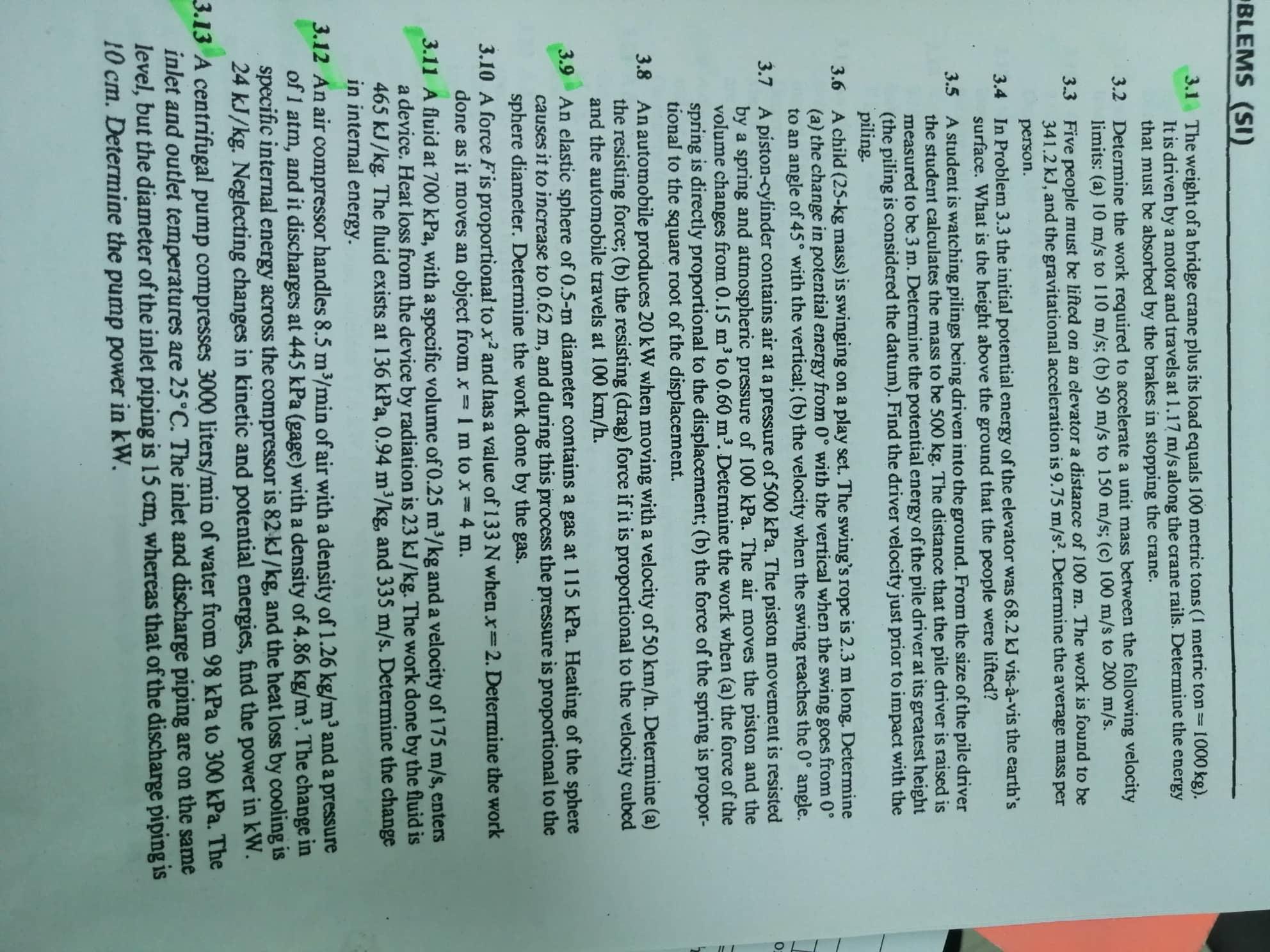
BLEMS (SI) =1000 kg). 3.1 The weight of a bridge crane plus its load equals 100 metric tons (1 metric ton= It is driven by a motor and travels at 1.17 m/s along the crane rails. Determine the energy that must be absorbed by the brakes in stopping the crane. 3.2 Determine the work required to accelerate a unit mass between the following velocity limits: (a) 10 m/s to 110 m/s; (b) 50 m/s to 150 m/s; (c) 100 m/s to 200 m/s. 3.3 Five people must be lifted on an elevator a distance of 100 m. The work is found to be 341.2 kJ, and the gravitational acceleration is 9.75 m/s2. Determine the average mass per person. 3.4 In Problem 3.3 the initial potential energy of the elevator was 68.2 kJ vis--vis the earth's surface. What is the height above the ground that the people were lifted? 3.5 A student is watching pilings being driven into the ground. From the size of the pile driver the student calculates the mass to be 500 kg. The distance that the pile driver is raised is measured to be 3 m. Determine the potential energy of the pile driver at its greatest height (the piling is considered the datum). Find the driver velocity just prior to impact with the piling. 3.6 A child (25-kg mass) is swinging on a play set. The swing's rope is 2.3 m long. Determine (a) the change in potential energy from 0 with the vertical when the swing goes from 0 to an angle of 45 with the vertical; (b) the velocity when the swing reaches the 0 angle. 3.7 A piston-cylinder contains air at a pressure of 500 kPa. The piston movement is resisted by a spring and atmospheric pressure of 100 kPa. The air moves the piston and the volume changes from 0.15 m to 0.60 m. Determine the work when (a) the force of the spring is directly proportional to the displacement; (b) the force of the spring is propor- tional to the square root of the displacement. 3.8 An automobile produces 20 kW when moving with a velocity of 50 km/h. Determine (a) the resisting force; (b) the resisting (drag) force if it is proportional to the velocity cubcd and the automobile travels at 100 km/h. 3.9 An elastic sphere of 0.5-m diameter contains a gas at 115 kPa. Heating of the sphere causes it to increase to 0.62 m, and during this process the pressure is proportional to the sphere diameter. Determine the work done by the gas. 3.10 A force F is proportional to x and has a value of 133 N when x 2. Determine the work done as it moves an object from x I m to x 4 m. 3.11 A fluid at 700 kPa, with a specific volume of 0.25 m/kg and a velocity of 175 m/s, enters a device. Heat loss from the device by radiation is 23 kJ /kg. The work done by the fluid is 465 kJ/kg. The fluid exists at 136 kPa, 0.94 m3/kg, and 335 m/s. Determine the change in internal energy. 3.12 An air compressor handles 8.5 m/min of air with a density of 1.26 kg/m and a pressure of 1 atm, and it discharges at 445 kPa (gage) with a density of 4.86 kg/m. The change in specific internal energy across the compressor is 82 kJ /kg, and the heat loss by cooling is 24 kJ/kg. Neglecting changes in kinetic and potential energies, find the power in kW. 3.13 A centrifugal pump compresses 3000 liters/min of water from 98 kPa to 300 kPa. The inlet and outlet temperatures are 25C. The inlet and discharge piping are on the same level, but the diameter of the inlet piping is 15 cm, whereas that of the discharge piping is 10 cm. Determine the pump power in kW.
Step by Step Solution
3.30 Rating (153 Votes )
There are 3 Steps involved in it
To solve the highlighted problem 311 we need to determine the work done by the fluid on a certain ob... View full answer

Get step-by-step solutions from verified subject matter experts
 Study Help