







Question: Plss answer the highlighted number SERVATION OF MASS AND ENERGY unknown flow rate; however, the water temperature increases from 13C to 24 C. Also, it
Plss answer the highlighted number
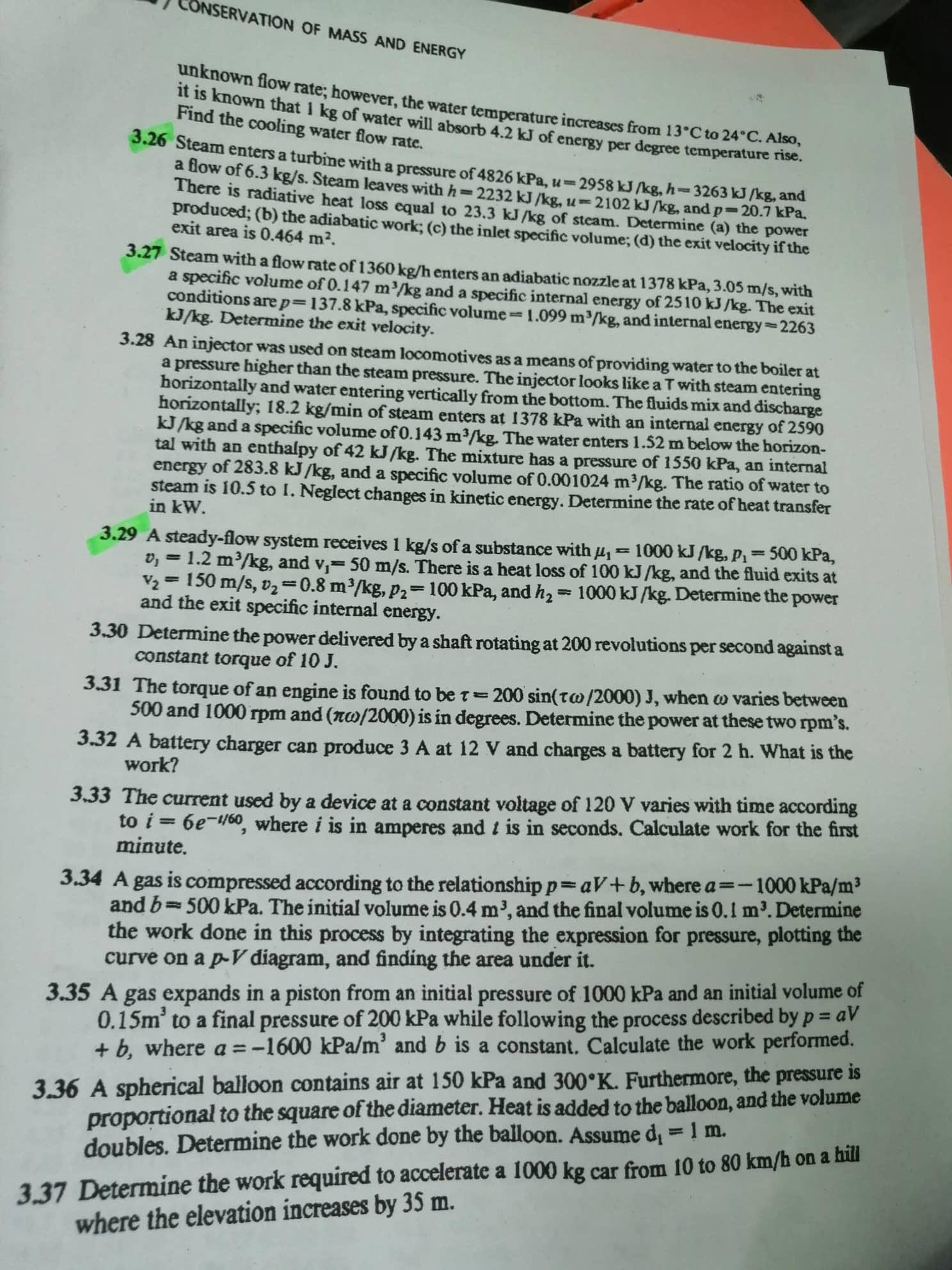
SERVATION OF MASS AND ENERGY unknown flow rate; however, the water temperature increases from 13C to 24 C. Also, it is known that 1 kg of water will absorb 4.2 kJ of energy per degree temperature rse. Find the cooling water flow rate. 3.26 Steam enters a turbine with a pressure of 4826 kPa, u=2958 kJ /kg, h=3263 kJ /kg, and a flow of 6.3 kg/s. Steam leaves with h= 2232 kJ /kg, u 2102 kJ/kg, and p=20.7 kPa. There is radiative heat loss equal to 23.3 kJ /kg of steam. Determine (a) the power produced; (b) the adiabatic work; (c) the inlet specific volume; (d) the exit velocity if the exit area is 0.464 m2. 3.27 Steam with a flow rate of 1360 kg/h enters an adiabatic nozzle at 1378 kPa, 3.05 m/s, with a specific volume of 0.147 m/kg and a specific internal energy of 2510 kJ /kg. The exit conditions arep=137.8 kPa, specific volume1.099 m/kg, and internal energy 2263 kJ/kg. Determine the exit velocity. 3.28 An injector was used on steam locomotives as a means of providing water to the boiler at a pressure higher than the steam pressure. The injector looks like a T with steam entering horizontally and water entering vertically from the bottom. The fluids mix and discharge horizontally; 18.2 kg/min of steam enters at 1378 kPa with an internal energy of 2590 kJ/kg and a specific volume of 0.143 m3/kg. The water enters 1.52 m below the horizon- tal with an enthalpy of 42 kJ/kg. The mixture has a pressure of 1550 kPa, an internal energy of 283.8 kJ/kg, and a specific volume of 0.001024 m3/kg. The ratio of water to steam is 10.5 to I. Neglect changes in kinetic energy. Determine the rate of heat transfer in kW. 3.29 A steady-flow system receives 1 kg/s of a substance with 4 1000 kJ/kg, P=500 kPa, v; = 1.2 m/kg, and v,= 50 m/s. There is a heat loss of 100 kJ/kg, and the fluid exits at V2 = 150 m/s, v2=0.8 m/kg, p2=100 kPa, and h2= 1000 kJ /kg. Determine the power and the exit specific internal energy. %3D %3D %3D 3.30 Determine the power delivered by a shaft rotating at 200 revolutions per second against a constant torque of 10 J. 3.31 The torque of an engine is found to be t= 200 sin(tw/2000) J, when w varies between 500 and 1000 rpm and (nw/2000) is in degrees. Determine the power at these two rpm's. 3.32 A battery charger can produce 3 A at 12 V and charges a battery for 2 h. What is the work? 3.33 The current used by a device at a constant voltage of 120 V varies with time according to i = 6e-460, where i is in amperes and t is in seconds. Calculate work for the first minute. %3D 3.34 A gas is compressed according to the relationship p=aV+b, where a=-1000 kPa/m and b=500 kPa. The initial volume is 0.4 m', and the final volume is 0.1 m. Determine the work done in this process by integrating the expression for pressure, plotting the curve on a p-V diagram, and finding the area under it. 3.35 A gas expands in a piston from an initial pressure of 1000 kPa and an initial volume of 0.15m' to a final pressure of 200 kPa while following the process described by p = aV + b, where a =-1600 kPa/m' and b is a constant. Calculate the work performed. 3.36 A spherical balloon contains air at 150 kPa and 300K. Furthermore, the pressure is proportional to the square of the diameter. Heat is added to the balloon, and the volume doubles. Determine the work done by the balloon. Assume d; = 1 m. 3.37 Determine the work required to accelerate a 1000 kg car from 10 to 80 km/h on a hill where the elevation increases by 35 m.
Step by Step Solution
3.52 Rating (149 Votes )
There are 3 Steps involved in it
To solve the highlighted problem 329 we will use the principles of energy balance for a steadyflow system Heres a stepbystep solution Given Mass flow ... View full answer

Get step-by-step solutions from verified subject matter experts
 Study Help