







Question: plz code in matlab an send the code Lab Assignment 4: Implementation of Laplace Transform Aim: To implement Laplace Transform using MATLAB. Theory: Laplace and
plz code in matlab an send the code
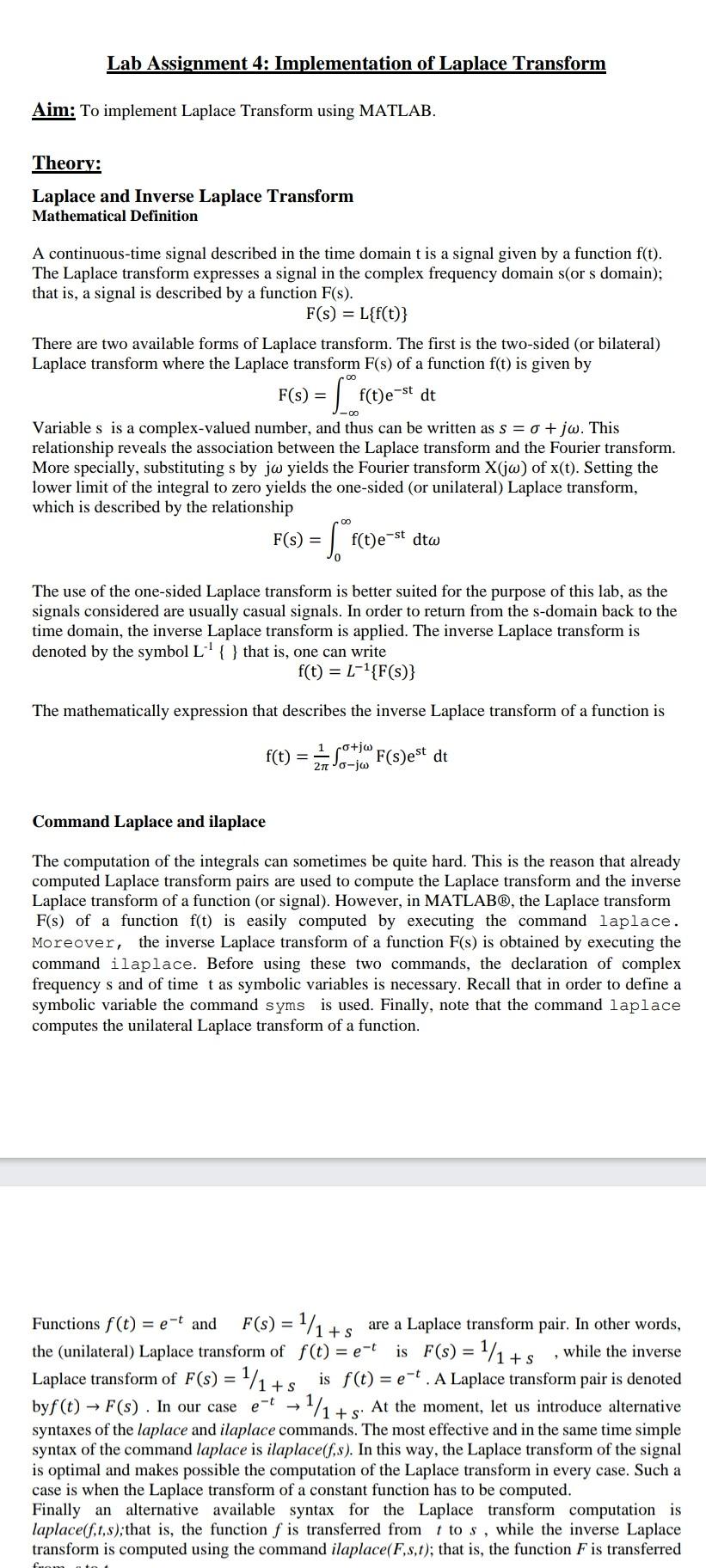
Lab Assignment 4: Implementation of Laplace Transform Aim: To implement Laplace Transform using MATLAB. Theory: Laplace and Inverse Laplace Transform Mathematical Definition A continuous-time signal described in the time domain t is a signal given by a function f(t). The Laplace transform expresses a signal in the complex frequency domain s(or s domain); that is, a signal is described by a function F(s). F(s) = L{f(t)} There are two available forms of Laplace transform. The first is the two-sided (or bilateral) Laplace transform where the Laplace transform F(s) of a function f(t) is given by F(S) = Sf(t)e=st dt Variables is a complex-valued number, and thus can be written ass = + jw. This relationship reveals the association between the Laplace transform and the Fourier transform. More specially, substituting s by jw yields the Fourier transform X(jw) of x(t). Setting the lower limit of the integral to zero yields the one-sided (or unilateral) Laplace transform, which is described by the relationship F(s) = S f(t)e+*+ dtw The use of the one-sided Laplace transform is better suited for the purpose of this lab, as the signals considered are usually casual signals. In order to return from the s-domain back to the time domain, the inverse Laplace transform is applied. The inverse Laplace transform is denoted by the symbol L' (that is, one can write f(t) = L-'{F(s)} The mathematically expression that describes the inverse Laplace transform of a function is f(t) = za So HWF(S)est dt Command Laplace and ilaplace The computation of the integrals can sometimes be quite hard. This is the reason that already computed Laplace transform pairs are used to compute the Laplace transform and the inverse Laplace transform of a function (or signal). However, in MATLAB, the Laplace transform F(s) of a function f(t) is easily computed by executing the command laplace. Moreover, the inverse Laplace transform of a function F(s) is obtained by executing the command ilaplace. Before using these two commands, the declaration of complex frequency s and of time t as symbolic variables is necessary. Recall that in order to define a symbolic variable the command syms is used. Finally, note that the command laplace computes the unilateral Laplace transform of a function. F(s) = 1/1 +5 Functions f(t) = e-t and are a Laplace transform pair. In other words, the (unilateral) Laplace transform of f(t) = e-t is F(s) = 1/1 +s while the inverse Laplace transform of F(s) = 1/1+s is f(t) = et. A Laplace transform pair is denoted byf (t) F(s) . In our case et 1/1 + s. At the moment, let us introduce alternative syntaxes of the laplace and ilaplace commands. The most effective and in the same time simple syntax of the command laplace is ilaplace(f,s). In this way, the Laplace transform of the signal is optimal and makes possible the computation of the Laplace transform in every case. Such a case is when the Laplace transform of a constant function has to be computed. Finally an alternative available syntax for the Laplace transform computation is laplace(f.1,s);that is, the function f is transferred from t to s , while the inverse Laplace transform is computed using the command ilaplace(F.s,t); that is, the function F is transferred fuam
Step by Step Solution
There are 3 Steps involved in it

Get step-by-step solutions from verified subject matter experts
 Study Help