





Question: - Port loading and unloading problem Design of a logistics decision making system There are 20 ships in the harbor, of different sizes and characteristics
- Port loading and unloading problem Design of a

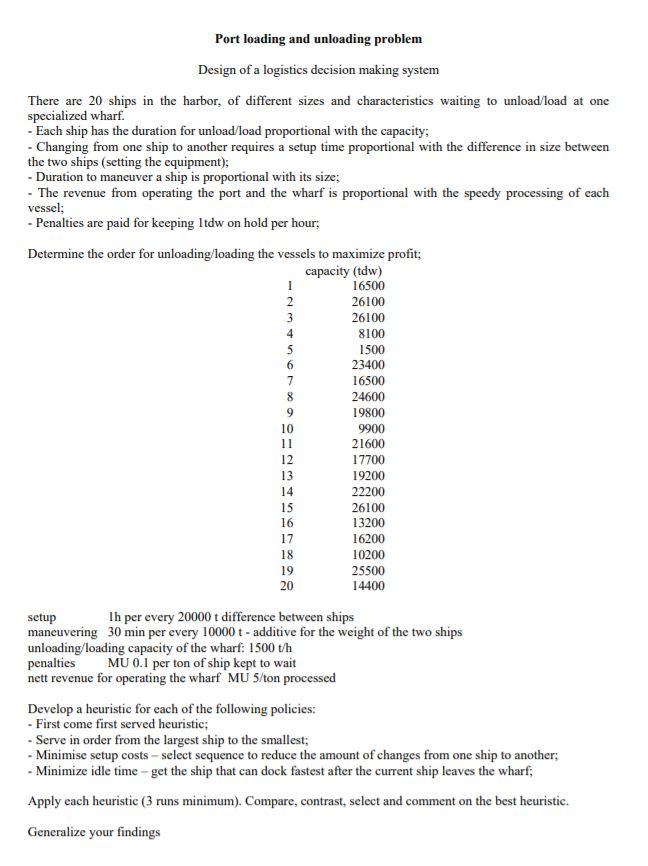
- Port loading and unloading problem Design of a logistics decision making system There are 20 ships in the harbor, of different sizes and characteristics waiting to unload/load at one specialized wharf. - Each ship has the duration for unload load proportional with the capacity; Changing from one ship to another requires a setup time proportional with the difference in size between the two ships (setting the equipment); - Duration to maneuver a ship is proportional with its size: - The revenue from operating the port and the wharf is proportional with the speedy processing of each vessel; - Penalties are paid for keeping Itdw on hold per hour: Determine the order for unloading/loading the vessels to maximize profit; capacity (tdw) 1 16500 2 26100 3 26100 8100 5 1500 23400 7 16500 24600 19800 9900 21600 17700 13 19200 22200 26100 13200 17 16200 18 10200 19 25500 20 14400 setup Ih per every 20000 t difference between ships maneuvering 30 min per every 10000 t - additive for the weight of the two ships unloading/loading capacity of the wharf: 1500 t/h penalties MU 0.1 per ton of ship kept to wait nett revenue for operating the wharf MU 5/ton processed Develop a heuristic for each of the following policies: - First come first served heuristic; - Serve in order from the largest ship to the smallest; - Minimise setup costs - select sequence to reduce the amount of changes from one ship to another; - Minimize idle time - get the ship that can dock fastest after the current ship leaves the wharf; Apply each heuristic (3 runs minimum). Compare, contrast, select and comment on the best heuristic. Generalize your findings 10 11 12 14 15 16 - Port loading and unloading problem Design of a logistics decision making system There are 20 ships in the harbor, of different sizes and characteristics waiting to unload/load at one specialized wharf. - Each ship has the duration for unload load proportional with the capacity; Changing from one ship to another requires a setup time proportional with the difference in size between the two ships (setting the equipment); - Duration to maneuver a ship is proportional with its size: - The revenue from operating the port and the wharf is proportional with the speedy processing of each vessel; - Penalties are paid for keeping Itdw on hold per hour: Determine the order for unloading/loading the vessels to maximize profit; capacity (tdw) 1 16500 2 26100 3 26100 8100 5 1500 23400 7 16500 24600 19800 9900 21600 17700 13 19200 22200 26100 13200 17 16200 18 10200 19 25500 20 14400 setup Ih per every 20000 t difference between ships maneuvering 30 min per every 10000 t - additive for the weight of the two ships unloading/loading capacity of the wharf: 1500 t/h penalties MU 0.1 per ton of ship kept to wait nett revenue for operating the wharf MU 5/ton processed Develop a heuristic for each of the following policies: - First come first served heuristic; - Serve in order from the largest ship to the smallest; - Minimise setup costs - select sequence to reduce the amount of changes from one ship to another; - Minimize idle time - get the ship that can dock fastest after the current ship leaves the wharf; Apply each heuristic (3 runs minimum). Compare, contrast, select and comment on the best heuristic. Generalize your findings 10 11 12 14 15 16

Step by Step Solution

There are 3 Steps involved in it

1 Expert Approved Answer
Step: 1 Unlock blur-text-image

Question Has Been Solved by an Expert!

Get step-by-step solutions from verified subject matter experts

Step: 2 Unlock
Step: 3 Unlock

Students Have Also Explored These Related General Management Questions!