







Question: Post 1: Initial Response Imagine you are responsible for your organizations analytic tasks, and you are currently brainstorming how to query a relational database of
Post 1: Initial Response
Imagine you are responsible for your organizations analytic tasks, and you are currently brainstorming how to query a relational database of marketing information for the organization. You want to test your understanding of how you might relate the database tables with the use of set theory, and particularly subsets. To carry out your test, complete each of the following:
To define two sets, set A and set B, first conduct an online browsing trial, in which you spend 1020 minutes looking at different websites, such as for national news, social media, sports, hobbies, recipes, etc. Let set A represent exactly three distinct company names from any online advertisements you saw during your browsing trial. Let set B represent at least three distinct company names for any online retailers you have purchased from in the past year. To prepare to use your algorithm, answer the following questions: How many elements are in set A? This is what you will set as m = _. How many elements are in set B? This is what you will set as n = _. What are your first and last elements of A? Show these as a[1] = __ and a[m] = _.* What are your first and last elements of B? Show these as b[1] = __ and b[n] = _.* *Note: Recognize that there are other elements you will cycle through as you trace the algorithm. While you are not required to list all elements in this form, you will need to use them, in addition to the first and last elements, as you complete your trace.
Using your sets A and B along with what you just outlined to prepare, determine an algorithm that you can use to see whether A B. State the algorithm that you would use to compare these sets. Based on your algorithm, did you find that A B or that A B? Explain. If A B, how are they related (e.g., disjoint, intersecting) ALSO THERE IS SOLVED EXAMPLE I HAD ATTACHED. ANSWER SHOULD BE IN THE FORM THAT I HAD ATTACHED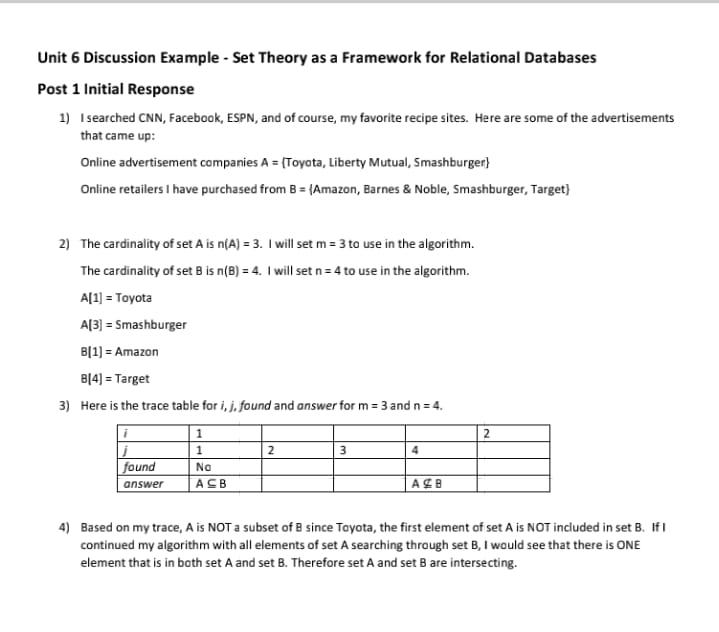
Step by Step Solution
There are 3 Steps involved in it

Get step-by-step solutions from verified subject matter experts
 Study Help