Question: Post your thoughts on a specific topic within the reading. your posts should be three paragraphs. The topic is cheerleader. I attached the reading
Post your thoughts on a specific topic within the reading. your posts should be three paragraphs. The topic is " cheerleader. I attached the reading pictures and an example below.
Paragraph 1 - Explain the concept and your particular area of focus. Talk about the overall theory and how your topic is different than the others.
Paragraph 2 - Explain how you will carry yourself in a professional setting relative to your leadership. How will you work with your bosses to show (or avoid showing) this quality? What steps can you take to make this happen?
Paragraph 3 - Explain how you will carry yourself in a professional setting relative to your followers. How will you foster (or suppress) this quality in the people that work for you? What steps can you take to make this happen
| Here is an example: Need for Achievement Need for achievement is one of the three major motivators identified by David McClelland in his research related to Achievement Motivation Theory. Achievement Motivation Theory attempts to identify how our behavior is motivated by our desires to satisfy needs. McClelland also identifies Power and Affiliation as needs for leaders. Leaders who display a high need for achievement tend to take responsibility for solving problems, set aggressive but attainable goals, and take calculated risks. Of the Big 5 personality traits, Need for Achievement is most closely associated with conscientiousness. In a professional setting, I will use this knowledge to understand my leader's motivations and their needs. If my leadership is motivated by affiliation, I will ensure that the relationship between me and my leader is iron-clad. If my leader's motivation is achievement, I will ensure that I am a positive contributor to goals and accomplishments. If my leader's motivation is power, I will ensure that I am taking strides to consistently improve their scope of control and political influence. Knowing my leader strives for a high level of achievement, I will work to help them complete tasks on time and be sure to check off the boxes or manage expectations when there may be delays. As a leader, I will use this knowledge to motivate my employees. Understanding their needs, I can offer rewards that are aligned to the needs of my followers. Employees with n. Power, I can offer additional control and influence within the organization as a reward for exemplary performance. For my N. Affiliation employees, I will make sure that they know that I value them and that our relationship is strong. Knowing that employees have a high need for achievement, I can motivate my followers with stretch goals and novel / difficult projects. |
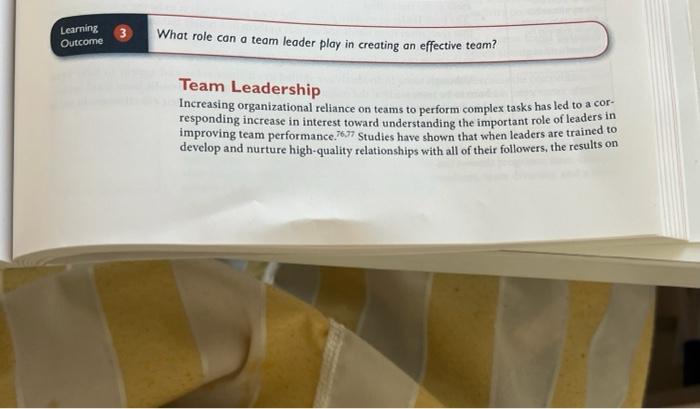
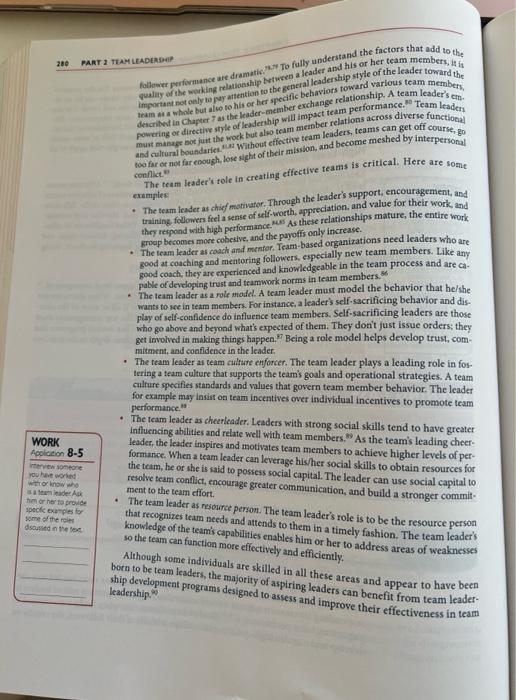
Learning Outcome What role can a team leader play in creating an effective team? Team Leadership Increasing organizational reliance on teams to perform complex tasks has led to a cors responding increase in interest toward understanding the important role of leaders in improving team performance.76.77 Studies have shown that when leaders are trained to develop and nurture high-quality relationships with all of their followers, the results on 200 PART 3 TEAM LEADERSHIP quality of the working relationship between a leader and his or her team members. It is follow performance are dramatic. To fully understand the factors that add to the Important not only to pay attention to the general leadership style of the leader toward the described in Chapter 7 as the leader-member exchange relationship. A team leader's cm team as a whole but also to his or her specific behaviors towand various team members powering or directive style of leadership will impact team performance. Team leaders and cultural boundaries Without effective team leaders, teams can get off course, must manage not just the work but also team member relations across diverse functional too far or not far enough, lose sight of their mission, and become meshed by interpersonal conflict. The team leader's role in creating effective teams is critical. Here are some exemples The team leader as chief motivator. Through the leader's support, encouragement and training followers feel a sense of self-worth, appreciation, and value for their work and they respond with high performance. As these relationships mature, the entire work groep becomes more cohesive, and the payoffs only increase. The team leader as coach and menter. Team-based organizations need leaders who are good at coaching and mentoring followers, especially new team members. Like any good coach, they are experienced and knowledgeable in the team process and are a pable of developing trust and teamwork norms in team members The team leader as a role model. A team leader must model the behavior that he/she wants to see in team members. For instance, a leader's self-sacrificing behavior and dis. play of self-confidence do influence team members. Self-sacrificing leaders are those who go above and beyond what's expected of them. They don't just issue orders, they get involved in making things happen. Being a role model helps develop trust, com mitment, and confidence in the leader The team leader as team culture enforcer. The team leader plays a leading role in fos- tering a team culture that supports the team's goals and operational strategies. A team culture specifies standards and values that govern team member behavior. The leader for example may insist on team incentives over individual incentives to promote team performance." The team leader as cheerleader. Leaders with strong social skills tend to have greater influencing abilities and relate well with team members. As the team's leading cheer WORK Apolcation 8-5 en someone you have worked with or know who de A him or her to provide profesoples to some of the roles dscnthet leader, the leader inspires and motivates team members to achieve higher levels of per formance. When a team leader can leverage his/her social skills to obtain resources for the team, he or she is said to possess social capital. The leader can use social capital to resolve team conflict. encourage greater communication, and build a stronger commit ment to the team effort. The team leader as resource person. The team leader's role is to be the resource person that recognizes team needs and attends to them in a timely fashion. The team leader's knowledge of the team's capabilities enables him or her to address areas of weaknesses so the team can function more effectively and efficiently Although some individuals are skilled in all these areas and appear to have been born to be team leaders, the majority of aspiring leaders can benefit from team leader ship development programs designed to assess and improve their effectiveness in team leadership









 Study Help