



Question: Potential Class Project TOPIC: Develop a Fashion Institute Project sponsor: The one who initiates the need for the project. Liaison with management. Creates the project
Potential Class Project TOPIC: Develop a Fashion Institute
Project sponsor: The one who initiates the need for the project.
Liaison with management.
Creates the project charter.
I. Project Scope
1. Give the project a name that reflects the purpose or final deliverable.
2. Describe the business problem or opportunity
Describe the business environment, if applicable
Explain how the final deliverable will solve the problem, or exploit the opportunity
3. Identify the project customer or customers
"Project Customer" is the user of the final deliverable, or represents the users.
Determine who will approve and use the project's final deliverable.
Customer may be internal or external to org.
If more than one customer, clarify which function, area, or decision each controls or owns.
Ask for customer acceptance criteria.
4. Rank the project decision criteria: faster, better, or cheaper.
As a baseline, assume all the project assumptions will be met.
Prioritize the three factors in the case of trade-offs.
Based on project sponsor's and customer's priorities.
What's most valuable to the project--faster, better, or cheaper?
5. Briefly outline the project customer's requirements.
Determine the problem the project customer wants to solve by using the specific final deliverable.
Find out whether the project customer is looking for specific features or has defined specifications for the final deliverable.
6. Describe the final deliverable(s)
The final deliverable is a product, service, process, or result.
It is delivered to the project customer.
It must satisfy the customer's requirements.
A project usually has only one or two deliverables.
If more than one option would satisfy the customer requirements, the PM or project team should work with the project customer and/or sponsor, if possible, to finalize the deliverable
7. Describe the acceptance criteria for the final deliverable.
List the criteria the customer will use to accept or reject the final deliverable.
Whenever possible, ask the customer to provide the criteria.
Determine who can approve budgets, make changes to acceptance criteria, and modify requirements.
Agree on how to measure the project customer's level of satisfaction with the final deliverable.
8. Describe the organizational deliverables.
The product, service, process, or result that is created to meet an organizational need or requirement (not a customer requirement).
An org'l deliverable may be a by-product of creating the final deliverable or maybe an additional deliverable.
Example: A report on a new area of technology that the team uses in producing a final deliverable for a customer.
The report is for the organization and was created to complete the project.
9. Define the acceptance criteria for any organizational deliverables
If the sponsor doesn't define these criteria, develop proposed criteria and give them to the sponsor for approval
10. Identify the project's major stakeholders.
Stakeholders are people or groups that will be affected by and care about the project.
They have formal or informal authority over the impacted groups and can affect the success of the project.
They usually do not have approval authority (unless they are also on the project team), but if they support the project, it will be easier.
They may be able to influence the project sponsor or customer.
Stakeholders are not members of the project team.
II. Project Assurance
-To set the tone for managing the risk on the project.
What is the maximum degree of risk allowed?
1. Establish the tolerance for risk--risk limits--for the project.
The amount of risk the management is willing to accept.
Assign numbers (1-10) representing the risk limit for the project.
Analyze the project's risk level, compare it to the risk limit.
Where possible, explain which types of risk are acceptable and which are not, or quantify unacceptable consequences in financial costs, delays, or quality
2. Identify critical or mandatory reviews and approvals.
Identify checkpoints (or toll-gates or sign-offs) for assuring project quality.
Define the reviews and approvals requested by the project customer or sponsor.
Note the reason for each review or approval.
Include the customer in this process, where appropriate.
3. Describe the communications--that is, status reports--that the organization requires
at a high level.
Status reports are used by management to monitor the project.
The sponsor should specify his/her needs from these reports.
Specify the frequency and content of each report.
III. Resources
-To communicate the resource limits--human, schedule, and monetary--that are available or allocated for the project.
1. Choose the project manager and initial team members.
2. Determine the project's deadlines
List the dates that MUST be met, including the final deliverable.
Avoid giving unnecessary deadlines. It's the team's job to plan how to best meet the real deadlines on the project.
Don't forget to set deadlines for any organizational deliverables.
3. Determine the limits on effort.
External staffing costs (contractors, etc).
Verify limits with the project sponsor.
Effort limit is the maximum amount of effort allowed on the project.
Could be measured in Full-Time Equivalents (FTEs).
4. Determine the project's cost objective/spending limit.
The maximum amount of money authorized for the project.
Tell the team what is included in the limit
5. List any organizational constraints on the project
Includes other than deadlines and costs limits
Use only constraints that are essential.
The project team should have as much freedom as possible to meet goals.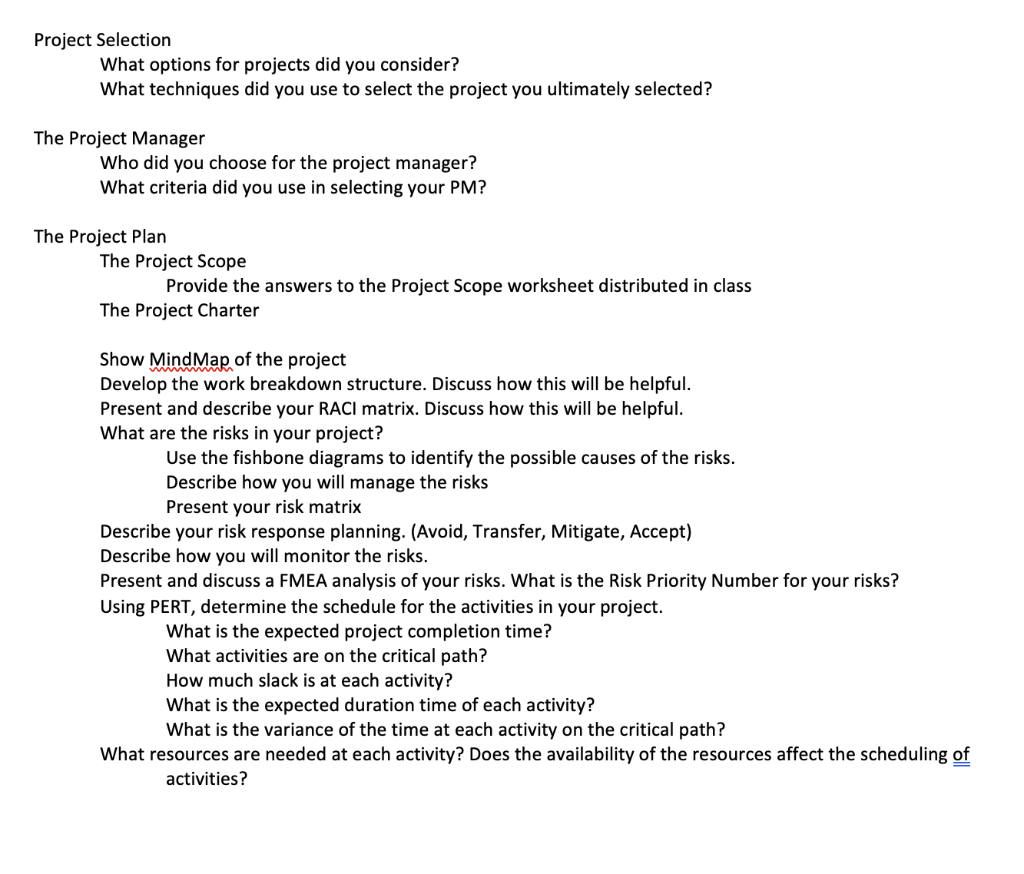
Project Selection What options for projects did you consider? What techniques did you use to select the project you ultimately selected? The Project Manager Who did you choose for the project manager? What criteria did you use in selecting your PM? The Project Plan The Project Scope Provide the answers to the Project Scope worksheet distributed in class The Project Charter Show Mind Map of the project Develop the work breakdown structure. Discuss how this will be helpful. Present and describe your RACI matrix. Discuss how this will be helpful. What are the risks in your project? Use the fishbone diagrams to identify the possible causes of the risks. Describe how you will manage the risks Present your risk matrix Describe your risk response planning. (Avoid, Transfer, Mitigate, Accept) Describe how you will monitor the risks. Present and discuss a FMEA analysis of your risks. What is the Risk Priority Number for your risks? Using PERT, determine the schedule for the activities in your project. What is the expected project completion time? What activities are on the critical path? How much slack is at each activity? What is the expected duration time of each activity? What is the variance of the time at each activity on the critical path? What resources are needed at each activity? Does the availability of the resources affect the scheduling of activities
Step by Step Solution
There are 3 Steps involved in it

Get step-by-step solutions from verified subject matter experts