







Question: Pottery Problem - Compatibility Mode - Saved to my Mac Layout References Mailings Review View Tell me Comme AaBbCcDdEe AaBbCcDdEe AaBbCcDc AaBbCcDd AaBbCcDdEe Normal No
Pottery Problem Compatibility Mode Saved to my Mac
Layout
References
Mailings
Review
View
Tell me
Comme
AaBbCcDdEe
AaBbCcDdEe
AaBbCcDc
AaBbCcDd
AaBbCcDdEe
Normal
No Spacing
Heading
Heading
Heading
Pottery Problem Part
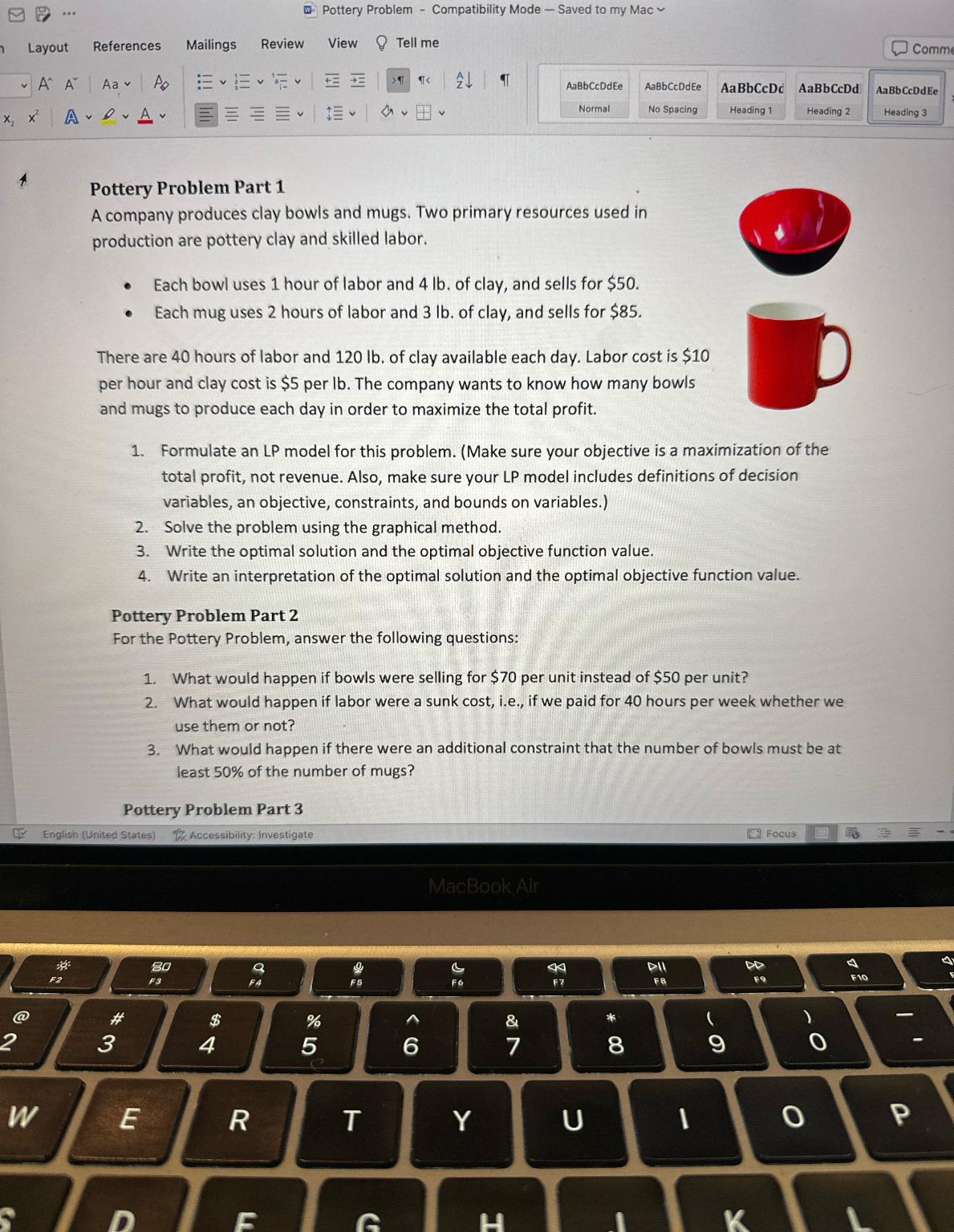
A company produces clay bowls and mugs. Two primary resources used in production are pottery clay and skilled labor.
Each bowl uses hour of labor and of clay, and sells for $
Each mug uses hours of labor and of clay, and sells for $
There are hours of labor and of clay available each day. Labor cost is $ per hour and clay cost is $ per The company wants to know how many bowls and mugs to produce each day in order to maximize the total profit.
Formulate an LP model for this problem. Make sure your objective is a maximization of the total profit, not revenue. Also, make sure your LP model includes definitions of decision variables, an objective, constraints, and bounds on variables.
Solve the problem using the graphical method.
Write the optimal solution and the optimal objective function value.
Write an interpretation of the optimal solution and the optimal objective function value.
Pottery Problem Part
For the Pottery Problem, answer the following questions:
What would happen if bowls were selling for $ per unit instead of $ per unit?
What would happen if labor were a sunk cost, ie if we paid for hours per week whether we use them or not?
What would happen if there were an additional constraint that the number of bowls must be at least of the number of mugs?
Pottery Problem Part
Step by Step Solution
There are 3 Steps involved in it
1 Expert Approved Answer
Step: 1 Unlock

Question Has Been Solved by an Expert!
Get step-by-step solutions from verified subject matter experts
Step: 2 Unlock
Step: 3 Unlock
 Study Help