







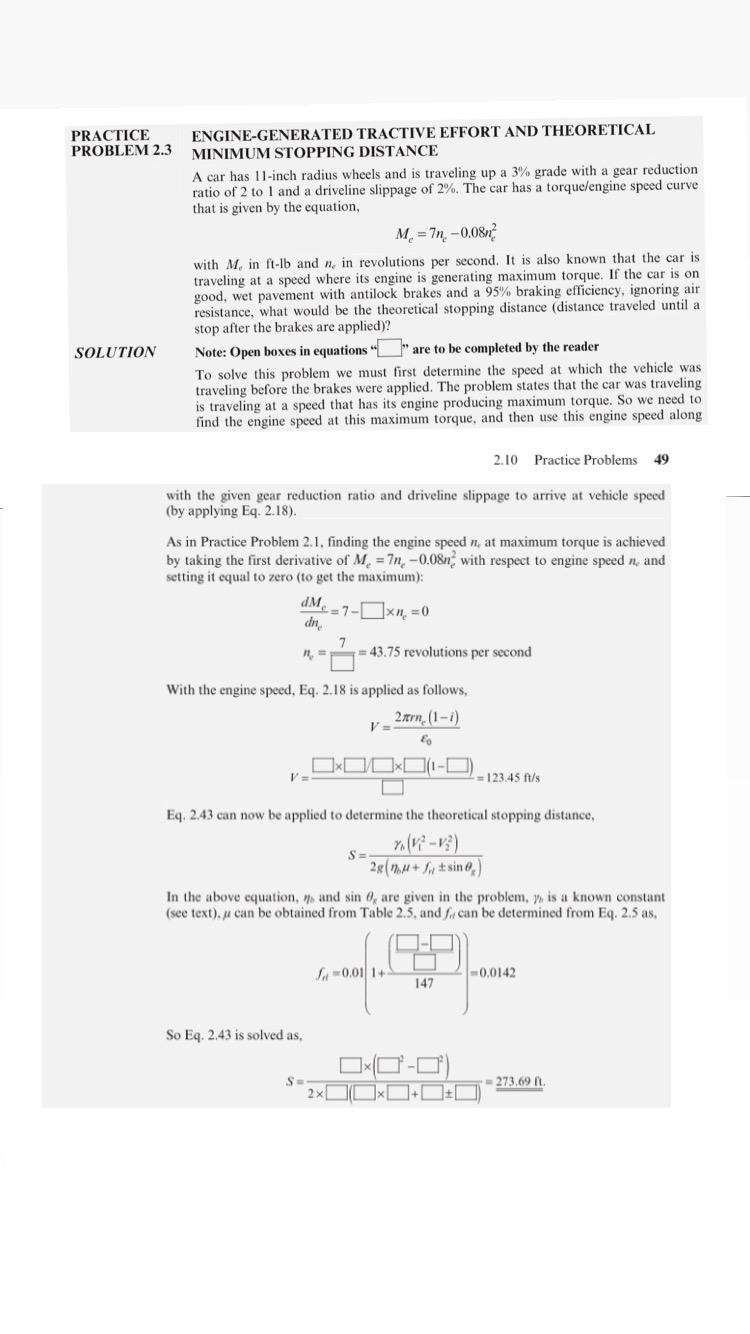
Question: PRACTICE ENGINE - GENERATED TRACTIVE EFFORT AND THEORETICAL PROBLEM 2 . 3 MINIMUM STOPPING DISTANCE A car has 1 1 - inch radius wheels and
PRACTICE
ENGINEGENERATED TRACTIVE EFFORT AND THEORETICAL
PROBLEM MINIMUM STOPPING DISTANCE
A car has inch radius wheels and is traveling up a grade with a gear reduction ratio of to and a driveline slippage of The car has a torqueengine speed curve that is given by the equation,
with in and in revolutions per second. It is also known that the car is traveling at a speed where its engine is generating maximum torque. If the car is on good, wet pavement with antilock brakes and a braking efficiency, ignoring air resistance, what would be the theoretical stopping distance distance traveled until a stop after the brakes are applied
SOLUTION Note: Open boxes in equations 'are to be completed by the reader
To solve this problem we must first determine the speed at which the vehicle was traveling before the brakes were applied. The problem states that the car was traveling is traveling at a speed that has its engine producing maximum torque. So we need to find the engine speed at this maximum torque, and then use this engine speed along
Practice Problems
with the given gear reduction ratio and driveline slippage to arrive at vehicle speed by applying Eq
As in Practice Problem finding the engine speed at maximum torque is achieved by taking the first derivative of with respect to engine speed and setting it equal to zero to get the maximum:
revolutions per second
With the engine speed, Eq is applied as follows,
Eq can now be applied to determine the theoretical stopping distance,
In the above equation, and are given in the problem, is a known constant see text can be obtained from Table and can be determined from Eq as
So Eq is solved as
Step by Step Solution
There are 3 Steps involved in it
1 Expert Approved Answer
Step: 1 Unlock

Question Has Been Solved by an Expert!
Get step-by-step solutions from verified subject matter experts
Step: 2 Unlock
Step: 3 Unlock
 Study Help