







Question: Principles of Management (MGT101 ) Assignment Workload: This Assignment comprise of a short Case. Assignment is to be submitted by each student individually. Assignment Purposes/Learning
Principles of Management (MGT101)
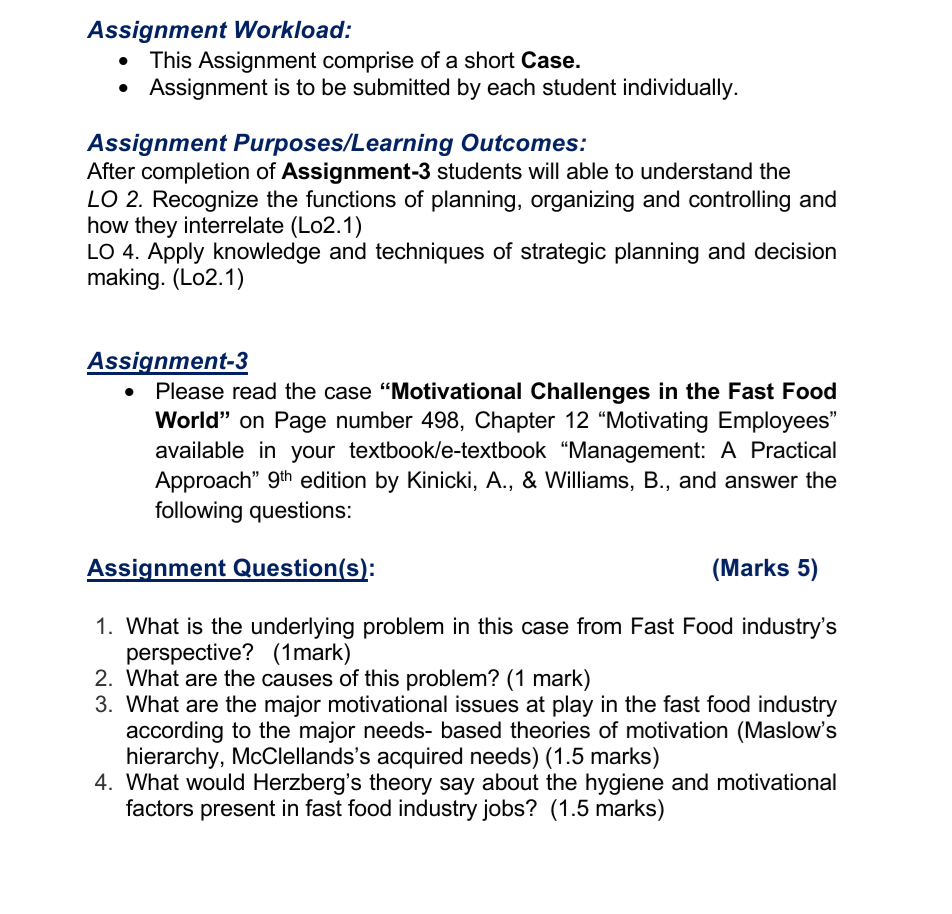
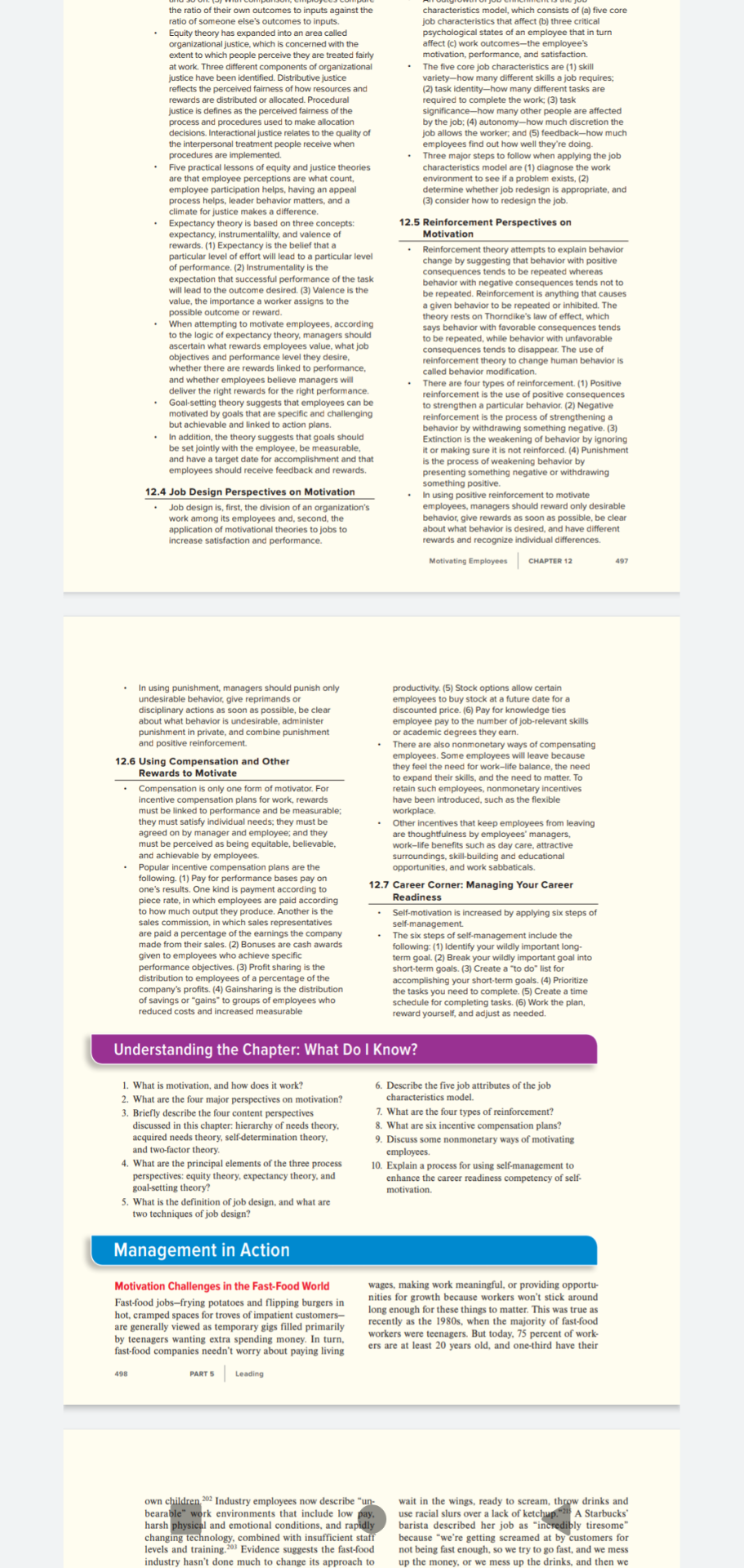
Assignment Workload: This Assignment comprise of a short Case. Assignment is to be submitted by each student individually. Assignment Purposes/Learning Outcomes: After completion of Assignment-3 students will able to understand the LO 2. Recognize the functions of planning, organizing and controlling and how they interrelate (L02.1) LO 4. Apply knowledge and techniques of strategic planning and decision making. (L02.1) Assignment-3 Please read the case Motivational Challenges in the Fast Food World on Page number 498, Chapter 12 Motivating Employees" available in your textbook/e-textbook Management: A Practical Approach 9th edition by Kinicki, A., & Williams, B., and answer the following questions: Assignment Question(s): (Marks 5) 1. What is the underlying problem in this case from Fast Food industry's perspective? (1mark) 2. What are the causes of this problem? (1 mark) 3. What are the major motivational issues at play in the fast food industry according to the major needs- based theories of motivation (Maslow's hierarchy, McClellands's acquired needs) (1.5 marks) 4. What would Herzberg's theory say about the hygiene and motivational factors present in fast food industry jobs? (1.5 marks) the ratio of their own outcomes to inputs against the ratio of someone else's outcomes to inputs Equity theory has expanded into an area called organizational justice, which is concerned with the extent to which people perceive they are treated fairly at work. Three different components of organizational justice have been identified. Distributive justice reflects the perceived fairness of how resources and rewards are distributed or allocated. Procedural justice is defines as the perceived fairness of the process and procedures used to make allocation decisions. Interactional justice relates to the quality of the interpersonal treatment people receive when procedures are implemented Five practical lessons of equity and justice theories are that employee perceptions are what count, employee participation helps, having an appeal process helps, leader behavior matters, and a climate for justice makes a difference. Expectancy theory is based on three concepts: expectancy, instrumentality, and valence of rewards. (1) Expectancy is the belief that a particular level of effort will lead to a particular level of performance (2) Instrumentality is the expectation that successful performance of the task will lead to the outcome desired. (3) Valence is the value, the importance a worker assigns to the possible outcome or reward. When attempting to motivate employees, according to the logic of expectancy theory, managers should ascertain what rewards employees value, what job objectives and performance level they desire, whether there are rewards linked to performance, and whether employees believe managers will deliver the right rewards for the right performance, Goal-setting theory suggests that employees can be motivated by goals that are specific and challenging but achievable and linked to action plans. In addition, the theory suggests that goals should be set jointly with the employee, be measurable, and have a target date for accomplishment and that employees should receive feedback and rewards. characteristics model, which consists of (a) five core job characteristics that affect (b) three critical psychological states of an employee that in turn affect (c) work outcomes-the employee's motivation, performance, and satisfaction. The five core job characteristics are (1) skill variety-how many different skills a job requires; (2) task identity-how many different tasks are required to complete the work; (3) task significance-how many other people are affected by the job; (4) autonomy-how much discretion the job allows the worker, and (5) feedback-how much employees find out how well they're doing. Three major steps to follow when applying the job characteristics model are (1) diagnose the work environment to see if a problem exists. (2) determine whether job redesign is appropriate, and (3) consider how to redesign the job. 12.5 Reinforcement Perspectives on Motivation Reinforcement theory attempts to explain behavior change by suggesting that behavior with positive consequences tends to be repeated whereas behavior with negative consequences tends not to be repeated. Reinforcement is anything that causes a given behavior to be repeated or inhibited. The theory rests on Thorndike's law of effect, which says behavior with favorable consequences tends to be repeated, while behavior with unfavorable consequences tends to disappear. The use of reinforcement theory to change human behavior is called behavior modification. There are four types of reinforcement (1) Positive reinforcement is the use of positive consequences to strengthen a particular behavior. (2) Negative reinforcement is the process of strengthening a behavior by withdrawing something negative. (3) Extinction is the weakening of behavior by ignoring it or making sure it is not reinforced. (4) Punishment is the process of weakening behavior by presenting something negative or withdrawing something positive In using positive reinforcement to motivate employees, managers should reward only desirable behavior, give rewards as soon as possible, be clear about what behavior is desired, and have different rewards and recognize individual differences. 12.4 Job Design Perspectives on Motivation Job design is, first, the division of an organization's work among its employees and, second, the application of motivational theories to jobs to increase satisfaction and performance. Motivating Employees CHAPTER 12 497 In using punishment, managers should punish only undesirable behavior, give reprimands or disciplinary actions as soon as possible, be clear about what behavior is undesirable, administer punishment in private, and combine punishment and positive reinforcement, 12.6 Using Compensation and Other Rewards to Motivate Compensation is only one form of motivator. For incentive compensation plans for work, rewards must be linked to performance and be measurable; they must satisfy individual needs; they must be agreed on by manager and employee; and they must be perceived as being equitable, believable, and achievable by employees. Popular Incentive compensation plans are the following. (1) Pay for performance bases pay on one's results. One kind is payment according to piece rate, in which employees are paid according to how much output they produce. Another the sales commission, in which sales representatives are paid a percentage of the earnings the company made from their sales. (2) Bonuses are cash awards given to employees who achieve specific performance objectives. (3) Profit sharing is the distribution to employees of a percentage of the company's profits. (4) Gainsharing is the distribution of savings or gains to groups of employees who reduced costs and increased measurable productivity. (5) Stock options allow certain employees to buy stock at a future date for a discounted price. (6) Pay for knowledge ties employee pay to the number of job-relevant skills or academic degrees they earn. There are also nonmonetary ways of compensating employees. Some employees will leave because they feel the need for work-life balance, the need to expand their skills, and the need to matter. To retain such employees, nonmonetary incentives have been introduced, such as the flexible workplace. Other incentives that keep employees from leaving are thoughtfulness by employees' managers, work-life benefits such as day care, attractive surroundings, skill-building and educational opportunities, and work sabbaticals 12.7 Career Corner: Managing Your Career Readiness Self-motivation is increased by applying six steps of self-management The six steps of self-management include the following: (1) Identify your wildly important long- term goal. (2) Break your wildly important goal into short-term goals. (3) Create a "to do list for accomplishing your short-term goals. (4) Prioritize the tasks you need to complete. (5) Create a time schedule for completing tasks. (6) Work the plan, reward yourself, and adjust as needed. Understanding the Chapter: What Do I Know? 1. What is motivation, and how does it work? 2. What are the four major perspectives on motivation? 3. Briefly describe the four content perspectives discussed in this chapter: hierarchy of needs theory, acquired needs theory, self-determination theory, and two-factor theory 4. What are the principal elements of the three process perspectives: equity theory, expectancy theory, and goal setting theory 5. What is the definition of job design, and what are two techniques of job design? 6. Describe the five job attributes of the job characteristics model. 7. What are the four types of reinforcement? 8. What are six incentive compensation plans? 9. Discuss some nonmonetary ways of motivating employees. 10. Explain a process for using self-management to enhance the career readiness competency of self- motivation Management in Action Motivation Challenges in the Fast-Food World Fast-food jobs-frying potatoes and flipping burgers in hot, cramped spaces for troves of impatient customers- are generally viewed as temporary gigs filled primarily by teenagers wanting extra spending money. In turn, fast-food companies needn't worry about paying living wages, making work meaningful, or providing opportu- nities for growth because workers won't stick around long enough for these things to matter. This was true as recently as the 1980s, when the majority of fast-food workers were teenagers. But today. 75 percent of work- ers are at least 20 years old, and one-third have their 498 PART 5 Leading own children 202 Industry employees now describe "un- bearable" work environments that include low pay. harsh physical and emotional conditions, and rapidly changing technology, combined with insufficient staff levels and training.20 Evidence suggests the fast-food industry hasn't done much to change its approach to wait in the wings, ready to scream, throw drinks and use racial slurs over a lack of ketchup.21 A Starbucks barista described her job as "incredibly tiresome" because "we're getting screamed at by customers for not being fast enough, so we try to go fast, and we mess up the money, or we mess up the drinks, and then we
Step by Step Solution
There are 3 Steps involved in it
1 Expert Approved Answer
Step: 1 Unlock

Question Has Been Solved by an Expert!
Get step-by-step solutions from verified subject matter experts
Step: 2 Unlock
Step: 3 Unlock
 Study Help