







Question: Problem # 1 ( 2 5 pts ) : Mode Superposition Method: Decoupling Equations of Motion The mode superposition method allows us to decouple our
Problem # pts: Mode Superposition Method: Decoupling Equations of Motion
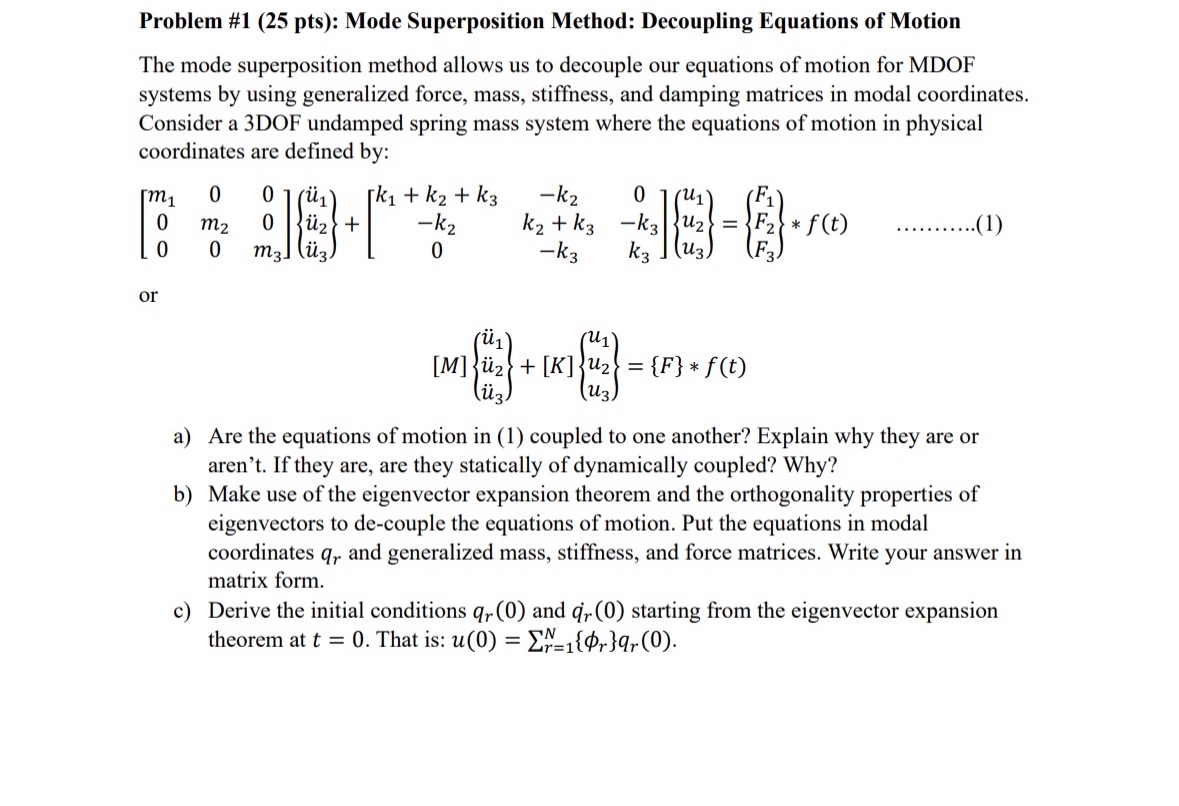
The mode superposition method allows us to decouple our equations of motion for MDOF systems by using generalized force, mass, stiffness, and damping matrices in modal coordinates. Consider a DOF undamped spring mass system where the equations of motion in physical coordinates are defined by:
or
a Are the equations of motion in coupled to one another? Explain why they are or aren't. If they are, are they statically of dynamically coupled? Why?
b Make use of the eigenvector expansion theorem and the orthogonality properties of eigenvectors to decouple the equations of motion. Put the equations in modal coordinates and generalized mass, stiffness, and force matrices. Write your answer in matrix form.
c Derive the initial conditions and starting from the eigenvector expansion theorem at That is:
Step by Step Solution
There are 3 Steps involved in it
1 Expert Approved Answer
Step: 1 Unlock

Question Has Been Solved by an Expert!
Get step-by-step solutions from verified subject matter experts
Step: 2 Unlock
Step: 3 Unlock
 Study Help