



Question: Problem 1) [40 pts) The 2020 Mars Rover Perseverance can use a directional antenna to transmit data to Earth. The bit rate of the communication

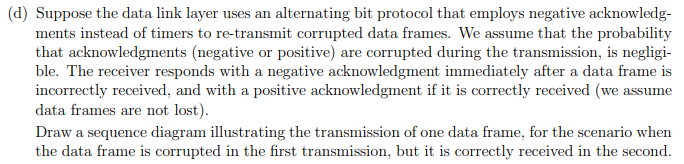
Problem 1) [40 pts) The 2020 Mars Rover Perseverance can use a directional antenna to transmit data to Earth. The bit rate of the communication channel is 500 bits / sec. The distance between Mars and Earth varies between 55.7 x 10⁶ km and 401.3 x 10⁶ km. The speed of light is 3 x 10⁸ m per sec. The data frames are 256 bytes long and acknowledgments take 6 bytes. (d) Suppose the data link layer uses an alternating bit protocol that employs negative acknowledg- ments instead of timers to re-transmit corrupted data frames. We assume that the probability that acknowledgments (negative or positive) are corrupted during the transmission, is negligi- ble. The receiver responds with a negative acknowledgment immediately after a data frame is incorrectly received, and with a positive acknowledgment if it is correctly received (we assume data frames are not lost). Draw a sequence diagram illustrating the transmission of one data frame, for the scenario when the data frame is corrupted in the first transmission, but it is correctly received in the second. Problem 1) [40 pts) The 2020 Mars Rover Perseverance can use a directional antenna to transmit data to Earth. The bit rate of the communication channel is 500 bits / sec. The distance between Mars and Earth varies between 55.7 x 10⁶ km and 401.3 x 10⁶ km. The speed of light is 3 x 10⁸ m per sec. The data frames are 256 bytes long and acknowledgments take 6 bytes. (d) Suppose the data link layer uses an alternating bit protocol that employs negative acknowledg- ments instead of timers to re-transmit corrupted data frames. We assume that the probability that acknowledgments (negative or positive) are corrupted during the transmission, is negligi- ble. The receiver responds with a negative acknowledgment immediately after a data frame is incorrectly received, and with a positive acknowledgment if it is correctly received (we assume data frames are not lost). Draw a sequence diagram illustrating the transmission of one data frame, for the scenario when the data frame is corrupted in the first transmission, but it is correctly received in the second
Step by Step Solution
There are 3 Steps involved in it

Get step-by-step solutions from verified subject matter experts