







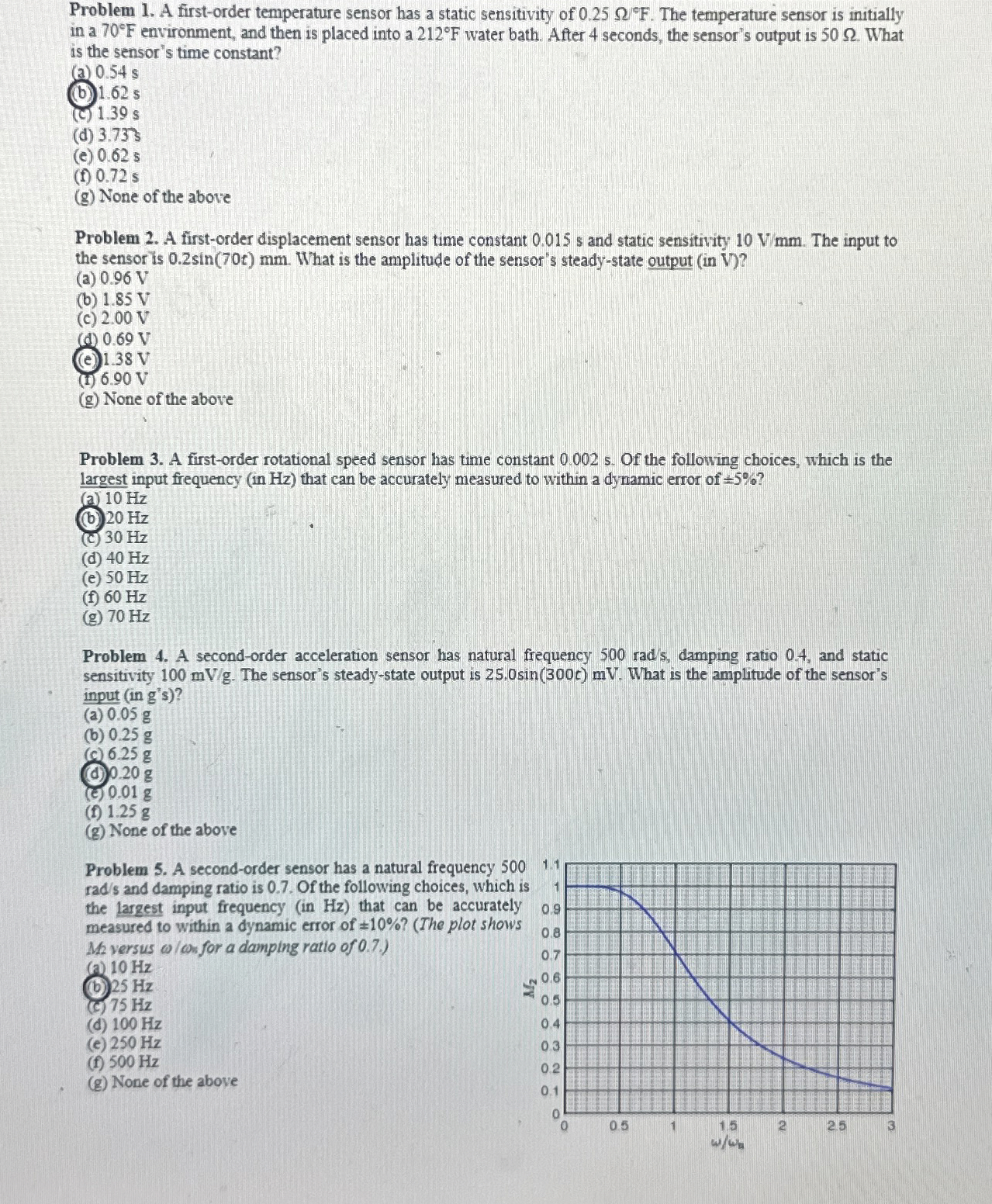
Question: Problem 1 . A first - order temperature sensor has a static sensitivity of 0 . 2 5 F . The temperature sensor is initially
Problem A firstorder temperature sensor has a static sensitivity of The temperature sensor is initially in a environment, and then is placed into a water bath. After seconds, the sensors output is What is the sensors time constant?
a s
b s
c s
d
e s
f s
g None of the above
Problem A firstorder displacement sensor has time constant s and static sensitivity The input to the sensor is What is the amplitude of the sensors steadystate output in V
a V
b V
c V
d V
c V
I V
g None of the above
Problem A firstorder rotational speed sensor has time constant s Of the following choices, which is the largest input frequency in Hz that can be accurately measured to within a dynamic error of
a Hz
b Hz
c Hz
d Hz
e Hz
f Hz
g Hz
Problem A secondorder acceleration sensor has natural frequency rad s damping ratio and static sensitivity The sensors steadystate output is What is the amplitude of the sensors input in gs
a g
b g
c g
d g
c g
f g
g None of the above
Problem A secondorder sensor has a natural frequency and damping ratio is Of the following choices, which the largest input frequency in Hz that can be accurately measured to within a dynamic error of The plot shows
Ma versus for a damping ratio of
a Hz
b Hz
c Hz
d Hz
e Hz
f Hz
g None of the above
Step by Step Solution
There are 3 Steps involved in it
1 Expert Approved Answer
Step: 1 Unlock

Question Has Been Solved by an Expert!
Get step-by-step solutions from verified subject matter experts
Step: 2 Unlock
Step: 3 Unlock
 Study Help