



Question: Problem 1: Brayton Cycle for a Spacecraft Consider the Brayton power cycle for a spacecraft shown in the diagram below. The working fluid is Argon.
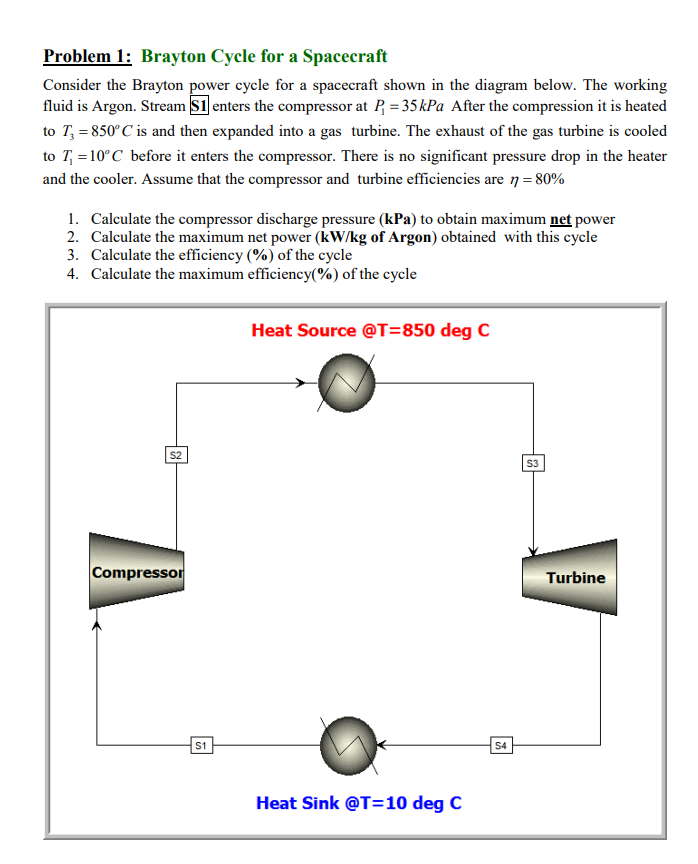
Problem 1: Brayton Cycle for a Spacecraft Consider the Brayton power cycle for a spacecraft shown in the diagram below. The working fluid is Argon. Stream $1 enters the compressor at P1=35kPa After the compression it is heated to T3=850C is and then expanded into a gas turbine. The exhaust of the gas turbine is cooled to T1=10C before it enters the compressor. There is no significant pressure drop in the heater and the cooler. Assume that the compressor and turbine efficiencies are =80% 1. Calculate the compressor discharge pressure (kPa) to obtain maximum net power 2. Calculate the maximum net power (kW/kg of Argon) obtained with this cycle 3. Calculate the efficiency (\%) of the cycle 4. Calculate the maximum efficiency(\%) of the cycle Problem 1: Brayton Cycle for a Spacecraft Consider the Brayton power cycle for a spacecraft shown in the diagram below. The working fluid is Argon. Stream $1 enters the compressor at P1=35kPa After the compression it is heated to T3=850C is and then expanded into a gas turbine. The exhaust of the gas turbine is cooled to T1=10C before it enters the compressor. There is no significant pressure drop in the heater and the cooler. Assume that the compressor and turbine efficiencies are =80% 1. Calculate the compressor discharge pressure (kPa) to obtain maximum net power 2. Calculate the maximum net power (kW/kg of Argon) obtained with this cycle 3. Calculate the efficiency (\%) of the cycle 4. Calculate the maximum efficiency(\%) of the cycle
Step by Step Solution
There are 3 Steps involved in it

Get step-by-step solutions from verified subject matter experts