







Question: PROBLEM 1. Electron Effective Mass in a 1D Conjucated Chain of Carbon Atoms Long one-dimensional conjugated chains of carbon atoms (illustrated above) have been proposed
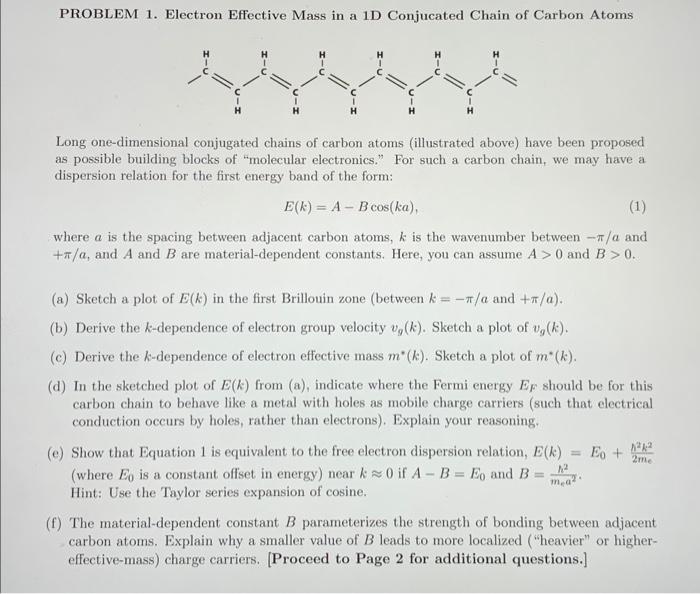
PROBLEM 1. Electron Effective Mass in a 1D Conjucated Chain of Carbon Atoms Long one-dimensional conjugated chains of carbon atoms (illustrated above) have been proposed as possible building blocks of "molecular electronics." For such a carbon chain, we may have a dispersion relation for the first energy band of the form: E(k)=ABcos(ka), where a is the spacing between adjacent carbon atoms, k is the wavenumber between /a and +/a, and A and B are material-dependent constants. Here, you can assume A>0 and B>0. (a) Sketch a plot of E(k) in the first Brillouin zone (between k=/a and +/a ). (b) Derive the k-dependence of electron group velocity vg(k). Sketch a plot of vg(k). (c) Derive the k-dependence of electron effective mass m(k). Sketch a plot of m(k). (d) In the sketched plot of E(k) from (a), indicate where the Fermi energy EF should be for this carbon chain to behave like a metal with holes as mobile charge carriers (such that electrical conduction occurs by holes, rather than electrons). Explain your reasoning. (e) Show that Equation 1 is equivalent to the free electron dispersion relation, E(k)=E0+2me2k2 (where E0 is a constant offset in energy) near k0 if AB=E0 and B=mea2h2. Hint: Use the Taylor series expansion of cosine. (f) The material-dependent constant B parameterizes the strength of bonding between adjacent carbon atoms. Explain why a smaller value of B leads to more localized ("heavier" or higher- PROBLEM 1. Electron Effective Mass in a 1D Conjucated Chain of Carbon Atoms Long one-dimensional conjugated chains of carbon atoms (illustrated above) have been proposed as possible building blocks of "molecular electronics." For such a carbon chain, we may have a dispersion relation for the first energy band of the form: E(k)=ABcos(ka), where a is the spacing between adjacent carbon atoms, k is the wavenumber between /a and +/a, and A and B are material-dependent constants. Here, you can assume A>0 and B>0. (a) Sketch a plot of E(k) in the first Brillouin zone (between k=/a and +/a ). (b) Derive the k-dependence of electron group velocity vg(k). Sketch a plot of vg(k). (c) Derive the k-dependence of electron effective mass m(k). Sketch a plot of m(k). (d) In the sketched plot of E(k) from (a), indicate where the Fermi energy EF should be for this carbon chain to behave like a metal with holes as mobile charge carriers (such that electrical conduction occurs by holes, rather than electrons). Explain your reasoning. (e) Show that Equation 1 is equivalent to the free electron dispersion relation, E(k)=E0+2me2k2 (where E0 is a constant offset in energy) near k0 if AB=E0 and B=mea2h2. Hint: Use the Taylor series expansion of cosine. (f) The material-dependent constant B parameterizes the strength of bonding between adjacent carbon atoms. Explain why a smaller value of B leads to more localized ("heavier" or higher
Step by Step Solution
There are 3 Steps involved in it

Get step-by-step solutions from verified subject matter experts
 Study Help