



Question: Problem 1: Exchange Rates [20 Points] Suppose that there are only two countries in the world: Localia (which is us), that uses the Localios (LCL)
![Problem 1: Exchange Rates [20 Points] Suppose that there are only](https://s3.amazonaws.com/si.experts.images/answers/2024/06/667550a18a570_385667550a145ce6.jpg)
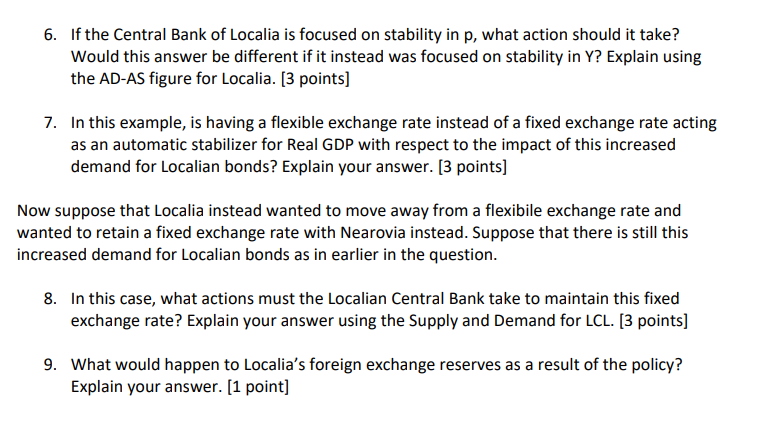
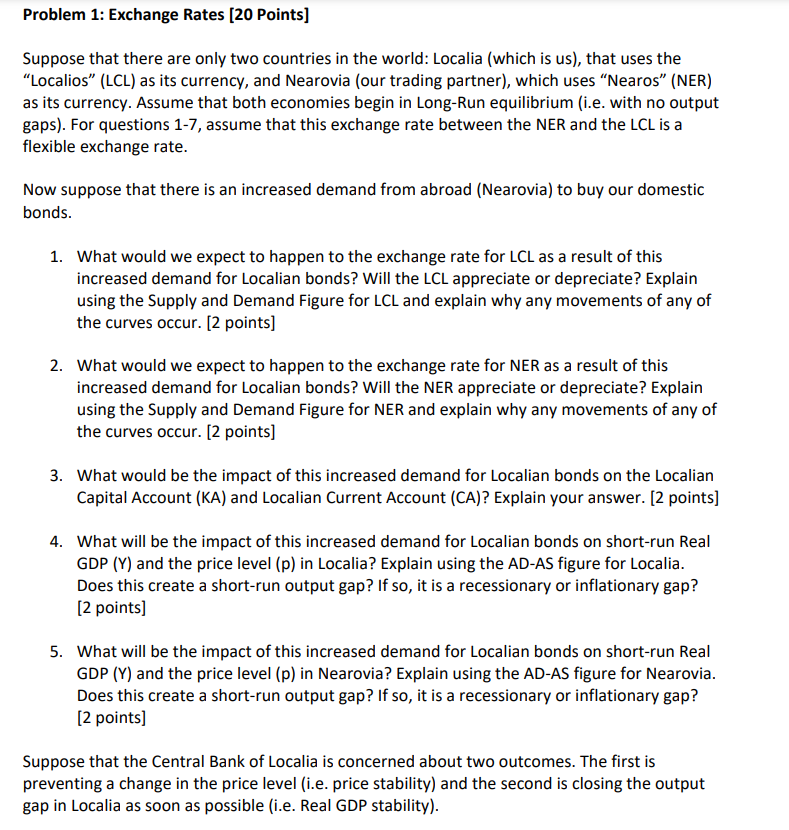
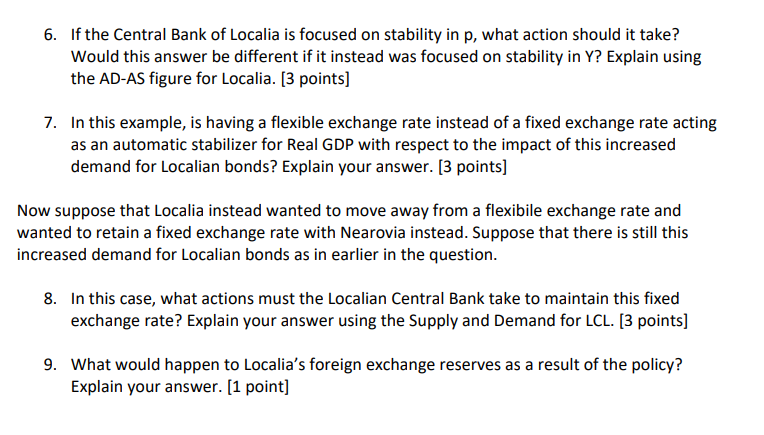
Problem 1: Exchange Rates [20 Points] Suppose that there are only two countries in the world: Localia (which is us), that uses the "Localios" (LCL) as its currency, and Nearovia (our trading partner), which uses "Nearos" (NER) as its currency. Assume that both economies begin in Long-Run equilibrium (i.e. with no output gaps). For questions 1-7, assume that this exchange rate between the NER and the LCL is a flexible exchange rate. Now suppose that there is an increased demand from abroad (Nearovia) to buy our domestic bonds. 1. What would we expect to happen to the exchange rate for LCL as a result of this increased demand for Localian bonds? Will the LCL appreciate or depreciate? Explain using the Supply and Demand Figure for LCL and explain why any movements of any of the curves occur. [2 points] 2. What would we expect to happen to the exchange rate for NER as a result of this increased demand for Localian bonds? Will the NER appreciate or depreciate? Explain using the Supply and Demand Figure for NER and explain why any movements of any of the curves occur. [2 points] 3. What would be the impact of this increased demand for Localian bonds on the Localian Capital Account (KA) and Localian Current Account (CA)? Explain your answer. [2 points] 4. What will be the impact of this increased demand for Localian bonds on short-run Real GDP (Y) and the price level (p) in Localia? Explain using the AD-AS figure for Localia. Does this create a short-run output gap? If so, it is a recessionary or inflationary gap? [2 points] 5. What will be the impact of this increased demand for Localian bonds on short-run Real GDP (Y) and the price level (p) in Nearovia? Explain using the AD-AS figure for Nearovia. Does this create a short-run output gap? If so, it is a recessionary or inflationary gap? [2 points] Suppose that the Central Bank of Localia is concerned about two outcomes. The first is preventing a change in the price level (i.e. price stability) and the second is closing the output gap in Localia as soon as possible (i.e. Real GDP stability).E. If the Central Bank of Localia is focused on stability in p, what action should it take? Would this answer be different ifit instead was focused on stability in Y? Explain using the AIDAS figure for Localia. [3 points] 3". In this example, is haying a flexible exchange rate instead of a fixed exchange rate acting as an automatic stabilizer for Real GDP with respect to the impact of this increased demand for Localian bonds? Explain your answer. [3 points] Now suppose that Localia instead wanted to move away from a flexibile exchange rate and wanted to retain a fixed exchange rate with Nearoyia instead. Suppose that there is still this increased demand for Localian bonds as in earlier in the question. 3. In this case, what actions must the Localian Central Bank take to maintain this xed exchange rate? Explain your answer using the Supply and Demand for LCL. [3 points] 9. 1|l'llhat would happen to Localia's foreign exchange reserves as a result of the policy? Explain your answer. [1 point]
Step by Step Solution
There are 3 Steps involved in it

Get step-by-step solutions from verified subject matter experts