







Question: Problem 1 In Applied Catalysis A 1 0 8 ( 1 9 9 4 ) , 7 - 1 9 the selective hydrogenation of isoprene
Problem
In Applied Catalysis A the selective hydrogenation of isoprene A over palladium
catalysts was described. In this study the gas phase reaction of isoprene methylbutadiene
towards methylbutene, methylbutene, methylbutene collectively termed B and
isopentane is investigated.
The global reaction scheme is given as:
isoprene isopentenes isopentane
A
B
C
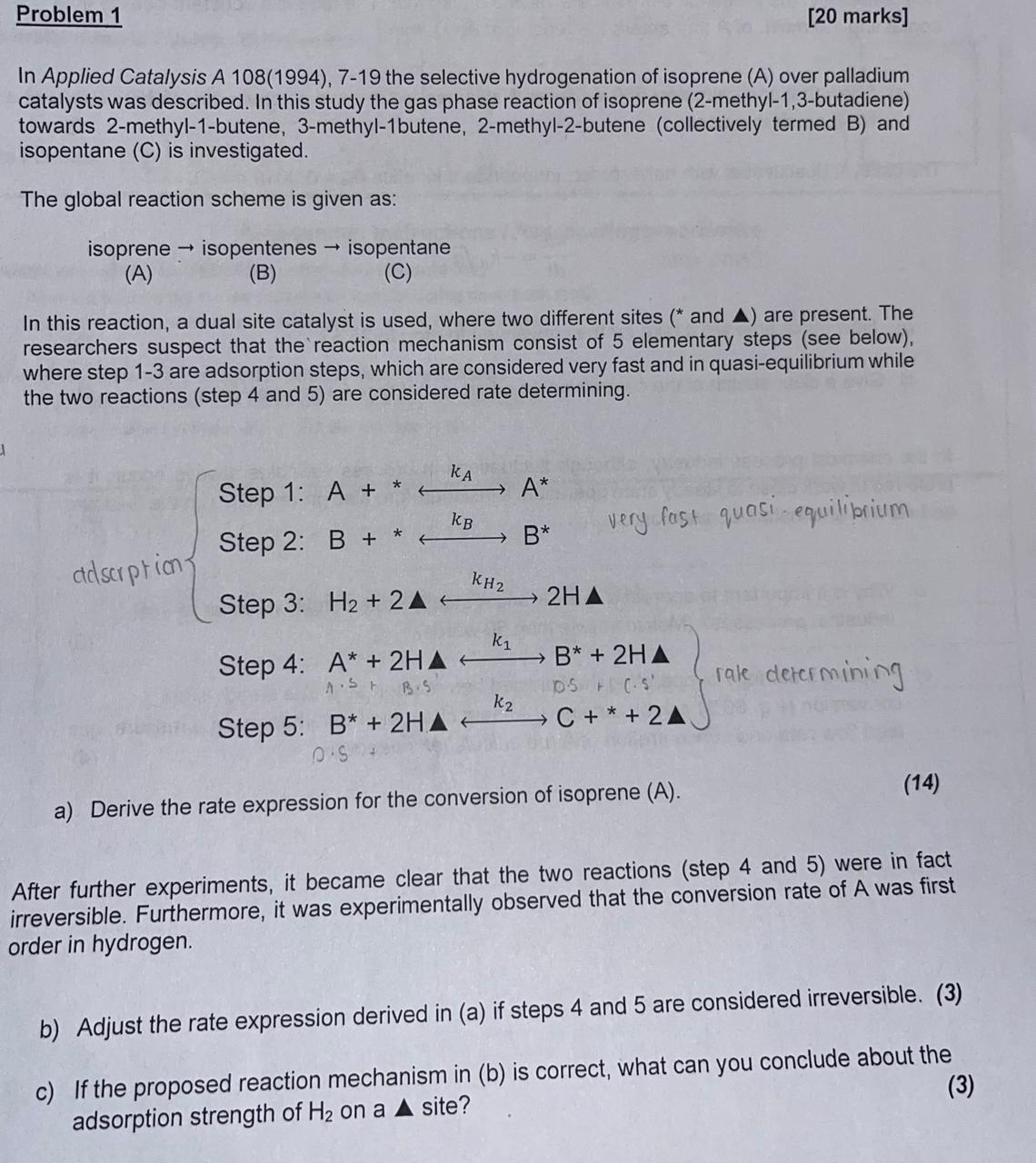
In this reaction, a dual site catalyst is used, where two different sites and are present. The
researchers suspect that the reaction mechanism consist of elementary steps see below
where step are adsorption steps, which are considered very fast and in quasiequilibrium while
the two reactions step and are considered rate determining.
adsciption Step :
Step :
Step :
very fast quasi equilibrium
a Derive the rate expression for the conversion of isoprene A
After further experiments, it became clear that the two reactions step and were in fact
irreversible. Furthermore, it was experimentally observed that the conversion rate of A was first
order in hydrogen.
b Adjust the rate expression derived in a if steps and are considered irreversible.
c If the proposed reaction mechanism in b is correct, what can you conclude about the
adsorption strength of on a site?
Step by Step Solution
There are 3 Steps involved in it
1 Expert Approved Answer
Step: 1 Unlock

Question Has Been Solved by an Expert!
Get step-by-step solutions from verified subject matter experts
Step: 2 Unlock
Step: 3 Unlock
 Study Help