







Question: Problem # 1: Let T: P3 > R3 be the linear transformation dened as P(-1) T0?) = P0) 17(2) Which of the following is a
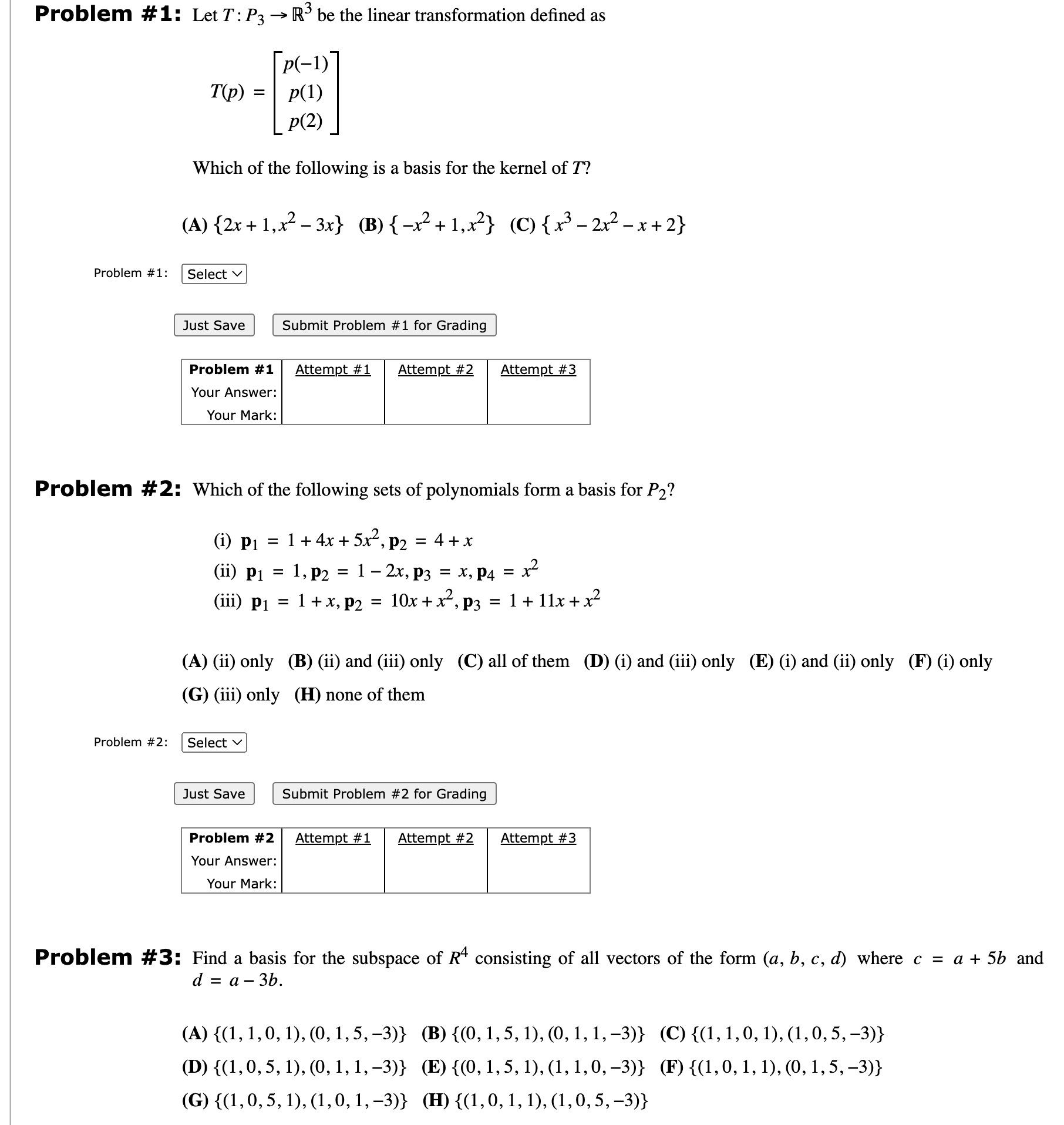
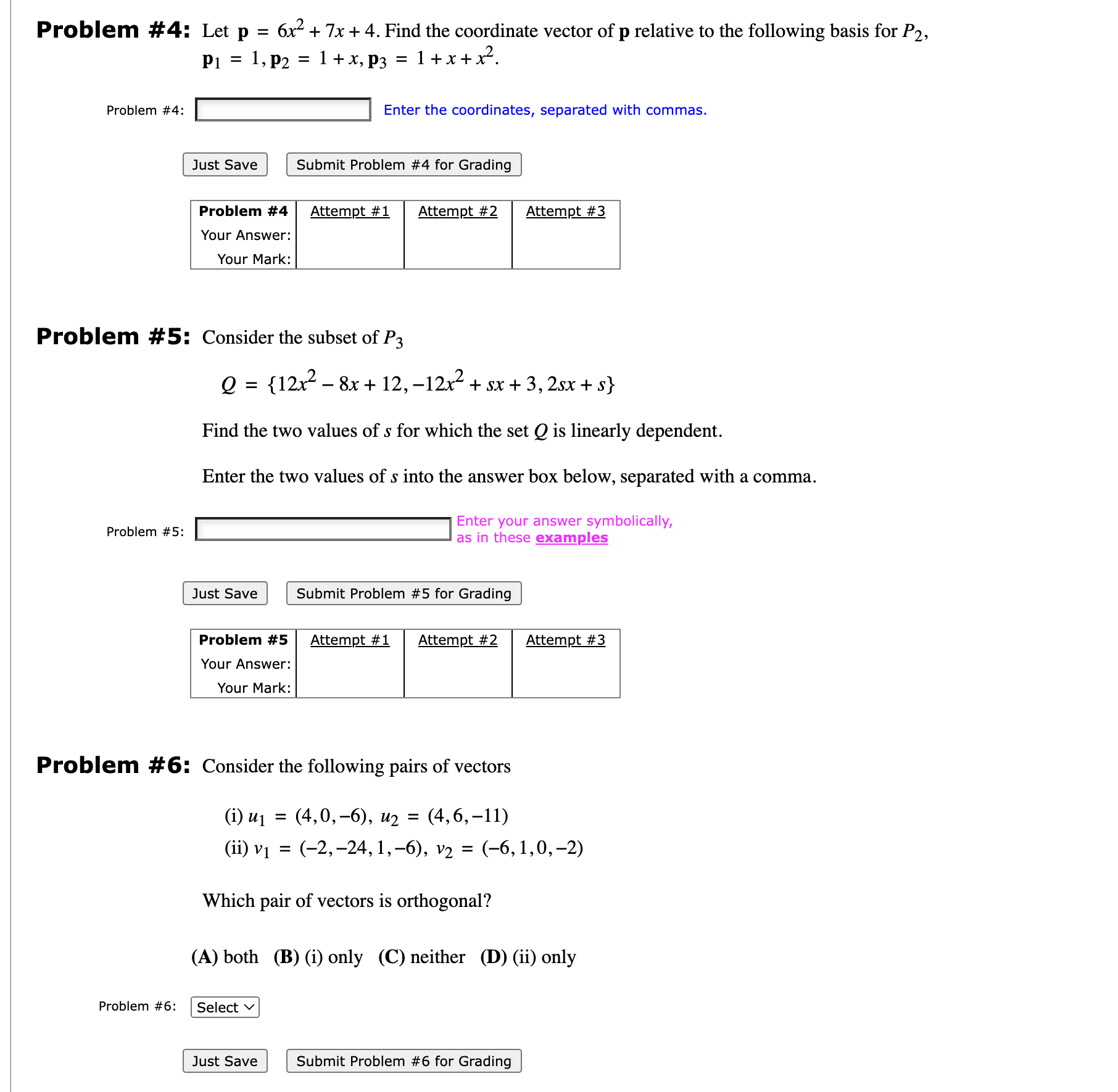

Problem # 1: Let T: P3 > R3 be the linear transformation dened as P(-1) T0?) = P0) 17(2) Which of the following is a basis for the kernel of T? (A) {2x+ 1,)? 3x} (B) {x2+ 1,x2} (C) {x3 2x2x+2} Problem #1: Problem #1 Attempt #1 Attempt #2 Attempt #3 Your Answer: Your Mark: Problem #2: Which of the following sets of polynomials form a basis for P2? (i) p1 = 1+4x+5x2,p2 = 4+x (ii)p1=1,p2 =12x,p3 =x,p4 =x2 (iii) [31 = 1+x,p2 =10x+x2,p3 = 1+ 11x+x2 (A) (ii) only (B) (ii) and (iii) only (C) all of them (D) (i) and (iii) only (E) (i) and (ii) only (F) (i) only (G) (iii) only (H) none of them Problem #2: Select V Just Save Submit Problem #2 for Grading Problem #2 Attempt #1 Attempt #2 Attempt #3 Your Answer: Your Mark: Problem #3: Find a basis for the subspace of R4 consisting of all vectors of the form (a, b, c, d) where c = a + 5b and d = a 3b. (A){(1,1,0,1),(O,1,5,3)} (B){(0,1,5,1),(0,1,1,3)} (C){(1,1,0,1),(1,0,5,3)} (D) {(1,0,5, 1),(0,1,1,3)} (E) {(0,1,5,1),(1,1,0,3)} (F) {(1,0,1,1),(0,1,5,3)} (G) {(1,0,5,1),(1,0,1,3)} (H) {(1,0,1,1),(1,0,5,3)} Problem #4: Let p 2 622 + 7x + 4. Find the coordinate vector of p relative to the following basis for P2, p1=1,p2 = l+x,p3 =1+x+x24 Problem #4: I:| Enter the coordinates, separated with commas. Submit Problem #4 for Grading Problem #4 Attempt #1 Attempt #2 Attempt #3 Your Answer: Your Mark: Problem #5: Consider the subset of P3 Q = {12x28x+12,12x2+sx+3,23x+s} Find the two values of s for which the set Q is linearly dependent. Enter the two values of s into the answer box below, separated with a comma. - I:| Em\" y\" \"W \"WWW Problem #5' as in these examples Just Save Submit Problem #5 for Grading Problem #5 Attempt #1 Attempt #2 Attempt #3 Your Answer: Your Mark: Problem #6: Consider the following pairs of vectors (i) u1 = (4,0,6), M2 = (4,6,ll) (ii) v1 = (2,-24, 1,6), v2 = (-6, l,0,2) Which pair of vectors is orthogonal? (A) both (B) (i) only (C) neither (D) (i) only Problem #6: E Problem #7: Let u = (1,-1,3) and a = (-3,3, 1). Find the vector component of u orthogonal to a. Enter your answer symbolically, Problem #7: as in these examples enter your answer in the form a,b,c Just Save Submit Problem #7 for Grading
Step by Step Solution
There are 3 Steps involved in it

Get step-by-step solutions from verified subject matter experts
 Study Help