







Question: Problem 1. Pressure differences in a fluid cause particles to move. Specifically, parti- cles will flow towards regions of lower and lower pressure. So, let
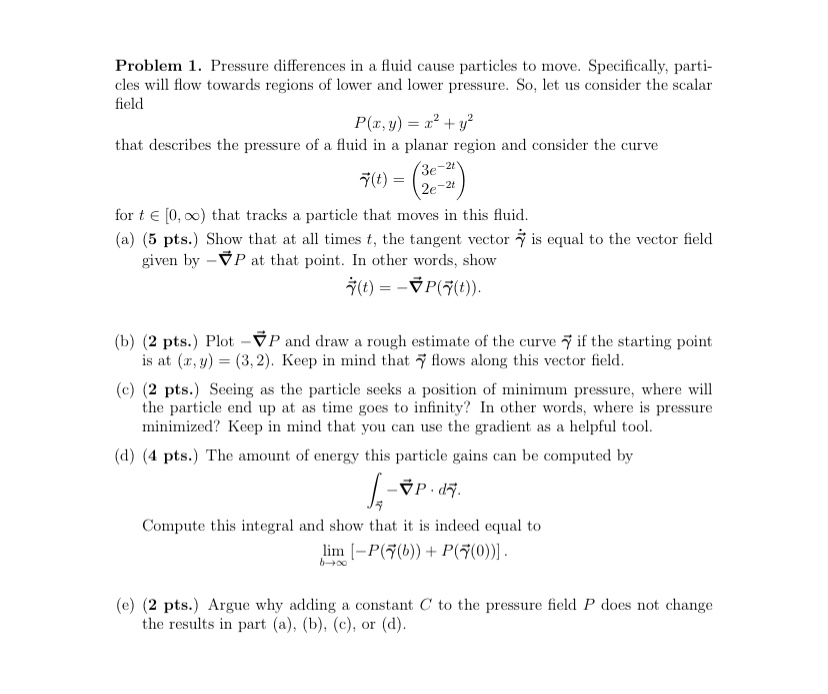
Problem 1. Pressure differences in a fluid cause particles to move. Specifically, parti- cles will flow towards regions of lower and lower pressure. So, let us consider the scalar field P(x, y) = x' + yl that describes the pressure of a fluid in a planar region and consider the curve 7 (t ) = 3e -2t 2e-2t for t c [0, co) that tracks a particle that moves in this fluid. (a) (5 pts.) Show that at all times t, the tangent vector y is equal to the vector field given by - VP at that point. In other words, show 7 (t ) = - VP(5(t)). (b) (2 pts.) Plot -VP and draw a rough estimate of the curve y if the starting point is at (x, y) = (3, 2). Keep in mind that 7 flows along this vector field. (c) (2 pts.) Seeing as the particle seeks a position of minimum pressure, where will the particle end up at as time goes to infinity? In other words, where is pressure minimized? Keep in mind that you can use the gradient as a helpful tool. (d) (4 pts.) The amount of energy this particle gains can be computed by 1 - UP . 17 . Compute this integral and show that it is indeed equal to lim [-P(5(6)) + P(7(0))]. (e) (2 pts.) Argue why adding a constant C to the pressure field P does not change the results in part (a), (b), (c), or (d)
Step by Step Solution
There are 3 Steps involved in it

Get step-by-step solutions from verified subject matter experts
 Study Help