







Question: Terminal velocity of a solid spherical particle falling in fluid media can be expressed by the equation 49(p,-p)D, 3Cpp where v is the terminal
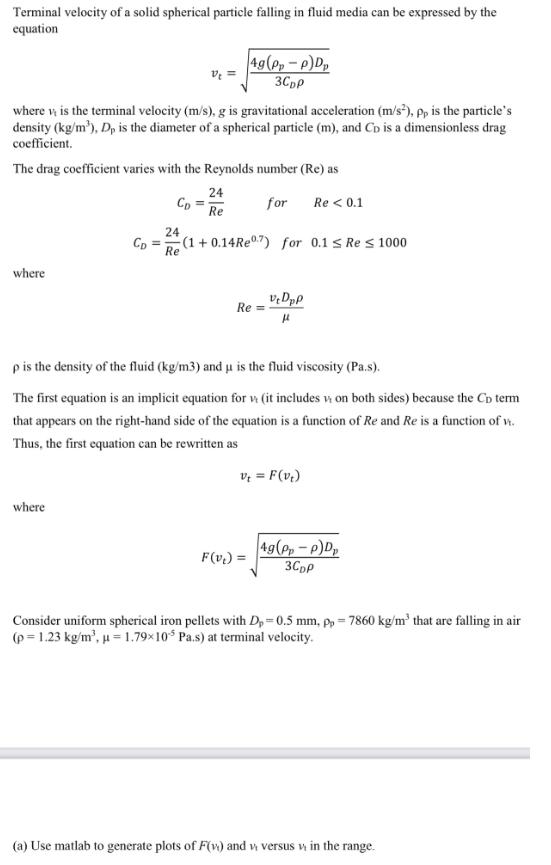
Terminal velocity of a solid spherical particle falling in fluid media can be expressed by the equation 49(p,-p)D, 3Cpp where v is the terminal velocity (m/s), g is gravitational acceleration (m/s"), p is the particle's density (kg/m'), Dp is the diameter of a spherical particle (m), and Co is a dimensionless drag coefficient. The drag coefficient varies with the Reynolds number (Re) as 24 Cp = Re for Re < 0.1 24 Cp = Re (1+ 0.14Re0:7) for 0.1 s Re s 1000 where v,Dpp Re = p is the density of the fluid (kg/m3) and u is the fluid viscosity (Pa.s). The first equation is an implicit equation for v (it includes v on both sides) because the Co term that appears on the right-hand side of the equation is a function of Re and Re is a function of v. Thus, the first equation can be rewritten as v: = F(v,) where 4g(p, - p)D, F(v.) = 3CDP Consider uniform spherical iron pellets with D, =0.5 mm, p, = 7860 kg/m' that are falling in air (p= 1.23 kg/m', u =1.7910 Pa.s) at terminal velocity. (a) Use matlab to generate plots of F(v) and w versus v in the range.
Step by Step Solution
3.45 Rating (152 Votes )
There are 3 Steps involved in it

Get step-by-step solutions from verified subject matter experts
 Study Help