







Question: Problem 1 Two solid spherical masses m 1 = 2 . 5 1 k g and m 3 = 1 . 4 8 k g
Problem
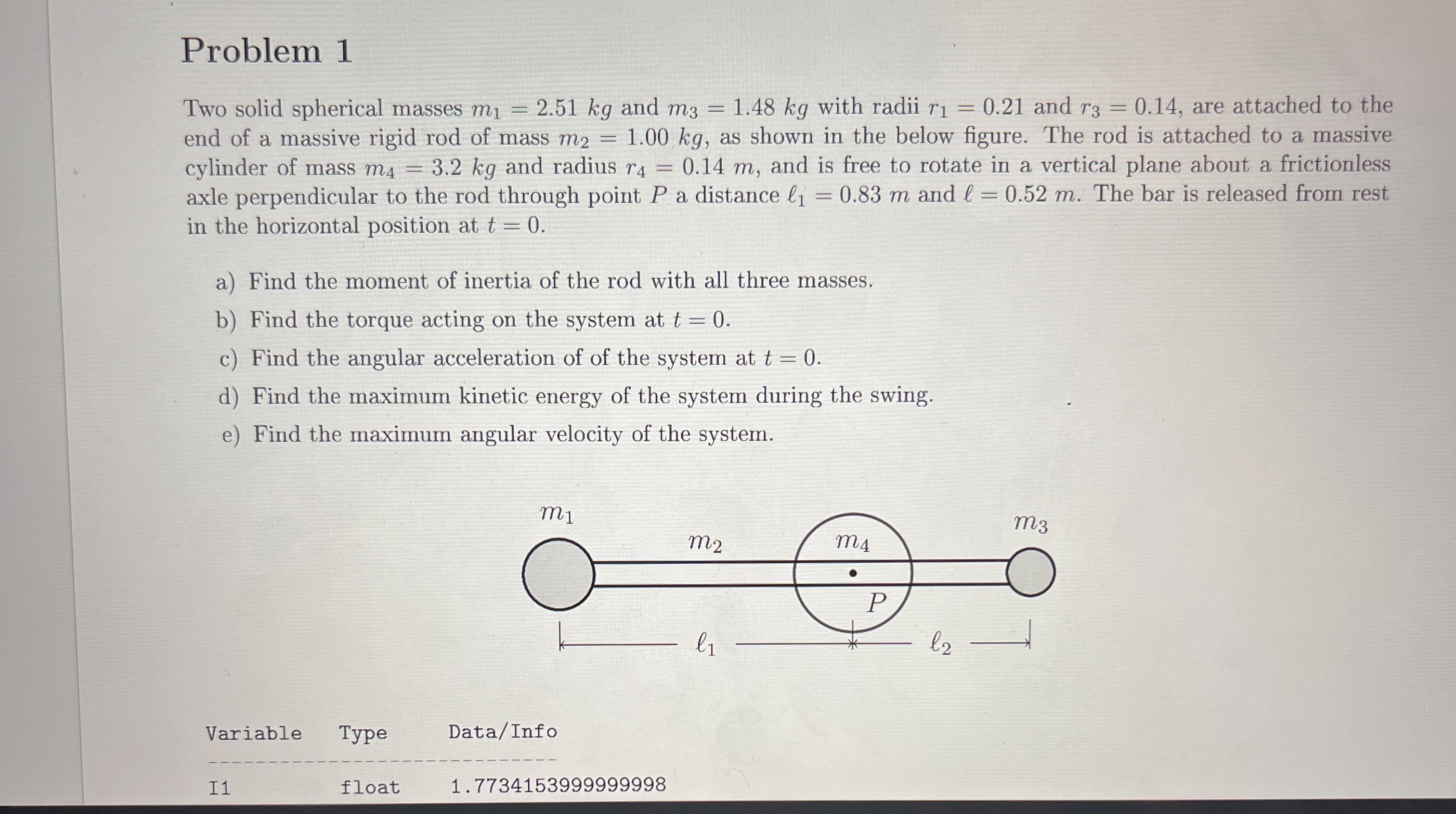
Two solid spherical masses and with radii and are attached to the end of a massive rigid rod of mass as shown in the below figure. The rod is attached to a massive cylinder of mass and radius and is free to rotate in a vertical plane about a frictionless axle perpendicular to the rod through point a distance and The bar is released from rest in the horizontal position at
a Find the moment of inertia of the rod with all three masses.
b Find the torque acting on the system at
c Find the angular acceleration of of the system at
d Find the maximum kinetic energy of the system during the swing.
e Find the maximum angular velocity of the system.
Variable Type DataInfo
I
float
Problem
Two solid spherical masses and with radii and are attached to the end of a massive rigid rod of mass as shown in the below figure. The rod is attached to a massive cylinder of mass and radius and is free to rotate in a vertical plane about a frictionless axle perpendicular to the rod through point a distance and The bar is released from rest in the horizontal position at
a Find the moment of inertia of the rod with all three masses.
b Find the torque acting on the system at
c Find the angular acceleration of of the system at
d Find the maximum kinetic energy of the system during the swing.
e Find the maximum angular velocity of the system.
Variable Type DataInfo
I
float
Variable Type DataInfo
tableIfloat,Ifloat,Ifloat,Ifloat,MoIfloat,PEfloat,alphafloat,dfloat,gfloat,lfloat,lfloat,mfloat,mint,mfloat,mfloat,rfloat,rfloat,rfloat,taufloat,
Variable Type DataInfo
tableIfloat,Ifloat,Ifloat,Ifloat,MoIfloat,PEfloat,alphafloat,dfloat,gfloat,lfloat,lfloat,mfloat,mint,mfloat,mfloat,rfloat,rfloat,rfloat,taufloat,
Problem
Two solid spherical masses and with radii and are attached to the end of a massive rigid rod of mass as shown in the below figure. The rod is attached to a massive cylinder of mass and radius and is free to rotate in a vertical plane about a frictionless axle perpendicular to the rod through point a distance and The bar is released from rest in the horizontal position at
a Find the moment of inertia of the rod with all three masses.
b Find the torque acting on the system at
c Find the angular acceleration of of the system at
d Find the maximum kinetic energy of the system during the swing.
e Find the maximum angular velocity of the system.
Variable Type Datnfo
float
Step by Step Solution
There are 3 Steps involved in it
1 Expert Approved Answer
Step: 1 Unlock

Question Has Been Solved by an Expert!
Get step-by-step solutions from verified subject matter experts
Step: 2 Unlock
Step: 3 Unlock
 Study Help