







Question: Problem 11.1.6 The inverse demand curve that a monopoly faces is p = 10Q'0-5. The rm's cost curve is C(Q) = 5Q. What is the
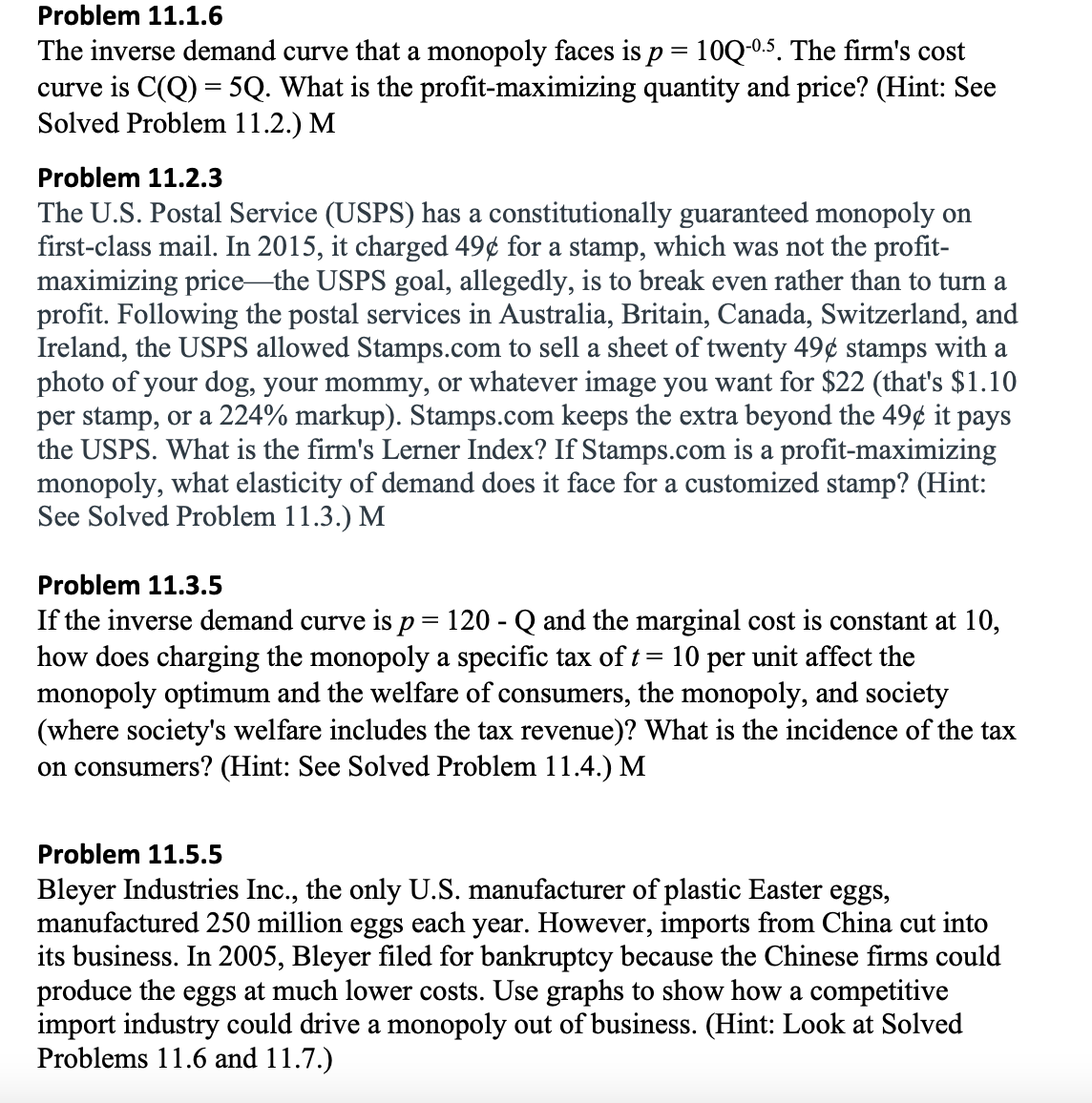
Problem 11.1.6 The inverse demand curve that a monopoly faces is p = 10Q'0-5. The rm's cost curve is C(Q) = 5Q. What is the prot-maximizing quantity and price? (Hint: See Solved Problem 11.2.) M Problem 11.2.3 The US. Postal Service (USPS) has a constitutionally guaranteed monopoly on rst-class mail. In 2015, it charged 49 for a stamp, which was not the prot- maximizing pricethe USPS goal, allegedly, is to break even rather than to turn a prot. Following the postal services in Australia, Britain, Canada, Switzerland, and Ireland, the USPS allowed Stamps.com to sell a sheet of twenty 49 stamps with a photo of your dog, your mommy, or whatever image you want for $22 (that's $1.10 per stamp, or a 224% markup). Stampseom keeps the extra beyond the 49 it pays the USPS. What is the rm's Lerner Index? If Stamps.com is a prot-maximizing monopoly, what elasticity of demand does it face for a customized stamp? (Hint: See Solved Problem 11.3.) M Problem 11.3.5 If the inverse demand curve is p = 120 - Q and the marginal cost is constant at 10, how does charging the monopoly a specic tax of t = 10 per unit affect the monopoly optimum and the welfare of consumers, the monopoly, and society (where society's welfare includes the tax revenue)? What is the incidence of the tax on consumers? (Hint: See Solved Problem 11.4.) M Problem 11.5.5 Bleyer Industries Inc., the only US. manufacturer of plastic Easter eggs, manufactured 250 million eggs each year. However, imports from China cut into its business. In 2005, Bleyer led for bankruptcy because the Chinese rms could produce the eggs at much lower costs. Use graphs to show how a competitive import industiy could drive a monopoly out of business. (Hint: Look at Solved Problems 11.6 and 11.7.)
Step by Step Solution
There are 3 Steps involved in it

Get step-by-step solutions from verified subject matter experts
 Study Help