Question: problem 1a problem 1 b A small, privately owned Asian company is producing a private-label soft drink called Yoggo. A bottling line puts the soft
problem 1a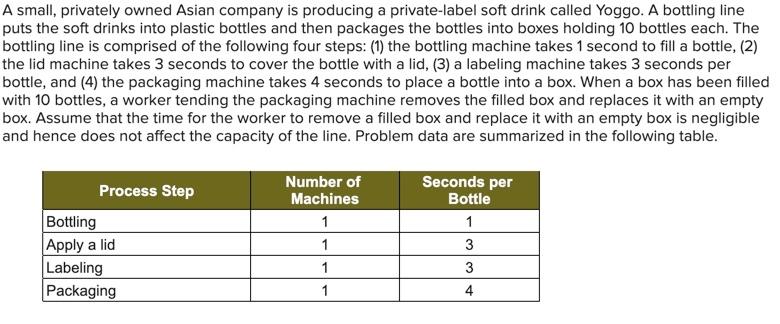
problem 1 b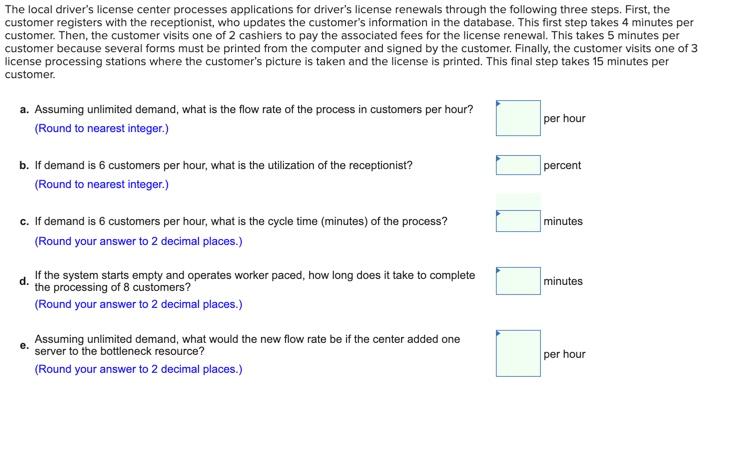
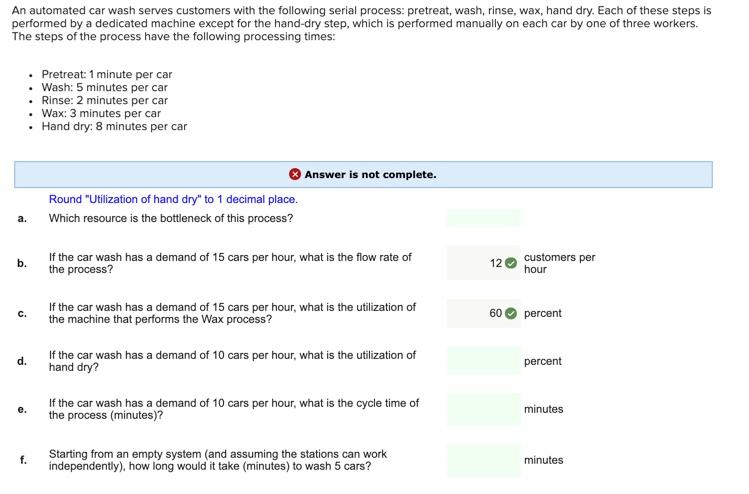
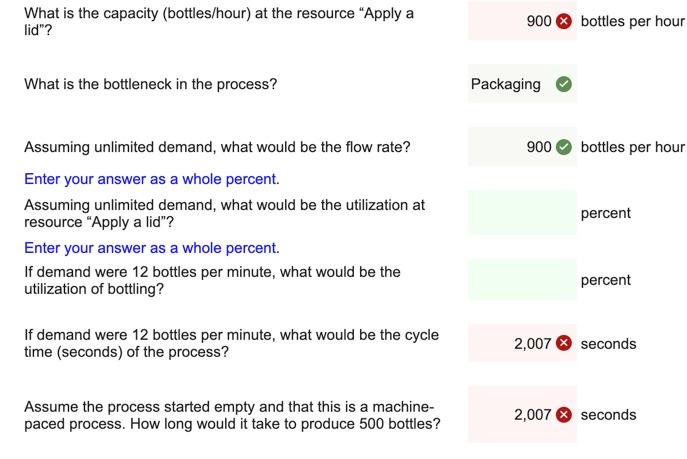
A small, privately owned Asian company is producing a private-label soft drink called Yoggo. A bottling line puts the soft drinks into plastic bottles and then packages the bottles into boxes holding 10 bottles each. The bottling line is comprised of the following four steps: (1) the bottling machine takes 1 second to fill a bottle, (2) the lid machine takes 3 seconds to cover the bottle with a lid, (3) a labeling machine takes 3 seconds per bottle, and (4) the packaging machine takes 4 seconds to place a bottle into a box. When a box has been filled with 10 bottles, a worker tending the packaging machine removes the filled box and replaces it with an empty box. Assume that the time for the worker to remove a filled box and replace it with an empty box is negligible and hence does not affect the capacity of the line. Problem data are summarized in the following table. Process Step Bottling Apply a lid Labeling Packaging Number of Machines 1 1 Seconds per Bottle 1 3 1 1 3 4 What is the capacity (bottles/hour) at the resource "Apply a lid"? 900 bottles per hour What is the bottleneck in the process? Packaging 900 bottles per hour Assuming unlimited demand, what would be the flow rate? Enter your answer as a whole percent. Assuming unlimited demand, what would be the utilization at resource "Apply a lid"? Enter your answer as a whole percent. If demand were 12 bottles per minute, what would be the utilization of bottling? percent percent If demand were 12 bottles per minute, what would be the cycle time (seconds) of the process? 2,007 seconds Assume the process started empty and that this is a machine- paced process. How long would it take to produce 500 bottles? 2,007 seconds The local driver's license center processes applications for driver's license renewals through the following three steps. First, the customer registers with the receptionist, who updates the customer's information in the database. This first step takes 4 minutes per customer. Then, the customer visits one of 2 cashiers to pay the associated fees for the license renewal. This takes 5 minutes per customer because several forms must be printed from the computer and signed by the customer. Finally, the customer visits one of 3 license processing stations where the customer's picture is taken and the license is printed. This final step takes 15 minutes per customer. a. Assuming unlimited demand, what is the flow rate of the process in customers per hour? (Round to nearest integer.) per hour percent b. If demand is 6 customers per hour, what is the utilization of the receptionist? (Round to nearest integer.) minutes c. If demand is 6 customers per hour, what is the cycle time (minutes) of the process? (Round your answer to 2 decimal places.) If the system starts empty and operates worker paced, how long does it take to complete the processing of 8 customers? (Round your answer to 2 decimal places.) minutes Assuming unlimited demand, what would the new flow rate be if the center added one server to the bottleneck resource? (Round your answer to 2 decimal places.) per hour An automated car wash serves customers with the following serial process: pretreat, wash, rinse, wax, hand dry. Each of these steps is performed by a dedicated machine except for the hand-dry step, which is performed manually on each car by one of three workers. The steps of the process have the following processing times: . Pretreat: 1 minute per car Wash: 5 minutes per car Rinse: 2 minutes per car . Wax: 3 minutes per car Hand dry: 8 minutes per car Answer is not complete. Round "Utilization of hand dry" to 1 decimal place. Which resource is the bottleneck of this process? a. b. If the car wash has a demand of 15 cars per hour, what is the flow rate of the process? 12 customers per hour C. If the car wash has a demand of 15 cars per hour, what is the utilization of the machine that performs the Wax process? 60 percent d. If the car wash has a demand of 10 cars per hour, what is the utilization of hand dry? percent If the car wash has a demand of 10 cars per hour, what is the cycle time of the process (minutes)? minutes f. Starting from an empty system (and assuming the stations can work independently), how long would it take (minutes) to wash 5 cars? minutes









 Study Help