







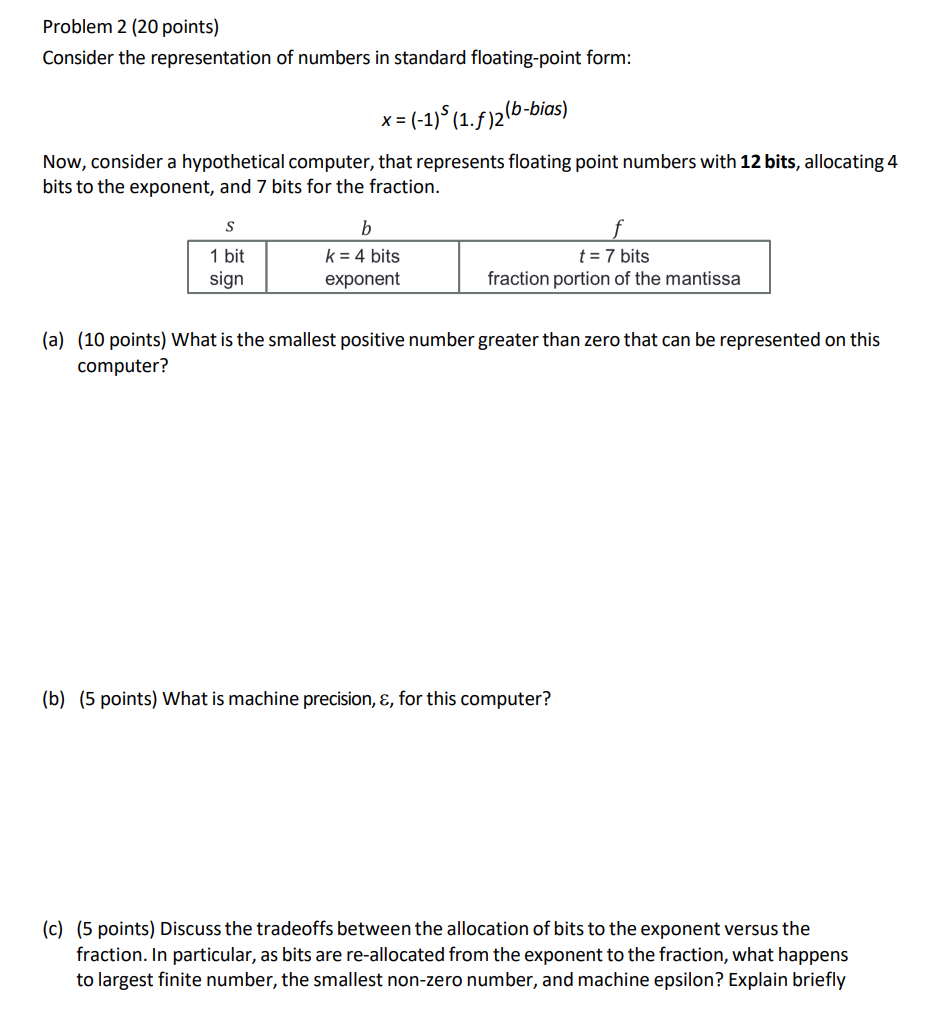
Question: Problem 2 ( 2 0 points ) Consider the representation of numbers in standard floating - point form: x = ( - 1 ) S
Problem points
Consider the representation of numbers in standard floatingpoint form:
Now, consider a hypothetical computer, that represents floating point numbers with bits, allocating
bits to the exponent, and bits for the fraction.
a points What is the smallest positive number greater than zero that can be represented on this
computer?
b points What is machine precision, for this computer?
c points Discuss the tradeoffs between the allocation of bits to the exponent versus the
fraction. In particular, as bits are reallocated from the exponent to the fraction, what happens
to largest finite number, the smallest nonzero number, and machine epsilon? Explain briefly
Step by Step Solution
There are 3 Steps involved in it
1 Expert Approved Answer
Step: 1 Unlock

Question Has Been Solved by an Expert!
Get step-by-step solutions from verified subject matter experts
Step: 2 Unlock
Step: 3 Unlock
 Study Help