







Question: Problem 2 ( 3 5 pts ) . Re - use the data from problem 1 . a . ( 7 pts ) Compute the
Problem pts Reuse the data from problem
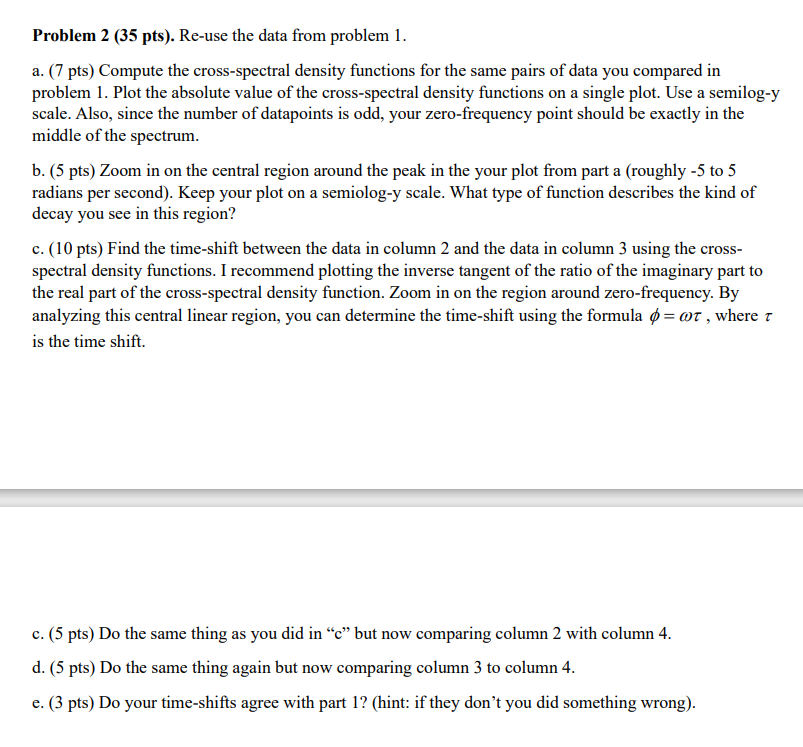
a pts Compute the crossspectral density functions for the same pairs of data you compared in problem Plot the absolute value of the crossspectral density functions on a single plot. Use a semilogy scale. Also, since the number of datapoints is odd, your zerofrequency point should be exactly in the middle of the spectrum.
b pts Zoom in on the central region around the peak in the your plot from part a roughly to radians per second Keep your plot on a semiology scale. What type of function describes the kind of decay you see in this region?
c pts Find the timeshift between the data in column and the data in column using the crossspectral density functions. I recommend plotting the inverse tangent of the ratio of the imaginary part to the real part of the crossspectral density function. Zoom in on the region around zerofrequency. By analyzing this central linear region, you can determine the timeshift using the formula phiomega tau where tau is the time shift.
c pts Do the same thing as you did in c but now comparing column with column
d pts Do the same thing again but now comparing column to column
e pts Do your timeshifts agree with part hint: if they don't you did something wrong
answer code must be in MATLAB only
Step by Step Solution
There are 3 Steps involved in it
1 Expert Approved Answer
Step: 1 Unlock

Question Has Been Solved by an Expert!
Get step-by-step solutions from verified subject matter experts
Step: 2 Unlock
Step: 3 Unlock
 Study Help