







Question: Problem 2: (5 marks) Is the series n n=1 absolutely convergent, conditionally convergent, or divergent? Make sure to show all your work and indicate clearly
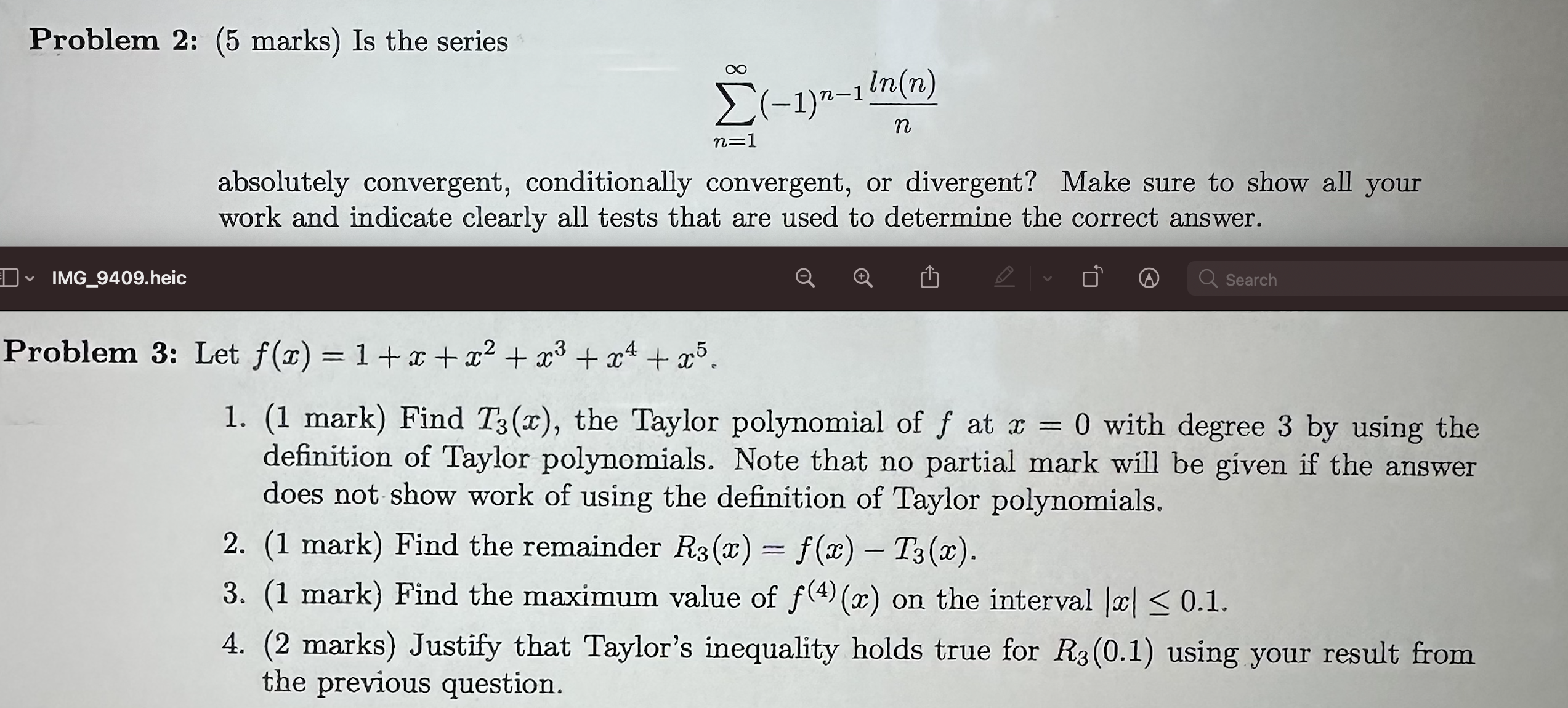
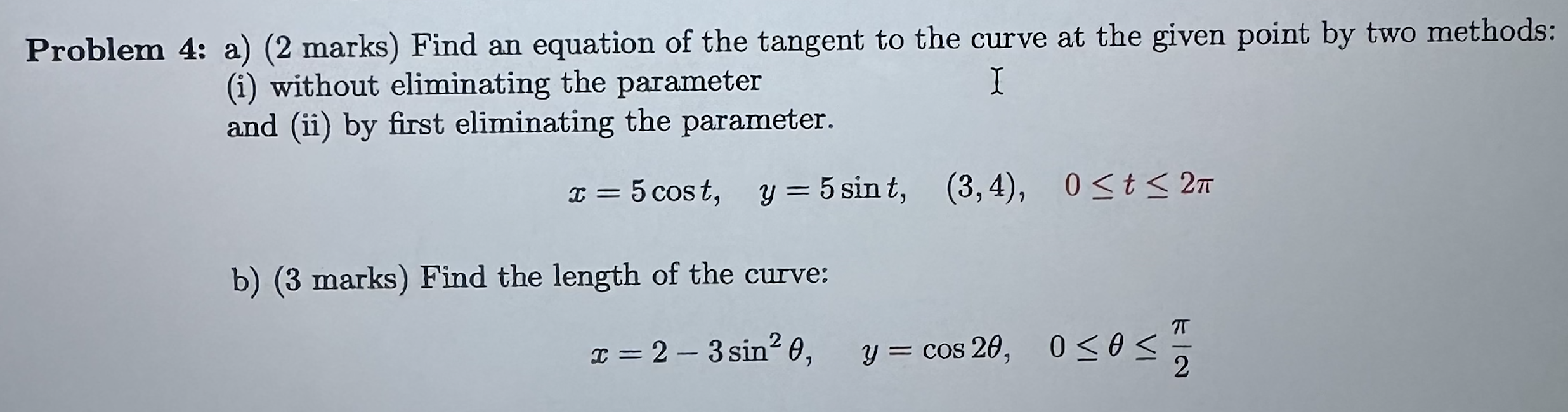
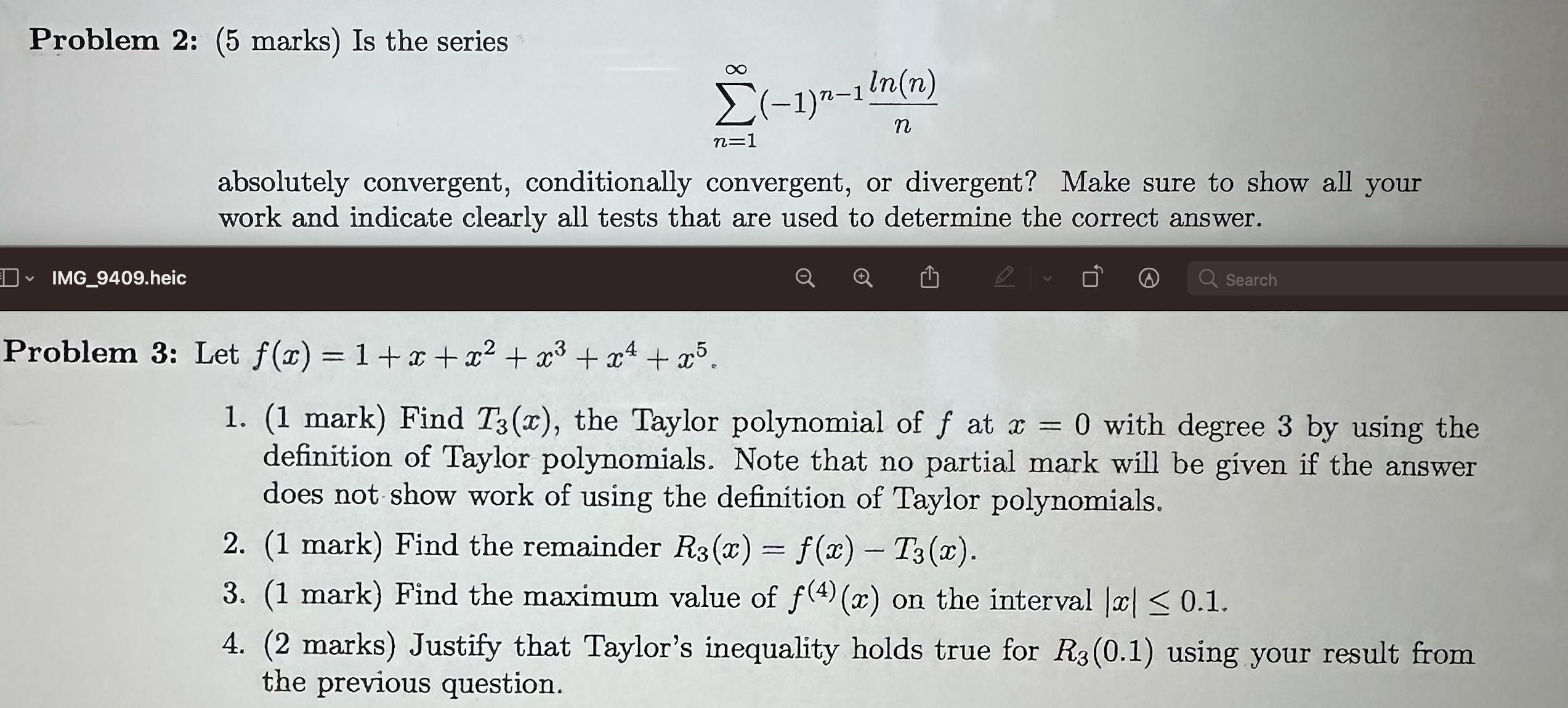
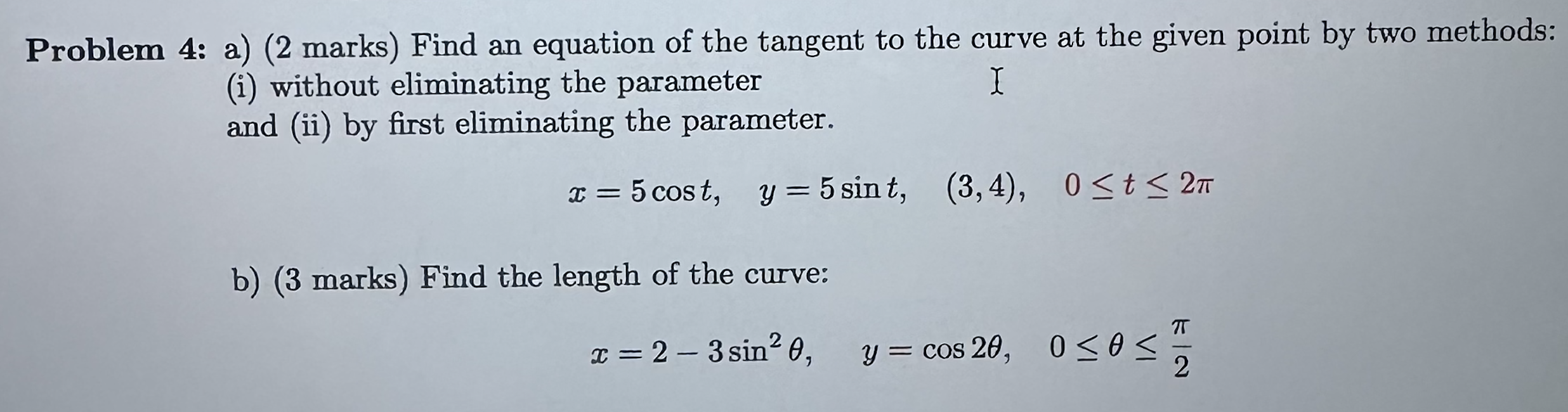
Problem 2: (5 marks) Is the series n n=1 absolutely convergent, conditionally convergent, or divergent? Make sure to show all your work and indicate clearly all tests that are used to determine the correct answer. D IMG_9409.heic Q Search Problem 3: Let f(x) = 1+ +2+23+24+25. 1. (1 mark) Find 73(x), the Taylor polynomial of f at x = 0 with degree 3 by using the definition of Taylor polynomials. Note that no partial mark will be given if the answer does not show work of using the definition of Taylor polynomials. 2. (1 mark) Find the remainder R3(x) = f(x) - T3(x). 3. (1 mark) Find the maximum value of f() (x) on the interval la|
Step by Step Solution
There are 3 Steps involved in it

Get step-by-step solutions from verified subject matter experts
 Study Help