







Question: Problem 2 A company needs to make three identical cuts in a piece of metal so that it can be fitted to another component properly.
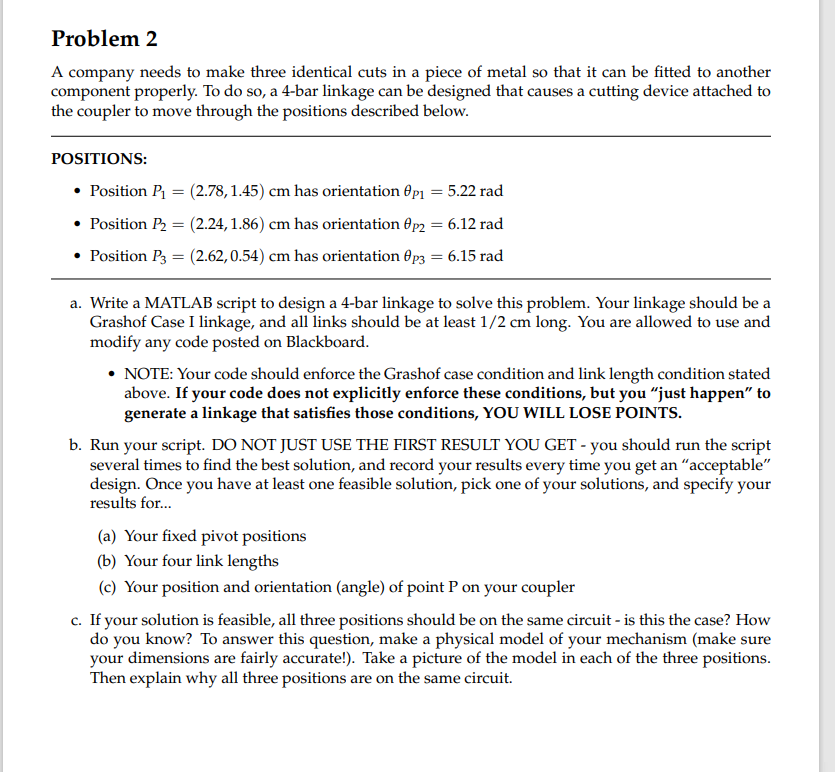
Problem 2 A company needs to make three identical cuts in a piece of metal so that it can be fitted to another component properly. To do so, a 4-bar linkage can be designed that causes a cutting device attached to the coupler to move through the positions described below. POSITIONS: Position P1 = (2.78, 1.45) cm has orientation Op = 5.22 rad Position P2 = (2.24, 1.86) cm has orientation 6p2 = 6.12 rad Position P3 = (2.62,0.54) cm has orientation 6p3 = 6.15 rad a. Write a MATLAB script to design a 4-bar linkage to solve this problem. Your linkage should be a Grashof Case I linkage, and all links should be at least 1/2 cm long. You are allowed to use and modify any code posted on Blackboard. NOTE: Your code should enforce the Grashof case condition and link length condition stated above. If your code does not explicitly enforce these conditions, but you "just happen" to generate a linkage that satisfies those conditions, YOU WILL LOSE POINTS. b. Run your script. DO NOT JUST USE THE FIRST RESULT YOU GET - you should run the script several times to find the best solution, and record your results every time you get an "acceptable" design. Once you have at least one feasible solution, pick one of your solutions, and specify your results for... (a) Your fixed pivot positions (b) Your four link lengths (c) Your position and orientation (angle) of point P on your coupler c. If your solution is feasible, all three positions should be on the same circuit - is this the case? How do you know? To answer this question, make a physical model of your mechanism (make sure your dimensions are fairly accurate!). Take a picture of the model in each of the three positions. Then explain why all three positions are on the same circuit. Problem 2 A company needs to make three identical cuts in a piece of metal so that it can be fitted to another component properly. To do so, a 4-bar linkage can be designed that causes a cutting device attached to the coupler to move through the positions described below. POSITIONS: Position P1 = (2.78, 1.45) cm has orientation Op = 5.22 rad Position P2 = (2.24, 1.86) cm has orientation 6p2 = 6.12 rad Position P3 = (2.62,0.54) cm has orientation 6p3 = 6.15 rad a. Write a MATLAB script to design a 4-bar linkage to solve this problem. Your linkage should be a Grashof Case I linkage, and all links should be at least 1/2 cm long. You are allowed to use and modify any code posted on Blackboard. NOTE: Your code should enforce the Grashof case condition and link length condition stated above. If your code does not explicitly enforce these conditions, but you "just happen" to generate a linkage that satisfies those conditions, YOU WILL LOSE POINTS. b. Run your script. DO NOT JUST USE THE FIRST RESULT YOU GET - you should run the script several times to find the best solution, and record your results every time you get an "acceptable" design. Once you have at least one feasible solution, pick one of your solutions, and specify your results for... (a) Your fixed pivot positions (b) Your four link lengths (c) Your position and orientation (angle) of point P on your coupler c. If your solution is feasible, all three positions should be on the same circuit - is this the case? How do you know? To answer this question, make a physical model of your mechanism (make sure your dimensions are fairly accurate!). Take a picture of the model in each of the three positions. Then explain why all three positions are on the same circuit
Step by Step Solution
There are 3 Steps involved in it
To tackle this problem we will write a MATLAB script to design a 4bar linkage that satisfies the given conditions Heres how we can approach the task a ... View full answer

Get step-by-step solutions from verified subject matter experts
 Study Help