







Question: Problem 2: Binomial Options Pricing (5 points) Imagine a case where there were only two possible stock prices in one month: $100 and $80, occurring
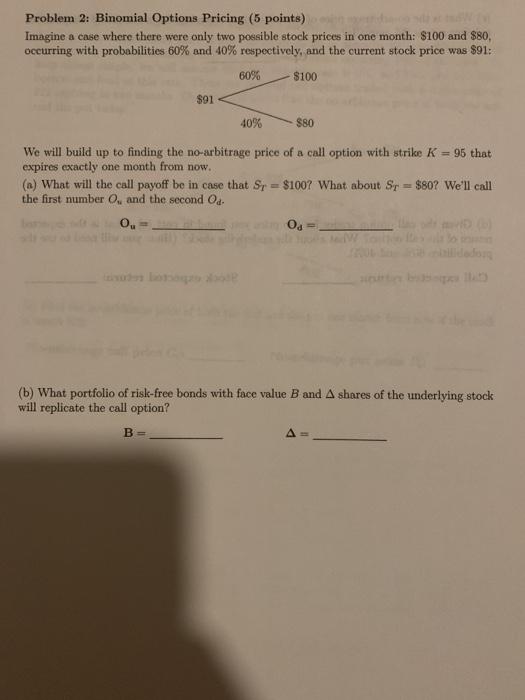
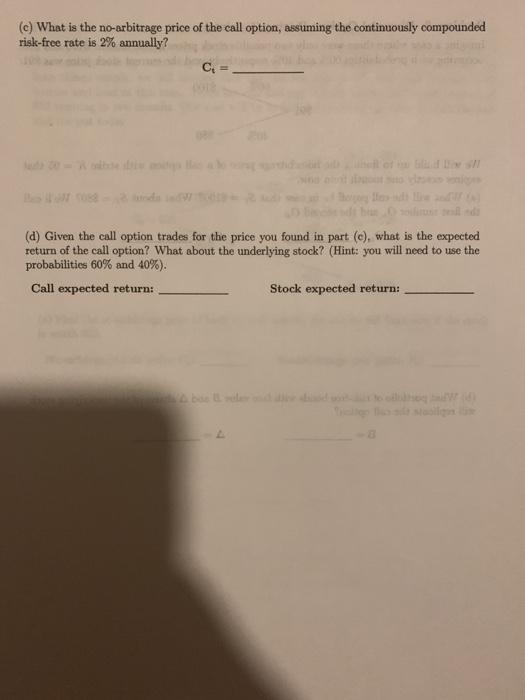
Problem 2: Binomial Options Pricing (5 points) Imagine a case where there were only two possible stock prices in one month: $100 and $80, occurring with probabilities 60% and 40% respectively, and the current stock price was $91: 60% $100 $91 40% $80 We will build up to finding the no-arbitrage price of a call option with strike K = 95 that expires exactly one month from now. (a) What will the call payoff be in case that Sr = $100? What about Sr = $80? We'll call the first number O. and the second Od 0. Od (b) What portfolio of risk-free bonds with face value B and A shares of the underlying stock will replicate the call option? B (c) What is the no-arbitrage price of the call option, assuming the continuously compounded risk-free rate is 2% annually? C (d) Given the call option trades for the price you found in part (e), what is the expected return of the call option? What about the underlying stock? (Hint: you will need to use the probabilities 60% and 40%). Call expected return; Stock expected return: Problem 2: Binomial Options Pricing (5 points) Imagine a case where there were only two possible stock prices in one month: $100 and $80, occurring with probabilities 60% and 40% respectively, and the current stock price was $91: 60% $100 $91 40% $80 We will build up to finding the no-arbitrage price of a call option with strike K = 95 that expires exactly one month from now. (a) What will the call payoff be in case that Sr = $100? What about Sr = $80? We'll call the first number O. and the second Od 0. Od (b) What portfolio of risk-free bonds with face value B and A shares of the underlying stock will replicate the call option? B (c) What is the no-arbitrage price of the call option, assuming the continuously compounded risk-free rate is 2% annually? C (d) Given the call option trades for the price you found in part (e), what is the expected return of the call option? What about the underlying stock? (Hint: you will need to use the probabilities 60% and 40%). Call expected return; Stock expected return
Step by Step Solution
There are 3 Steps involved in it

Get step-by-step solutions from verified subject matter experts
 Study Help