







Question: Problem 2 Calculate the centroid, I , I x y , and I y y ( all w . r . t . the centroid
Problem
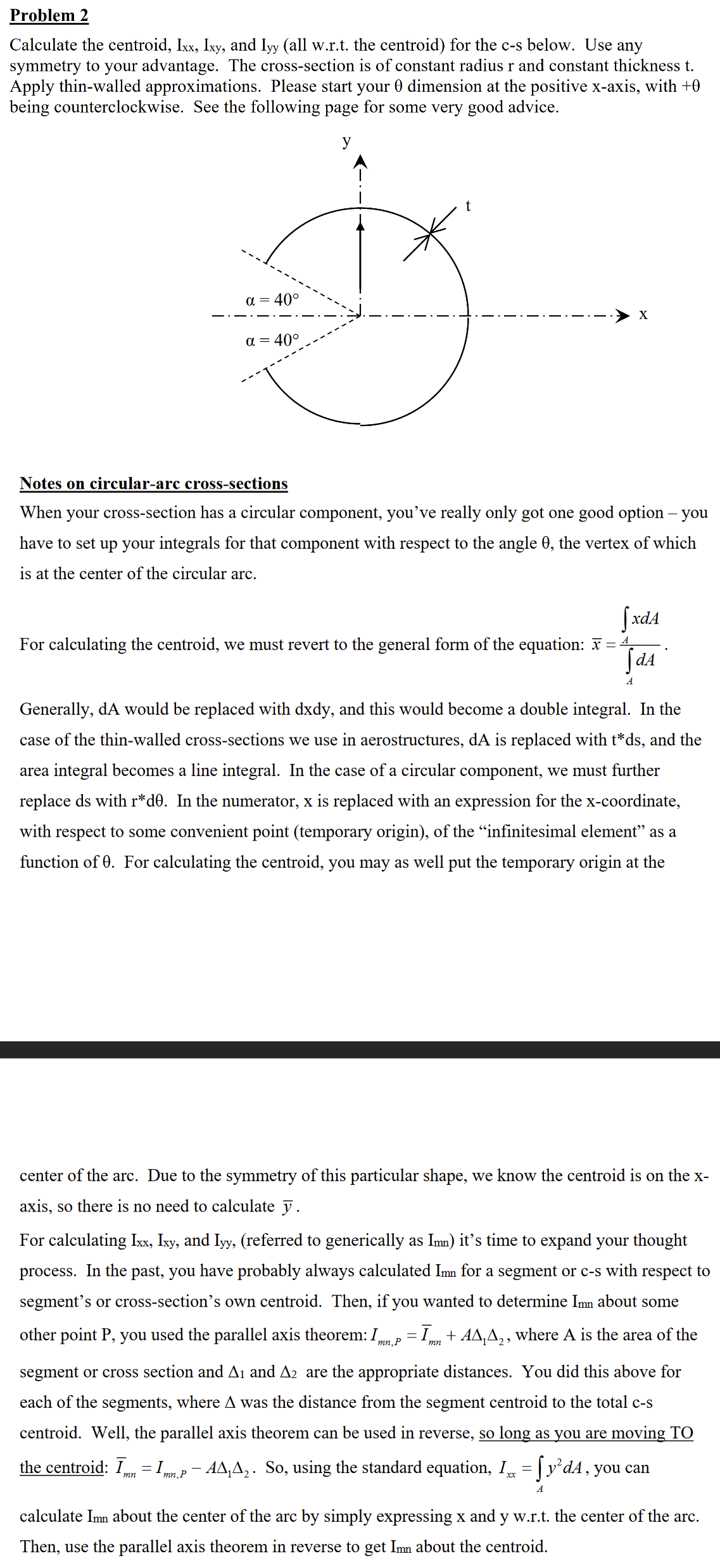
Calculate the centroid, and all wrt the centroid for the cs below. Use any
symmetry to your advantage. The crosssection is of constant radius and constant thickness
Apply thinwalled approximations. Please start your dimension at the positive axis, with
being counterclockwise. See the following page for some very good advice.
Notes on circulararc crosssections
When your crosssection has a circular component, you've really only got one good option you
have to set up your integrals for that component with respect to the angle the vertex of which
is at the center of the circular arc.
For calculating the centroid, we must revert to the general form of the equation:
Generally, dA would be replaced with dxdy and this would become a double integral. In the
case of the thinwalled crosssections we use in aerostructures, is replaced with and the
area integral becomes a line integral. In the case of a circular component, we must further
replace with In the numerator, is replaced with an expression for the coordinate,
with respect to some convenient point temporary origin of the "infinitesimal element" as a
function of For calculating the centroid, you may as well put the temporary origin at the
center of the arc. Due to the symmetry of this particular shape, we know the centroid is on the x
axis, so there is no need to calculate
For calculating and referred to generically as it's time to expand your thought
process. In the past, you have probably always calculated for a segment or cs with respect to
segment's or crosssections own centroid. Then, if you wanted to determine about some
other point you used the parallel axis theorem: where is the area of the
segment or cross section and and are the appropriate distances. You did this above for
each of the segments, where was the distance from the segment centroid to the total cs
centroid. Well, the parallel axis theorem can be used in reverse, so long as you are moving TO
the centroid: So using the standard equation, you can
calculate about the center of the arc by simply expressing and wrt the center of the arc.
Then, use the parallel axis theorem in reverse to get about the centroid.
Step by Step Solution
There are 3 Steps involved in it
1 Expert Approved Answer
Step: 1 Unlock

Question Has Been Solved by an Expert!
Get step-by-step solutions from verified subject matter experts
Step: 2 Unlock
Step: 3 Unlock
 Study Help