



Question: Problem 2 Debye Length Sketch the dependence of the electrostatic energy of the charge fluctuation within the volume r on the linear size r on
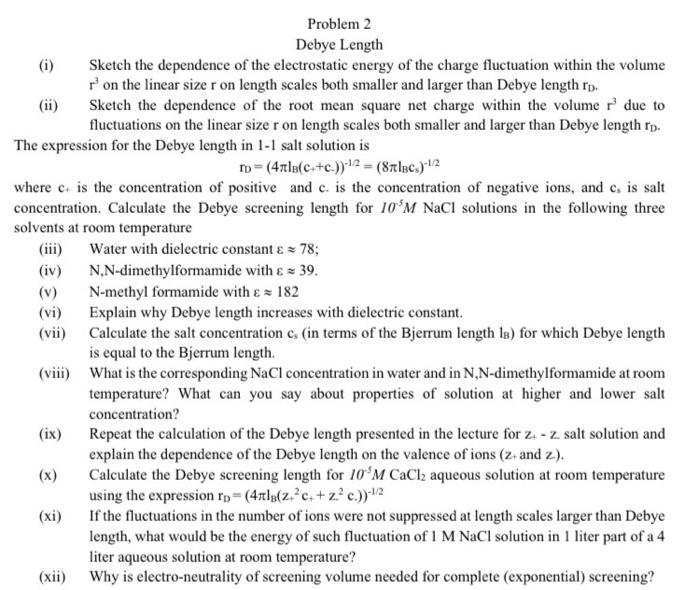
Problem 2 Debye Length Sketch the dependence of the electrostatic energy of the charge fluctuation within the volume r on the linear size r on length scales both smaller and larger than Debye length rp. (ii) Sketch the dependence of the root mean square net charge within the volume r due to fluctuations on the linear size r on length scales both smaller and larger than Debye length ry. The expression for the Debye length in 1-1 salt solution is ro= (4xle(c:+c.)) +2 = (8nloc.)12 where c is the concentration of positive and c. is the concentration of negative ions, and c is salt concentration. Calculate the Debye screening length for 10'M NaCl solutions in the following three solvents at room temperature (iii) Water with dielectric constant & 78; (iv) N.N-dimethylformamide with = 39. (v) N-methyl formamide with = 182 (vi) Explain why Debye length increases with dielectric constant. (vii) Calculate the salt concentration c (in terms of the Bjerrum length le) for which Debye length is equal to the Bjerrum length. (viii) What is the corresponding NaCl concentration in water and in N,N-dimethylformamide at room temperature? What can you say about properties of solution at higher and lower salt concentration? (ix) Repeat the calculation of the Debye length presented in the lecture for z. - 2. salt solution and explain the dependence of the Debye length on the valence of ions (z+and z). Calculate the Debye screening length for 10M CaCl2 aqueous solution at room temperature using the expression ro = (4xle(z.?c + z2c.))12 If the fluctuations in the number of ions were not suppressed at length scales larger than Debye length, what would be the energy of such fluctuation of 1 M NaCl solution in 1 liter part of a 4 liter aqueous solution at room temperature? (xii) Why is electro-neutrality of screening volume needed for complete (exponential) screening? (xi)
Step by Step Solution
There are 3 Steps involved in it

Get step-by-step solutions from verified subject matter experts