







Question: Problem 2: Simulation Lobstah Claw operates a eet of ve lobster boats in Boston, Massachusetts. Every weekday of the year, each boat leaves early in
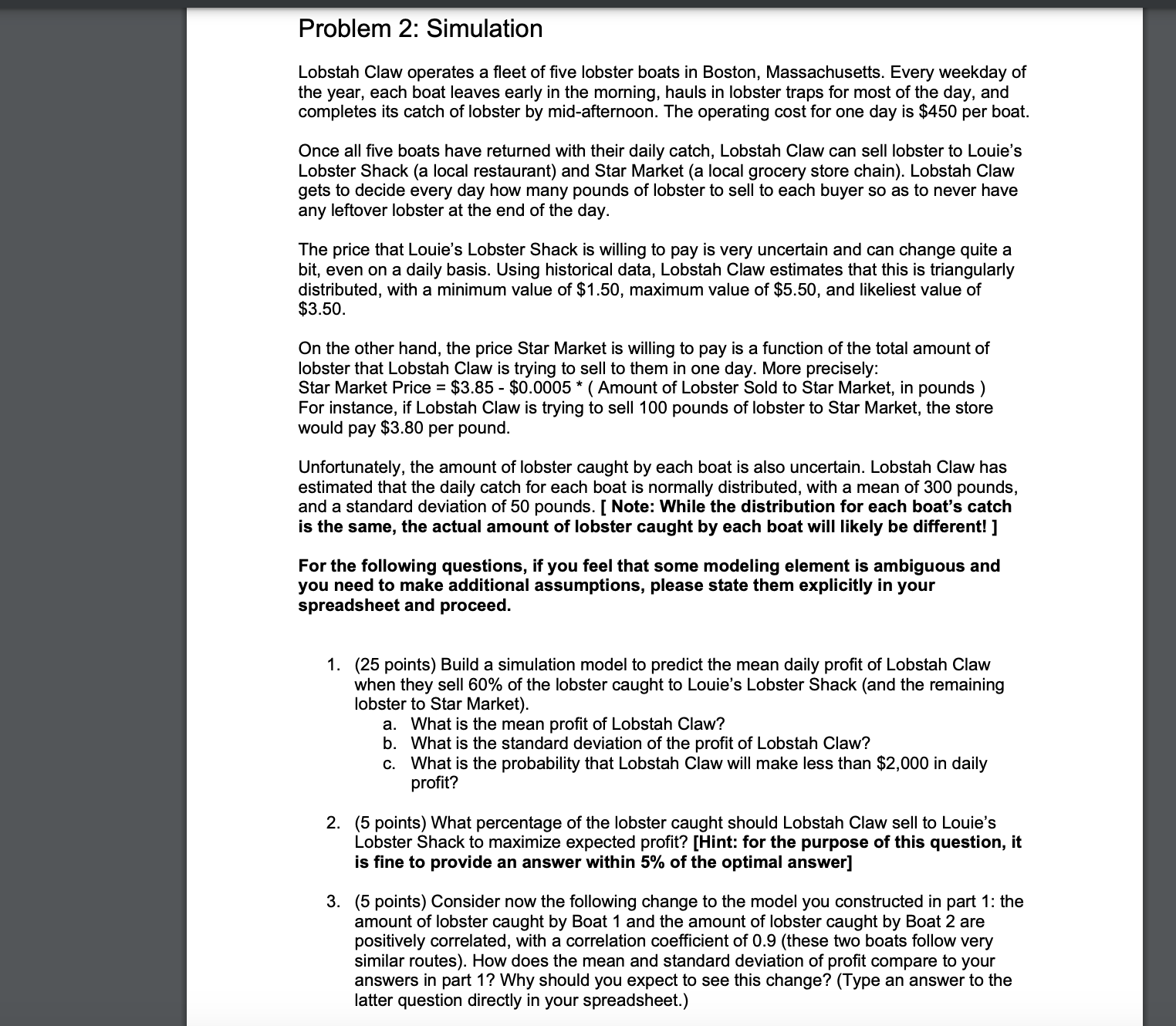
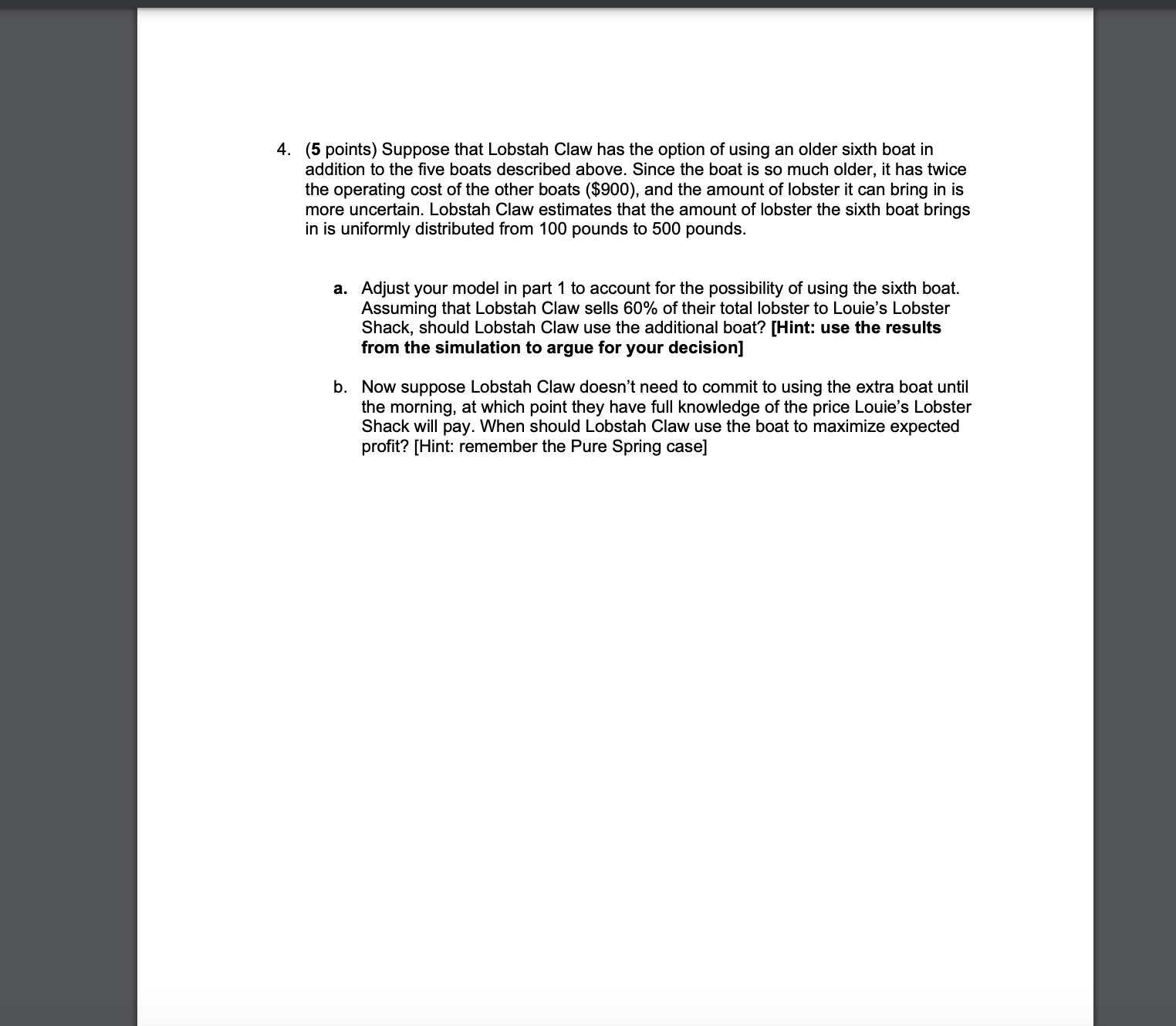
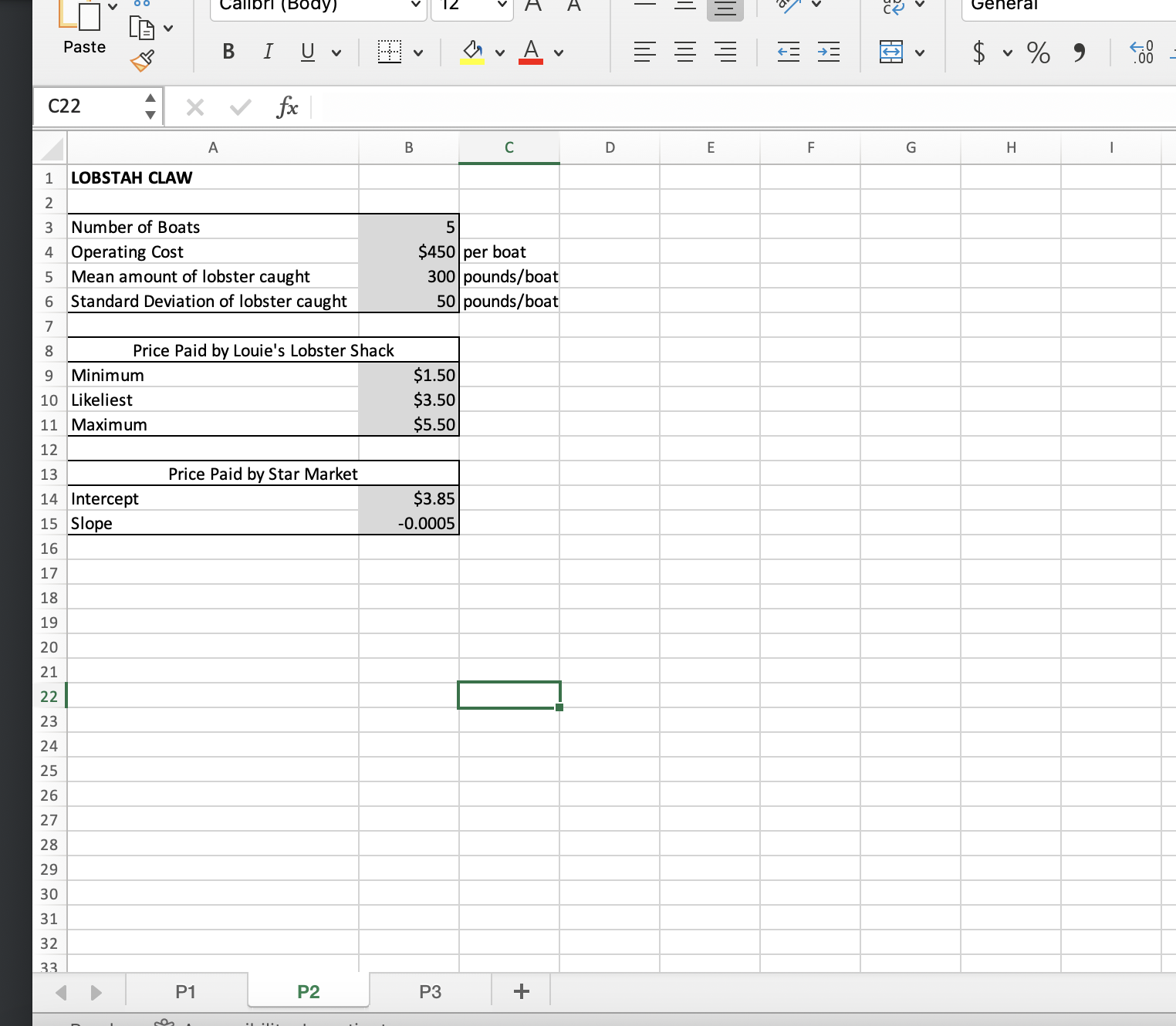
Problem 2: Simulation Lobstah Claw operates a eet of ve lobster boats in Boston, Massachusetts. Every weekday of the year, each boat leaves early in the morning, hauls in lobster traps for most of the day. and completes its catch of lobster by mid-afternoon. The operating cost for one day is $450 per boat. Once all ve boats have returned with their daily catch, Lobstah Claw can sell lobster to Louie's Lobster Shack (a local restaurant) and Star Market (a local grocery store chain). Lobstah Claw gets to decide every day how many pounds of lobster to sell to each buyer so as to never have any leftover lobster at the end of the day. The price that Louie's Lobster Shack is willing to pay is very uncertain and can change quite a bit, even on a daily basis. Using historical data, Lobstah Claw estimates that this is triangularly distributed, with a minimum value of $1.50, maximum value of $5.50, and likeliest value of $3.50. On the other hand, the price Star Market is willing to pay is a function of the total amount of lobster that Lobstah Claw is trying to sell to them in one day. More precisely: Star Market Price = $3.85 - $00005 * ( Amount of Lobster Sold to Star Market, in pounds ) For instance. if Lobstah Claw is trying to sell 100 pounds of lobster to Star Market. the store would pay $3.80 per pound. Unfortunately. the amount of lobster caught by each boat is also uncertain. Lobstah Claw has estimated that the daily catch for each boat is normally distributed, with a mean of 300 pounds, and a standard deviation of 50 pounds. [ Note: While the distribution for each boat's catch is the same, the actual amount of lobster caught by each boat will likely be different! ] For the following questions, if you feel that some modeling element is ambiguous and you need to make additional assumptions, please state them explicitly in your spreadsheet and proceed. 1. (25 points) Build a simulation model to predict the mean daily prot of Lobstah Claw when they sell 60% of the lobster caught to Louie's Lobster Shack (and the remaining lobster to Star Market). a. What is the mean prot of Lobstah Claw? b. What is the standard deviation of the prot of Lobstah Claw? c. What is the probability that Lobstah Claw will make less than $2,000 in daily prot? 2. (5 points) What percentage of the lobster caught should Lobstah Claw sell to Louie's Lobster Shack to maximize expected profit? [Hint: for the purpose of this question, it is ne to provide an answer within 5% of the optimal answer] (5 points) Consider now the following change to the model you constructed in part 1: the amount of lobster caught by Boat 1 and the amount of lobster caught by Boat 2 are positively correlated. with a correlation coefcient of 0.9 (these two boats follow very similar routes). How does the mean and standard deviation of prot compare to your answers in part 1? Why should you expect to see this change? (Type an answer to the latter question directly in your spreadsheet.) 4. (5 points) Suppose that Lobstah Claw has the option of using an older sixth boat in addition to the ve boats described above. Since the boat is so much older. it has twice the operating cost of the other boats ($900), and the amount of lobster it can bring in is more uncertain. Lobstah Claw estimates that the amount of lobster the sixth boat brings in is uniformly distributed from 100 pounds to 500 pounds. a. Adjust your model in part 1 to account for the possibility of using the sixth boat. Assuming that Lobstah Claw sells 60% of their total lobster to Louie's Lobster Shack. should Lobstah Claw use the additional boat? [Hint: use the results from the simulation to argue for your decision] . Now suppose Lobstah Claw doesn't need to commit to using the extra boat until the morning, at which point they have full knowledge of the price Louie's Lobster Shack will pay. When should Lobstah Claw use the boat to maximize expected prot? [Hint: remember the Pure Spring case] LO Paste BIUV MVA E = 2 2 v $ ~ % 9 00 C22 X V fx A B C D E F G H 1 1 LOBSTAH CLAW IN Number of Boats 5 Operating Cost $450 per boat 5 Mean amount of lobster caught 300 pounds/boat 6 Standard Deviation of lobster caught 50 pounds/boat 00 Price Paid by Louie's Lobster Shack 9 Minimum $1.50 10 Likeliest $3.50 11 Maximum $5.50 12 13 Price Paid by Star Market 14 Intercept $3.85 15 Slope -0.0005 16 17 18 19 20 21 22 23 24 25 26 27 28 29 30 31 32 33 P1 P2 P3 +
Step by Step Solution
There are 3 Steps involved in it

Get step-by-step solutions from verified subject matter experts
 Study Help