



Question: .......... Problem 2: The Neverending HIV/AIDS Epidemic [4 Points] You were hired as a consultant by WHO to tackle the HIV / AIDS epidemic. Thankfully
..........
![.......... Problem 2: The Neverending HIV/AIDS Epidemic [4 Points] You were hired](https://s3.amazonaws.com/si.experts.images/answers/2024/07/6685a67047858_9286685a67022342.jpg)
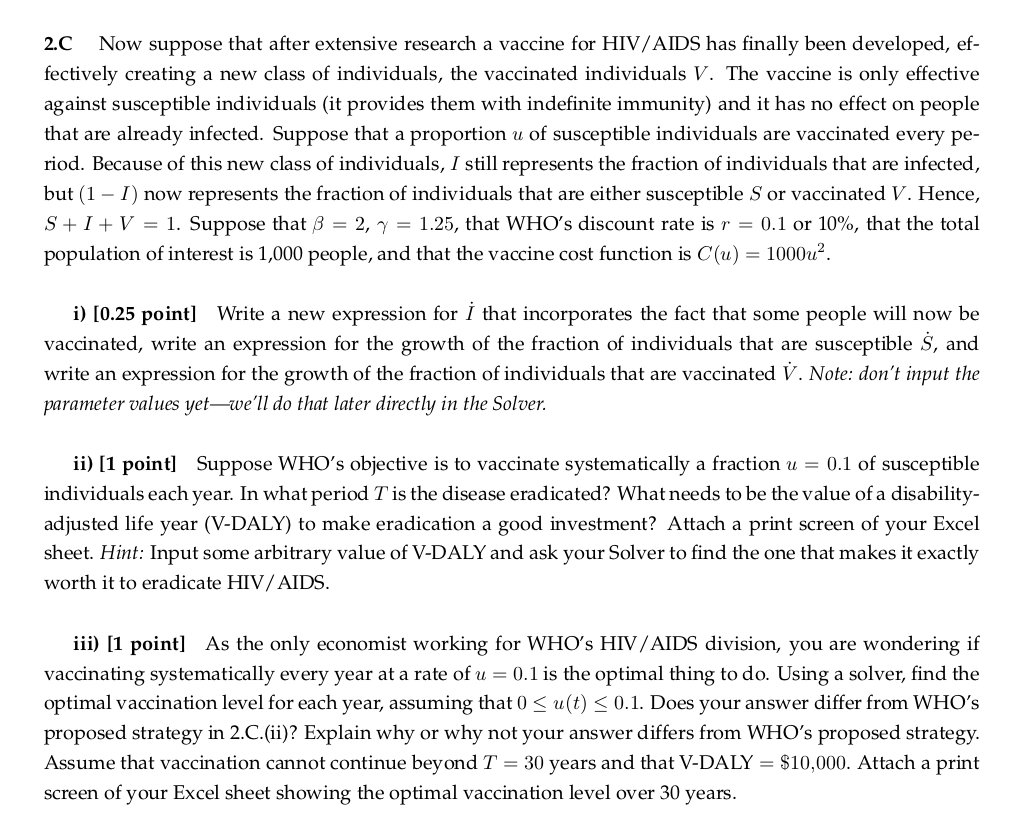
Problem 2: The Neverending HIV/AIDS Epidemic [4 Points] You were hired as a consultant by WHO to tackle the HIV / AIDS epidemic. Thankfully in many parts of the world, the epidemic has reached a steady state where the growth in susceptible individuals is equal to the growth in infected individuals. Let I denote the fraction of individuals that are infected (i.e. 0 g I g 1) and (1 I) denote the fraction of individuals that are susceptible. Let ,8 denote the effective contact rate between the susceptible and infected individuals, and let 7 denote the rate of recovery (i.e., the rate at which infected individuals transition back into susceptible individuals}.1 As such, the growth in I (that is, the change over time in the fraction of individuals that are infected, I ,' pronounced "l-dot") is given by: I=,8(1I)IqI 2.A [0.5 point] Find an expression for the steady-state value of infected individuals, I33. Under which conditions does I 33 = 0? Given your answer, how would WHO want its public health policies to affect 8 and 7? Show your work and explain in words. 2.3 Suppose WHO is considering a nonpharmaceutical intervention in the form of a massive information campaign promoting the use of condoms, which would help reducing the effective contact rate 8. i} [0.25 point] What will happen to the long-term steady-state level of infected individuals? Show your work in math and explain in words. ii} [1 point] Now suppose that, before the information campaign, 8 = 2 and 7 = 1.25, and that experts predict the campaign would reduce contact rate 8 by 5% indefinitely. Assume the campaign costs $0 today and would save lives that a have a constant value of a disability-adjusted life year (V-DALY) of $10,000. Assume the population contains 1,000 individuals and WHO's discount rate is r = 0.1 or 10%. What is the value of I 33 today? What would be the value of I33 if WHO decides to proceed with the information campaign? How high does 0 need to be for WHO to choose not to proceed with the campaign? Attach a print screen of your Excel sheet. Hint: Use a BUG-year horizon to approximate the infection costs that are incurred indefinitely. lInfected individuals die from complications associated with HIV] AIDS and an equal number of individuals are born into the susceptible population. 2.C Now suppose that after extensive research a vaccine for HIV/ AIDS has nally been developed, ef- fectively creating a new class of individuals, the vaccinated individuals V. The vaccine is only effective against susceptible individuals (it provides them with indefinite immunity} and it has no effect on people that are already infected. Suppose that a proportion u of susceptible individuals are vaccinated every pe- riod. Because of this new class of individuals, I still represents the fraction of individuals that are infected, but (1 I) now represents the fraction of individuals that are either susceptible .S' or vaccinated V. Hence, 3 + I + V = 1. Suppose that ,6 = 2, 7 = 1.25, that WHO's disth rate is r = 0.1 or 10%, that the total population of interest is 1,000 people, and that the vaccine cost function is 0(a) = 1000212. i} [0.25 point] Write a new expression for I that incorporates the fact that some people will now be vaccinated, write an expression for the growth of the fraction of individuals that are susceptible 5', and write an expression for the growth of the fraction of individuals that are vaccinated V. Note: don't input the parameter values yetwe'l l do that later directly in the Solver. ii} [1 point] Suppose WHO's objective is to vaccinate systematically a fraction u = 0.1 of susceptible individuals each year. In what period T is the disease eradicated? What needs to be the value ofa disability- adjusted life year (V-DALY} to make eradication a good investment? Attach a print screen of your Excel sheet. Hint: Input some arbitrary value of V-DALY and ask your Solver to find the one that makes it exactly worth it to eradicate HIV / AIDS. iii} [1 point] As the only economist working for WHO's HIV/AIDS division, you are wondering if vaccinating systematically every year at a rate of u = 0.1 is the optimal thing to do. Using a solver, find the optimal vaccination level for each year, assuming that 0 S u(t) 5 0.1. Does your answer differ from WHO's proposed strategy in 2.C.(ii)? Explain why or why not your answer differs from WHO's proposed strategy. Assume that vaccination cannot continue beyond T = 30 years and that V-DALY = $10,000. Attach a print screen of your Excel sheet showing the optimal vaccination level over 30 years
Step by Step Solution
There are 3 Steps involved in it

Get step-by-step solutions from verified subject matter experts