







Question: Problem 2.1 Let X1, X2, X3 be random variables with zero-mean and unit variance: E(Xi) = 0 and var(X,-) : 1. Assume that the covariance
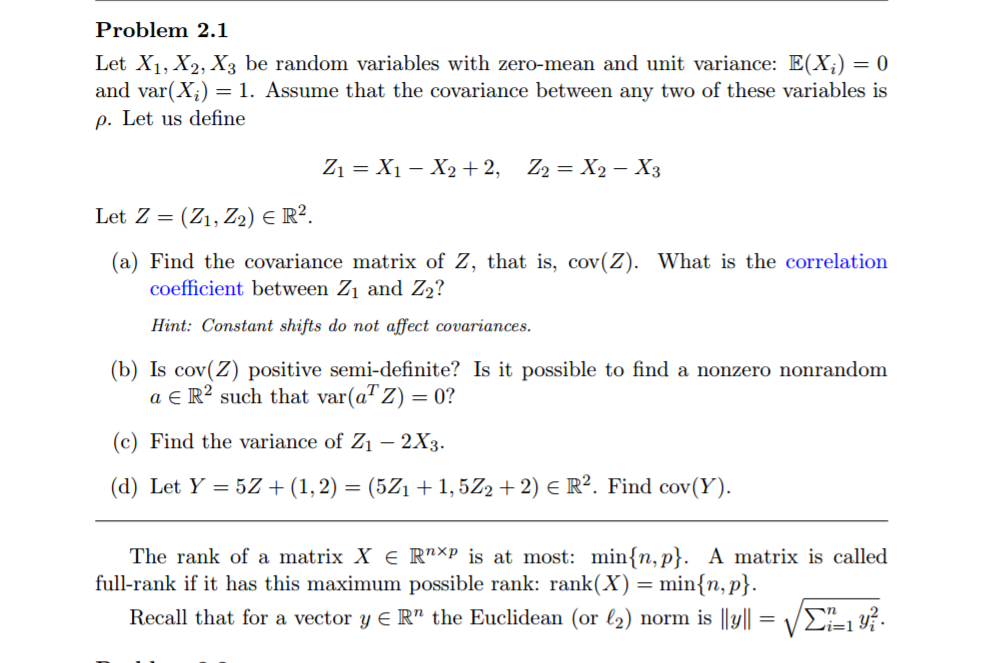
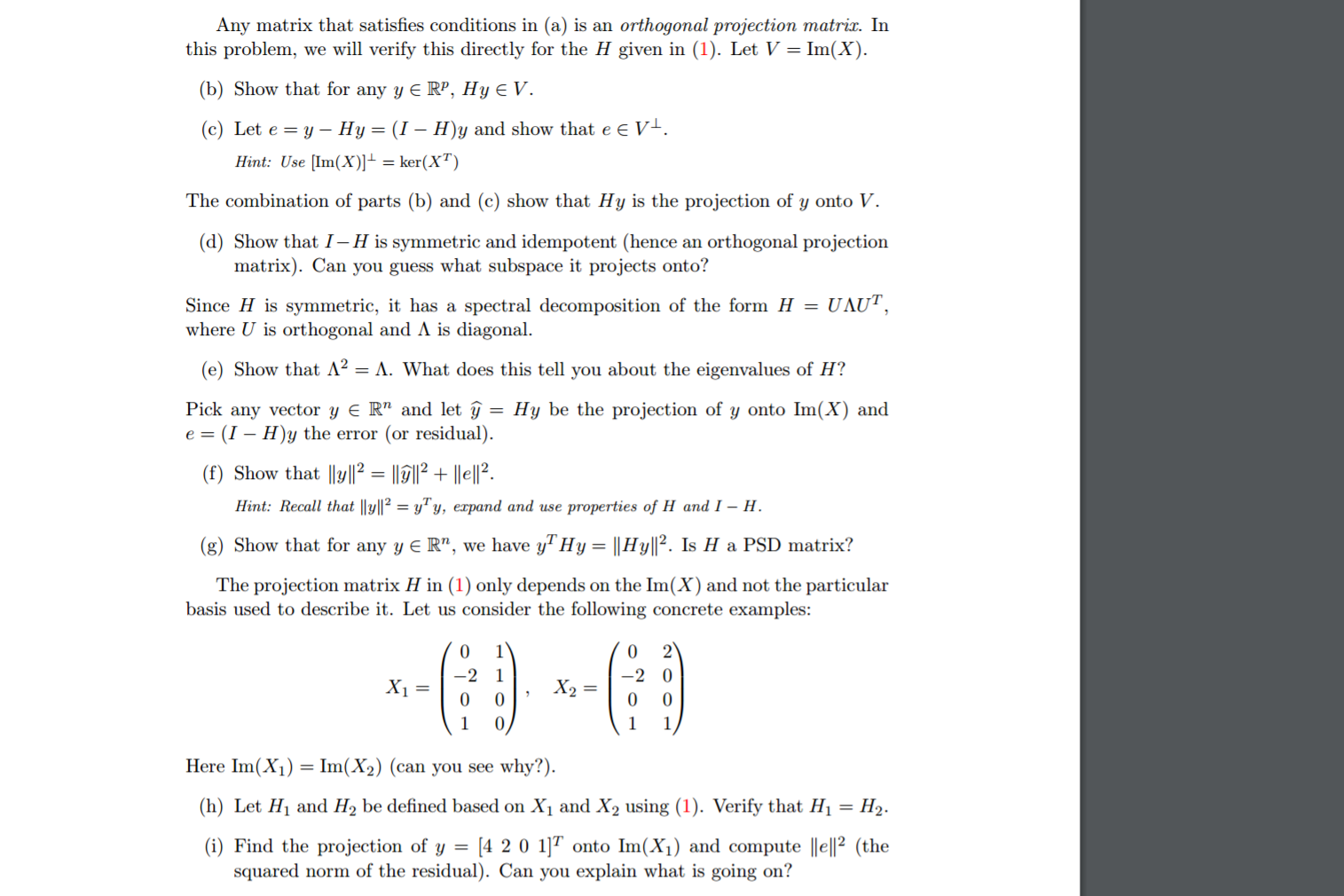
Problem 2.1 Let X1, X2, X3 be random variables with zero-mean and unit variance: E(Xi) = 0 and var(X,-) : 1. Assume that the covariance between any two of these variables is p. Let us dene Zl=X1X2+2, Z2=X2X3 Let Z = (21,32) 6R2. (a) Find the covariance matrix of Z, that is, cov(Z). What is the correlation coefcient between Z1 and Z2? Hint: Constant shifts do not affect covariances. (b) Is cov(Z) positive semi-denite? Is it possible to nd a nonzero nonrandom a. E R2 such that var(aTZ) = 0? (c) Find the variance of Z1 2X3. (d) Let Y = 52 + (1, 2) = (521 +1,522 + 2) E R2. Find cov(Y). The rank of a matrix X E R\"? is at most: min{n,p}. A matrix is called full-rank if it has this maximum possible rank: rank(X) = min{n,p}. Recall that for a vector y 6 R\" the Euclidean (or 2) norm is "y\" = \"'le yf. Any matrix that satises conditions in (a) is an orthogonal projection metrics. In this problem, we will verify this directly for the H given in (1). Let V = Irn(X). (b) Show that for any 3; 6 IR\
Step by Step Solution
There are 3 Steps involved in it

Get step-by-step solutions from verified subject matter experts
 Study Help