







Question: Problem 22.61 - Enhanced - with Hints and Feedback Review | Constants Part A You sometimes create a spark when you touch a doorknob after
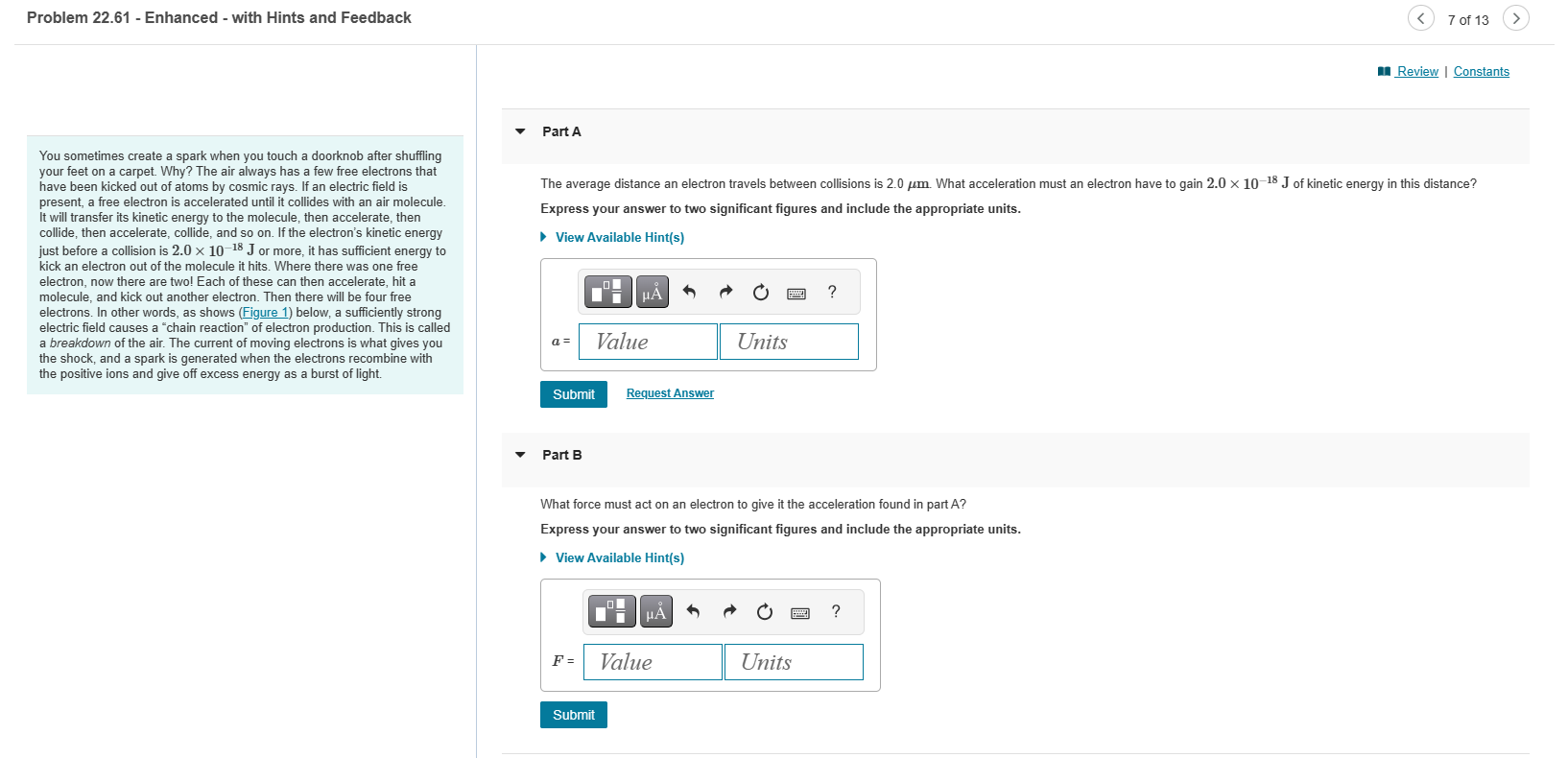
Problem 22.61 - Enhanced - with Hints and Feedback Review | Constants Part A You sometimes create a spark when you touch a doorknob after shuffling your feet on a carpet. Why? The air always has a few free electrons that have been kicked out of atoms by cosmic rays. If an electric field is The average distance an electron travels between collisions is 2.0 um. What acceleration must an electron have to gain 2.0 x 10 18 J of kinetic energy in this distance? present, a free electron is accelerated until it collides with an air molecule. It will transfer its kinetic energy to the molecule, then accelerate, then Express your answer to two significant figures and include the appropriate units. collide, then accelerate, collide, and so on. If the electron's kinetic energy View Available Hint(s) just before a collision is 2.0 x 10⁻¹⁸ J or more, it has sufficient energy to kick an electron out of the molecule it hits. Where there was one free electron, now there are two! Each of these can then accelerate, hit a molecule, and kick out another electron. Then there will be four free HA FC ? electrons. In other words, as shows (Figure 1) below, a sufficiently strong electric field causes a "chain reaction" of electron production. This is called a breakdown of the air. The current of moving electrons is what gives you a= Value Units the shock, and a spark is generated when the electrons recombine with the positive ions and give off excess energy as a burst of light. Submit Request Answer Part B What force must act on an electron to give it the acceleration found in part A? Express your answer to two significant figures and include the appropriate units. View Available Hint(s) 0 EX ? F = Value Units Submit
Step by Step Solution
There are 3 Steps involved in it

Get step-by-step solutions from verified subject matter experts
 Study Help