







Question: Problem 3 (1 point each, total 15 points) Please answer the following questions. 1. In a database, there are values a data element can take,
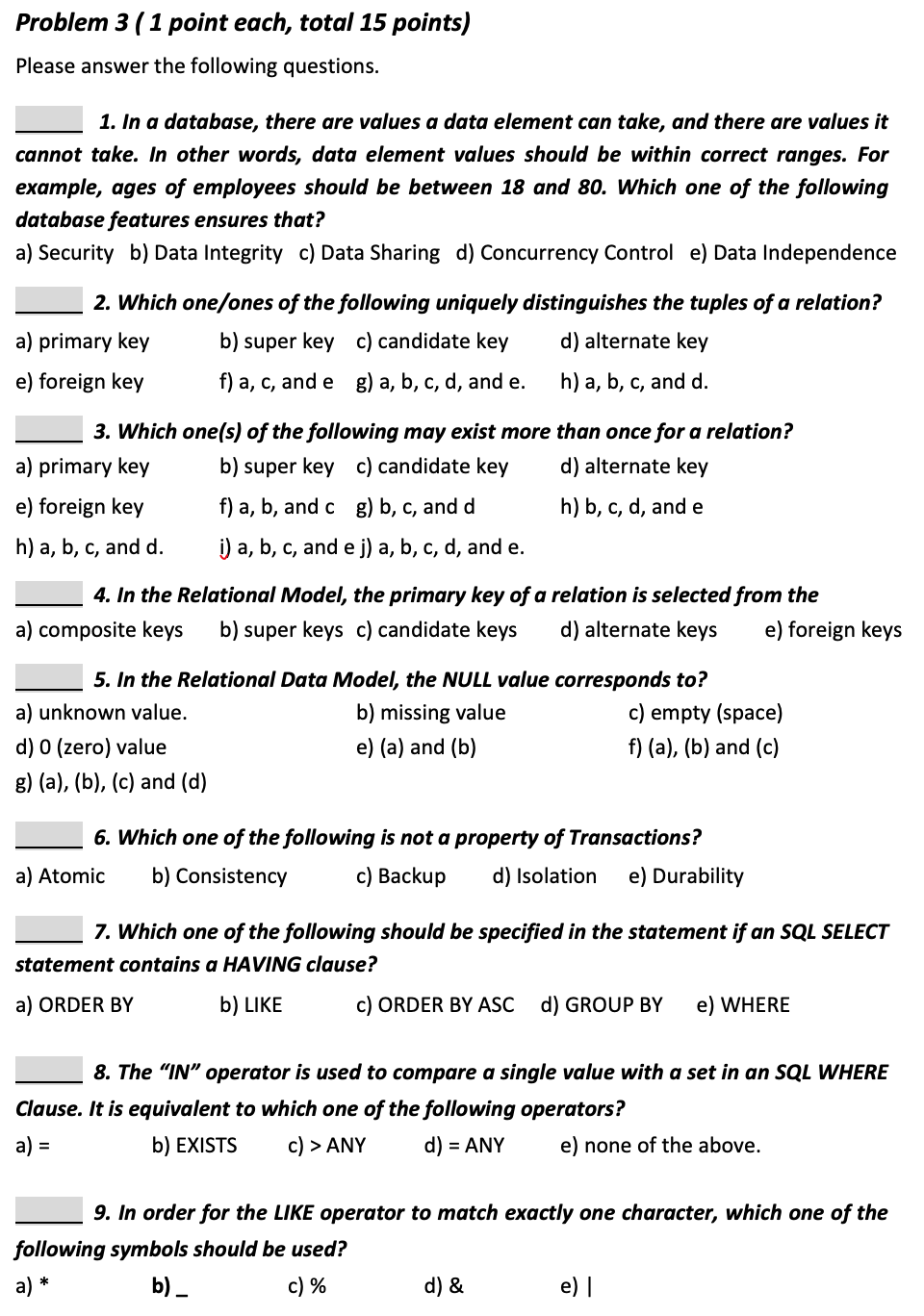
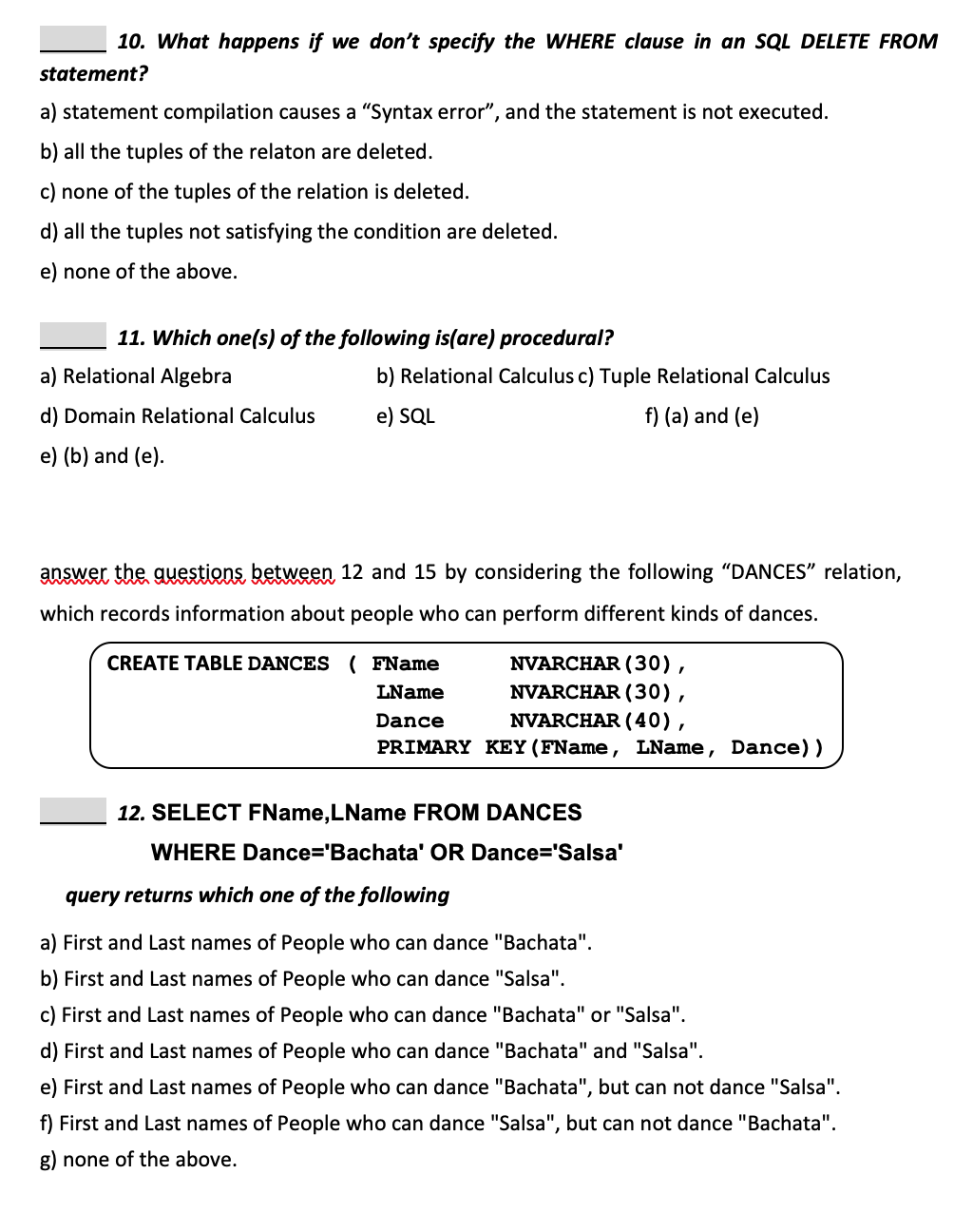
Problem 3 (1 point each, total 15 points) Please answer the following questions. 1. In a database, there are values a data element can take, and there are values it cannot take. In other words, data element values should be within correct ranges. For example, ages of employees should be between 18 and 80. Which one of the following database features ensures that? a) Security b) Data Integrity c) Data Sharing d) Concurrency Control e) Data Independence 2. Which one/ones of the following uniquely distinguishes the tuples of a relation? a) primary key b) super key c) candidate key d) alternate key e) foreign key f) a, c, and e g) a, b, c, d, and e. h) a, b, c, and d. 3. Which one(s) of the following may exist more than once for a relation? a) primary key b) super key c) candidate key d) alternate key e) foreign key f) a, b, and c g) b, c, and d h) b, c, d, and e h) a, b, c, and d. i) a, b, c, and e j) a, b, c, d, and e. 4. In the Relational Model, the primary key of a relation is selected from the a) composite keys b) super keys c) candidate keys d) alternate keys e) foreign keys 5. In the Relational Data Model, the NULL value corresponds to? a) unknown value. b) missing value c) empty (space) d) 0 (zero) value e) (a) and (b) f) (a), (b) and (c) g) (a), (b), (c) and (d) 6. Which one of the following is not a property of Transactions? a) Atomic b) Consistency c) Backup d) Isolation e) Durability 7. Which one of the following should be specified in the statement if an SQL SELECT statement contains a HAVING clause? a) ORDER BY b) LIKE c) ORDER BY ASC d) GROUP BY e) WHERE 8. The IN operator is used to compare a single value with a set in an SQL WHERE Clause. It is equivalent to which one of the following operators? b) EXISTS c) > ANY d) = ANY e) none of the above. a) = 9. In order for the LIKE operator to match exactly one character, which one of the following symbols should be used? a) * b)_ c) % d) & e) 10. What happens if we don't specify the WHERE clause in an SQL DELETE FROM statement? a) statement compilation causes a "Syntax error, and the statement is not executed. b) all the tuples of the relaton are deleted. c) none of the tuples of the relation is deleted. d) all the tuples not satisfying the condition are deleted. e) none of the above. 11. Which one(s) of the following is(are) procedural? a) Relational Algebra b) Relational Calculus c) Tuple Relational Calculus d) Domain Relational Calculus e) SQL f) (a) and (e) e) (b) and (e). answer the questions between 12 and 15 by considering the following DANCES relation, which records information about people who can perform different kinds of dances. CREATE TABLE DANCES (FName NVARCHAR (30), LName NVARCHAR (30), Dance NVARCHAR (40), PRIMARY KEY (FName, LName, Dance) ) 12. SELECT FName,LName FROM DANCES WHERE Dance='Bachata' OR Dance='Salsa' query returns which one of the following a) First and Last names of People who can dance "Bachata". b) First and Last names of People who can dance "Salsa". c) First and Last names of People who can dance "Bachata" or "Salsa". d) First and last names of People who can dance "Bachata" and "Salsa". e) First and last names of People who can dance "Bachata", but can not dance "Salsa". f) First and Last names of People who can dance "Salsa", but can not dance "Bachata". g) none of the above
Step by Step Solution
There are 3 Steps involved in it

Get step-by-step solutions from verified subject matter experts
 Study Help