







Question: Problem 3 [12 marks] Consider again Problem B from Part 2.4.: Problem B: minimize v = 1891 + 41/2 subject to 21/1 + 1/2 IV
![Problem 3 [12 marks] Consider again Problem B from Part 2.4.:](https://dsd5zvtm8ll6.cloudfront.net/si.experts.images/questions/2024/10/670735d7cdea0_783670735d7bb1ab.jpg)
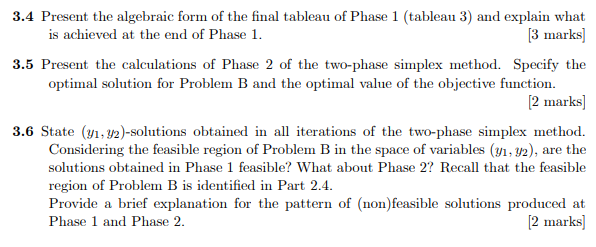
Problem 3 [12 marks] Consider again Problem B from Part 2.4.: Problem B: minimize v = 1891 + 41/2 subject to 21/1 + 1/2 IV IV IV 12 It can be solved by the two-phase simplex method. The key steps of the first phase are outlined on the next page. 3.1 Explain why and how variables t1, to, wj and w2 are introduced. [2 marks] 3.2 What is the algebraic expression for the bottom row of tableau 1? How is that expres- sion obtained? Why does the bottom row contain "-W" rather than "+W"? [2 marks] 3.3 For the preceding row of tableau 1, why do we use the expression with "-v" rather than an expression for "y"? [1 mark]3.4 Present the algebraic form of the final tableau of Phase 1 (tableau 3) and explain what is achieved at the end of Phase 1. [3 marks] 3.5 Present the calculations of Phase 2 of the two-phase simplex method. Specify the optimal solution for Problem B and the optimal value of the objective function. [2 marks] 3.6 State (91, y2)-solutions obtained in all iterations of the two-phase simplex method. Considering the feasible region of Problem B in the space of variables (11, 12), are the solutions obtained in Phase 1 feasible? What about Phase 2? Recall that the feasible region of Problem B is identified in Part 2.4. Provide a brief explanation for the pattern of (non)feasible solutions produced at Phase 1 and Phase 2. [2 marks]
Step by Step Solution
There are 3 Steps involved in it

Get step-by-step solutions from verified subject matter experts
 Study Help