







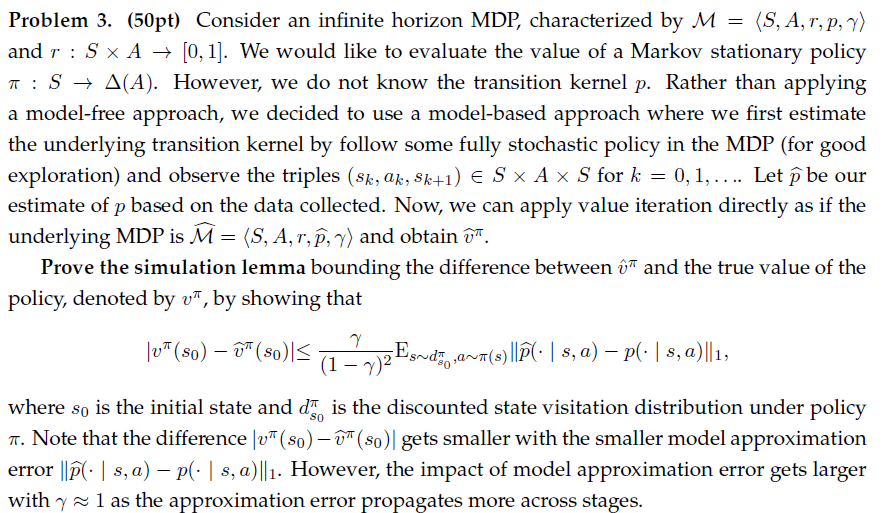
Question: Problem 3 . ( 5 0 pt ) Consider an infinite horizon MDP , characterized by M = ( : S , A , r
Problem pt Consider an infinite horizon MDP characterized by ::
and : We would like to evaluate the value of a Markov stationary policy
: However, we do not know the transition kernel Rather than applying
a modelfree approach, we decided to use a modelbased approach where we first estimate
the underlying transition kernel by follow some fully stochastic policy in the MDP for good
exploration and observe the triples for dots Let hat be our
estimate of based on the data collected. Now, we can apply value iteration directly as if the
underlying MDP is widehat:widehat: and obtain widehat
Prove the simulation lemma bounding the difference between hat and the true value of the
policy, denoted by by showing that
widehat
where is the initial state and is the discounted state visitation distribution under policy
Note that the difference widehat gets smaller with the smaller model approximation
error However, the impact of model approximation error gets larger
with ~~ as the approximation error propagates more across stages.
Step by Step Solution
There are 3 Steps involved in it
1 Expert Approved Answer
Step: 1 Unlock

Question Has Been Solved by an Expert!
Get step-by-step solutions from verified subject matter experts
Step: 2 Unlock
Step: 3 Unlock
 Study Help