







Question: Problem 3: Liquid extraction is an operation used to separate the components of a liquid mixture of two or more species. In the simplest case,
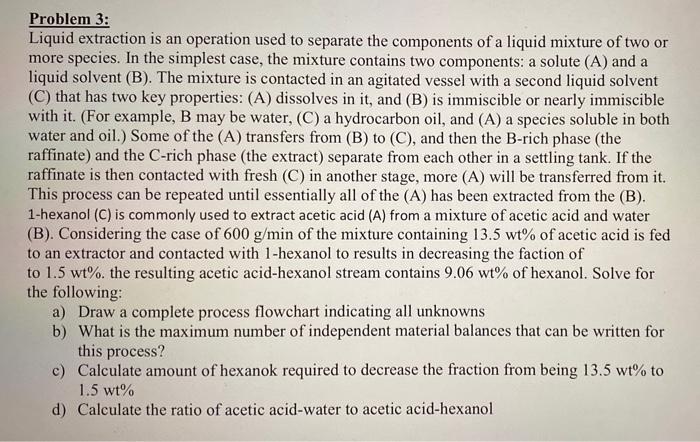
Problem 3: Liquid extraction is an operation used to separate the components of a liquid mixture of two or more species. In the simplest case, the mixture contains two components: a solute (A) and a liquid solvent (B). The mixture is contacted in an agitated vessel with a second liquid solvent (C) that has two key properties: (A) dissolves in it, and (B) is immiscible or nearly immiscible with it. (For example, B may be water, (C) a hydrocarbon oil, and (A) a species soluble in both water and oil.) Some of the (A) transfers from (B) to (C), and then the B-rich phase (the raffinate) and the C-rich phase (the extract) separate from each other in a settling tank. If the raffinate is then contacted with fresh (C) in another stage, more (A) will be transferred from it. This process can be repeated until essentially all of the (A) has been extracted from the (B). 1-hexanol (C) is commonly used to extract acetic acid (A) from a mixture of acetic acid and water (B). Considering the case of 600 g/min of the mixture containing 13.5 wt% of acetic acid is fed to an extractor and contacted with 1-hexanol to results in decreasing the faction of to 1.5 wt%. the resulting acetic acid-hexanol stream contains 9.06 wt% of hexanol. Solve for the following: a) Draw a complete process flowchart indicating all unknowns b) What is the maximum number of independent material balances that can be written for this process? c) Calculate amount of hexanok required to decrease the fraction from being 13.5 wt% to 1.5 wt% d) Calculate the ratio of acetic acid-water to acetic acid-hexanol
Step by Step Solution
There are 3 Steps involved in it

Get step-by-step solutions from verified subject matter experts
 Study Help