







Question: Problem 3 Maintenance engineers at Tinker Air Force Base use sheets of aluminum in maintenance, repair, and overhaul (MRO) operations. The distance between consecutive flaws
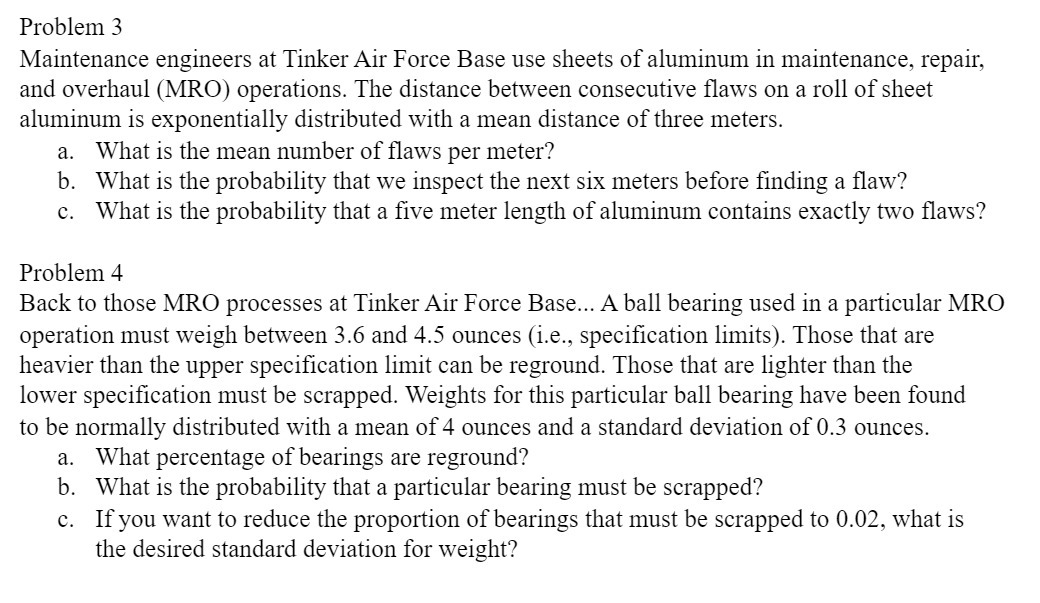
Problem 3 Maintenance engineers at Tinker Air Force Base use sheets of aluminum in maintenance, repair, and overhaul (MRO) operations. The distance between consecutive flaws on a roll of sheet aluminum 1s exponentially distributed with a mean distance of three meters. a. What is the mean number of flaws per meter? b. What is the probability that we inspect the next six meters before finding a flaw? c. What is the probability that a five meter length of aluminum contains exactly two flaws? Problem 4 Back to those MRO processes at Tinker Air Force Base... A ball bearing used 1n a particular MRO operation must weigh between 3.6 and 4.5 ounces (i.e., specification limits). Those that are heavier than the upper specification limit can be reground. Those that are lighter than the lower specification must be scrapped. Weights for this particular ball bearing have been found to be normally distributed with a mean of 4 ounces and a standard deviation of 0.3 ounces. a. What percentage of bearings are reground? b. What is the probability that a particular bearing must be scrapped? c. If you want to reduce the proportion of bearings that must be scrapped to 0.02, what 1s the desired standard deviation for weight
Step by Step Solution
There are 3 Steps involved in it

Get step-by-step solutions from verified subject matter experts
 Study Help