







Question: Problem 3: This problem is like a homework problem done earlier in the class, but instead of a block sliding off a hoop, in this
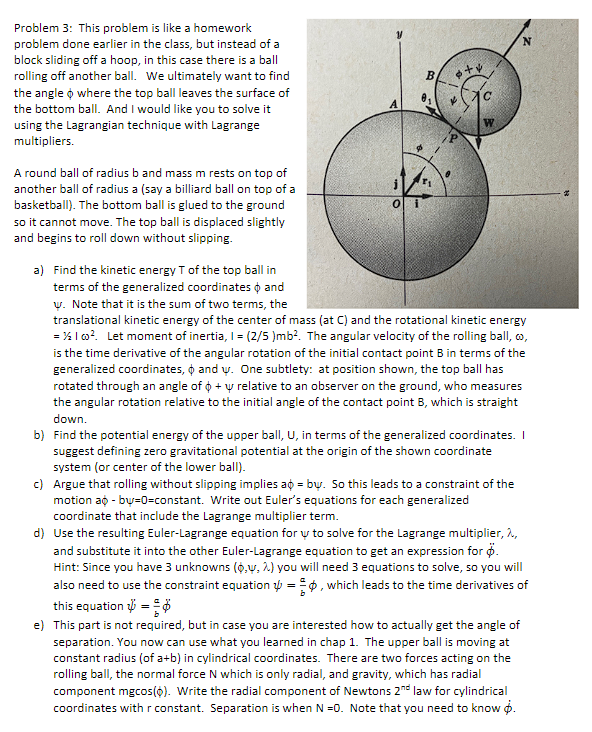
Problem 3: This problem is like a homework problem done earlier in the class, but instead of a block sliding off a hoop, in this case there is a ball rolling off another ball. We ultimately want to find the angle o where the top ball leaves the surface of the bottom ball. And I would like you to solve it using the Lagrangian technique with Lagrange multipliers. A round ball of radius b and mass m rests on top of another ball of radius a (say a billiard ball on top of a basketball). The bottom ball is glued to the ground so it cannot move. The top ball is displaced slightly and begins to roll down without slipping. a) Find the kinetic energy T of the top ball in terms of the generalized coordinates o and w. Note that it is the sum of two terms, the translational kinetic energy of the center of mass (at () and the rotational kinetic energy = ) 1 02. Let moment of inertia, I= (2/5 )mb'. The angular velocity of the rolling ball, c, is the time derivative of the angular rotation of the initial contact point B in terms of the generalized coordinates, $ and w. One subtlety: at position shown, the top ball has rotated through an angle of + y relative to an observer on the ground, who measures the angular rotation relative to the initial angle of the contact point B, which is straight down. b) Find the potential energy of the upper ball, U, in terms of the generalized coordinates. I suggest defining zero gravitational potential at the origin of the shown coordinate system (or center of the lower ball). c) Argue that rolling without slipping implies ao = by. So this leads to a constraint of the motion ap - by=0=constant. Write out Euler's equations for each generalized coordinate that include the Lagrange multiplier term. d) Use the resulting Euler-Lagrange equation for w to solve for the Lagrange multiplier, 2, and substitute it into the other Euler-Lagrange equation to get an expression for . Hint: Since you have 3 unknowns ((,w, 7.) you will need 3 equations to solve, so you will also need to use the constraint equation y = = $, which leads to the time derivatives of this equation w = = $ e) This part is not required, but in case you are interested how to actually get the angle of separation. You now can use what you learned in chap 1. The upper ball is moving at constant radius ( of a+b) in cylindrical coordinates. There are two forces acting on the rolling ball, the normal force N which is only radial, and gravity, which has radial component mgcos(0). Write the radial component of Newtons 2": law for cylindrical coordinates with r constant. Separation is when N =0. Note that you need to know o
Step by Step Solution
There are 3 Steps involved in it

Get step-by-step solutions from verified subject matter experts
 Study Help