







Question: Problem 4. (24 points) A fiber engineer is designing an SM-SIF at 1 = 1000nm using silica core with refractive index n1(1) = 1.4580 +

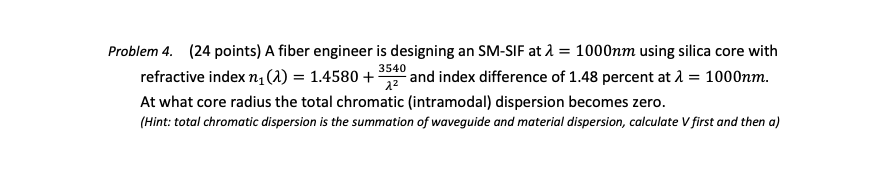
Problem 4. (24 points) A fiber engineer is designing an SM-SIF at 1 = 1000nm using silica core with refractive index n1(1) = 1.4580 + 3540 and index difference of 1.48 percent at 2 = 1000nm. At what core radius the total chromatic (intramodal) dispersion becomes zero. (Hint: total chromatic dispersion is the summation of waveguide and material dispersion, calculate V first and then a) Problem 4. (24 points) A fiber engineer is designing an SM-SIF at i = 1000nm using silica core with refractive index n1() = 1.4580 + 3540 and index difference of 1.48 percent at 1 = 1000nm. At what core radius the total chromatic (intramodal) dispersion becomes zero. (Hint: total chromatic dispersion is the summation of waveguide and material dispersion, calculate V first and then a) Problem 4. (24 points) A fiber engineer is designing an SM-SIF at 1 = 1000nm using silica core with refractive index n1(1) = 1.4580 + 3540 and index difference of 1.48 percent at 2 = 1000nm. At what core radius the total chromatic (intramodal) dispersion becomes zero. (Hint: total chromatic dispersion is the summation of waveguide and material dispersion, calculate V first and then a) Problem 4. (24 points) A fiber engineer is designing an SM-SIF at i = 1000nm using silica core with refractive index n1() = 1.4580 + 3540 and index difference of 1.48 percent at 1 = 1000nm. At what core radius the total chromatic (intramodal) dispersion becomes zero. (Hint: total chromatic dispersion is the summation of waveguide and material dispersion, calculate V first and then a)
Step by Step Solution
There are 3 Steps involved in it

Get step-by-step solutions from verified subject matter experts
 Study Help