







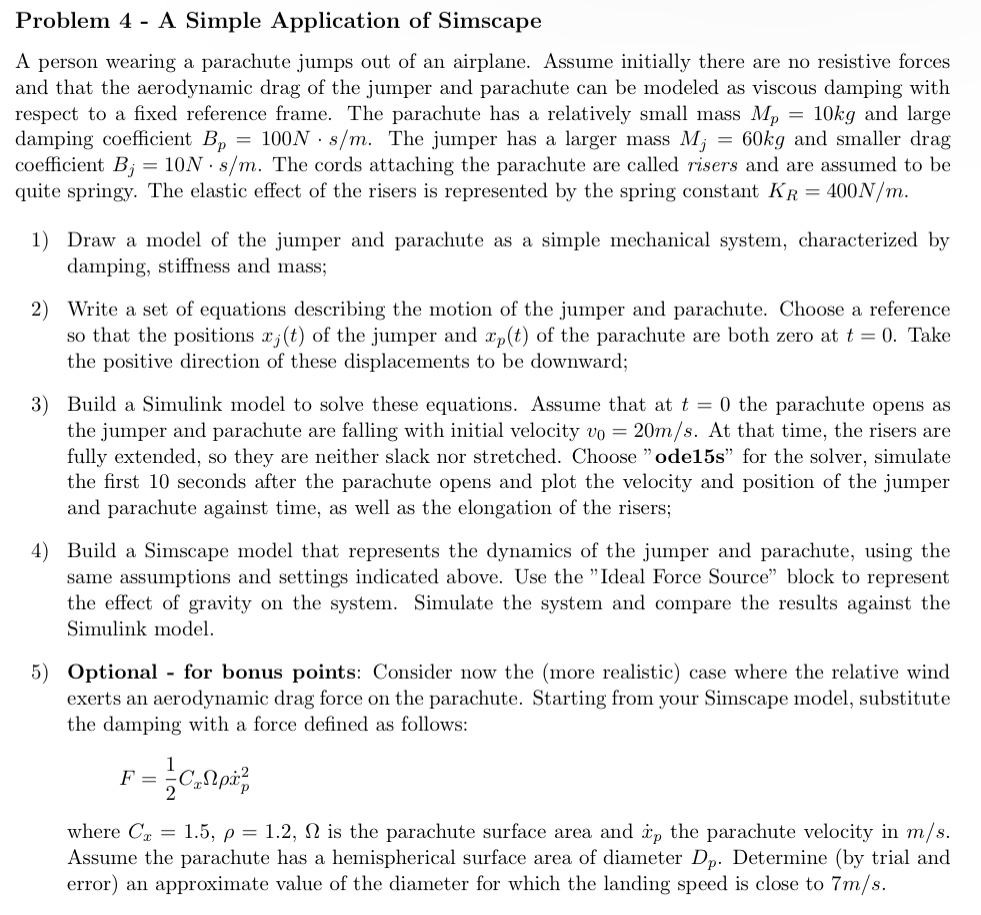
Question: Problem 4 - A Simple Application of Simscape A person wearing a parachute jumps out of an airplane. Assume initially there are no resistive forces
Problem A Simple Application of Simscape
A person wearing a parachute jumps out of an airplane. Assume initially there are no resistive forces
and that the aerodynamic drag of the jumper and parachute can be modeled as viscous damping with
respect to a fixed reference frame. The parachute has a relatively small mass and large
damping coefficient The jumper has a larger mass and smaller drag
coefficient The cords attaching the parachute are called risers and are assumed to be
quite springy. The elastic effect of the risers is represented by the spring constant
Draw a model of the jumper and parachute as a simple mechanical system, characterized by
damping, stiffness and mass;
Write a set of equations describing the motion of the jumper and parachute. Choose a reference
so that the positions of the jumper and of the parachute are both zero at Take
the positive direction of these displacements to be downward;
Build a Simulink model to solve these equations. Assume that at the parachute opens as
the jumper and parachute are falling with initial velocity At that time, the risers are
fully extended, so they are neither slack nor stretched. Choose "odes for the solver, simulate
the first seconds after the parachute opens and plot the velocity and position of the jumper
and parachute against time, as well as the elongation of the risers;
Build a Simscape model that represents the dynamics of the jumper and parachute, using the
same assumptions and settings indicated above. Use the "Ideal Force Source" block to represent
the effect of gravity on the system. Simulate the system and compare the results against the
Simulink model.
Optional for bonus points: Consider now the more realistic case where the relative wind
exerts an aerodynamic drag force on the parachute. Starting from your Simscape model, substitute
the damping with a force defined as follows:
where is the parachute surface area and the parachute velocity in
Assume the parachute has a hemispherical surface area of diameter Determine by trial and
error an approximate value of the diameter for which the landing speed is close to
Step by Step Solution
There are 3 Steps involved in it
1 Expert Approved Answer
Step: 1 Unlock

Question Has Been Solved by an Expert!
Get step-by-step solutions from verified subject matter experts
Step: 2 Unlock
Step: 3 Unlock
 Study Help