







Question: Problem 4 Chapter 8: Read and watch the video for the case Forecasting and Supply Chain Management at Deckers Outdoor Corporation (pages 323&324) and provide
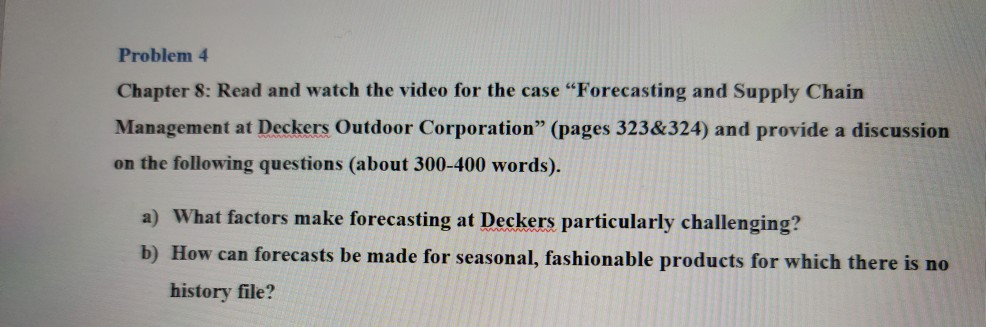
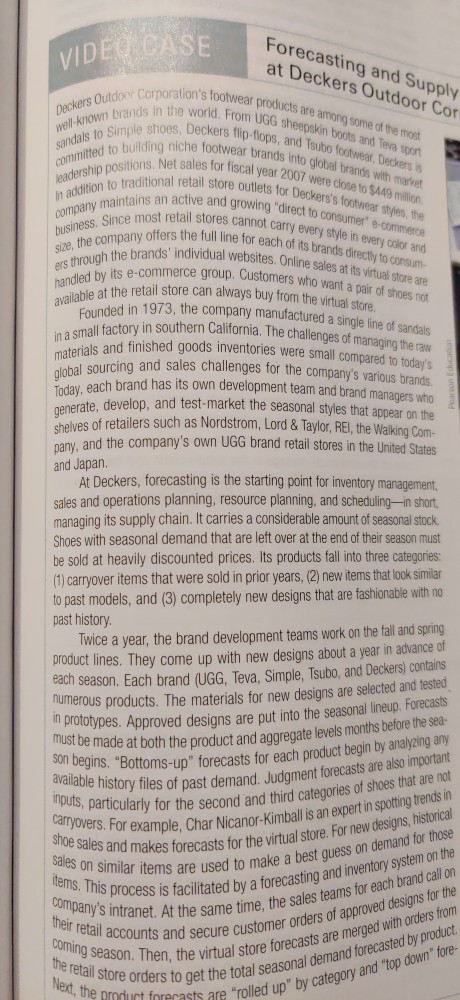
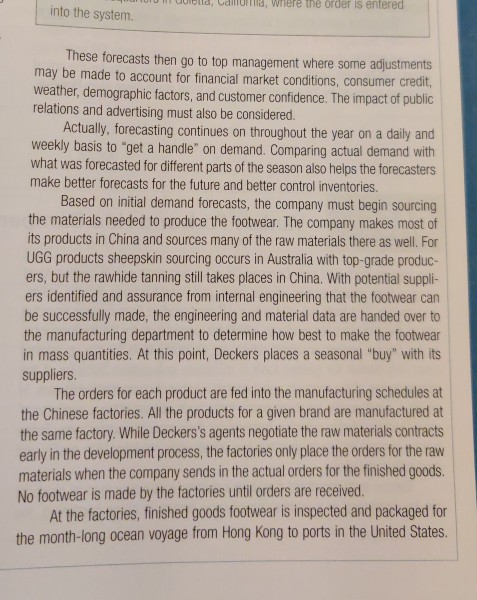
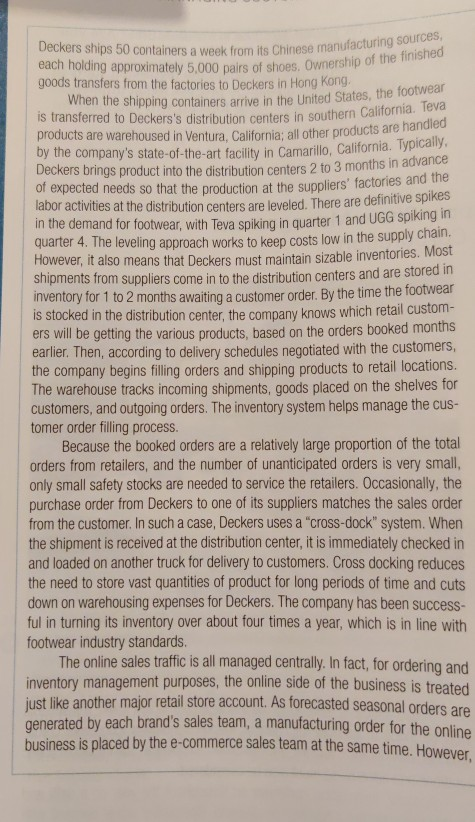
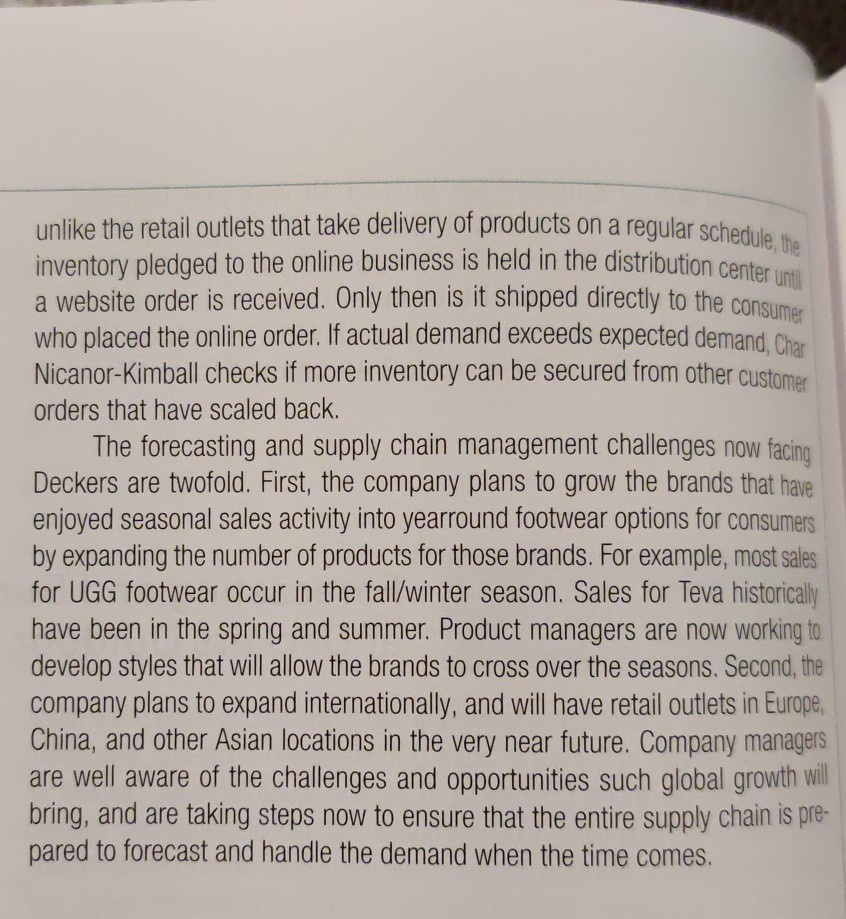
Problem 4 Chapter 8: Read and watch the video for the case Forecasting and Supply Chain Management at Deckers Outdoor Corporation (pages 323&324) and provide a discussion on the following questions (about 300-400 words). a) What factors make forecasting at Deckers particularly challenging? b) How can forecasts be made for seasonal, fashionable products for which there is no history file? VIDEU CASE Foro Forecasting and Supply at Deckers Outdoor Cor neckers Outdoor Comoration's vell-known brands in the world aandals lo Simple shoes, Decke mitted to building niche fa leadership positions. Net sa In addition to traditional retail on's footwear products are among some of the most world. From UGG Sheepskin boots and Tema soort Deckers flip-flops, and isubo footwear, Decker she footwear brands into global brands with mati let sales for fiscal year 2007 were close to $449 min al retail store outlets Tor Deckers's footwear styles the e and growing "direct to consumer 8-commerce etail stores cannot carry every style in every color and s the full line for each of its brands directly to consum ds' individual websites. Online sales at its virtual store are group. Customers who want a pair of shoes not any maintains an active and growing company maintain business. Since most retail sto size, the company offers the full ers through the brands' indivi handled by its e-c available at there Founded in 1973 in a small factory in southern materials and finished go global sourcing and sales Today, each brand has its o e at the retail store can always buy from the virtual sta od in 1973, the company manufactured a single line of sandals in southern California. The challenges of managing the raw finished goods inventories were small compared to today's rcing and sales challenges for the company's various brands each brand has its own development team and brand managers who erate, develop, and test-market the seasonal styles that appear on the es of retailers such as Nordstrom, Lord & Taylor, REI, the Walking Com- nany, and the company's own UGG brand retail stores in the United States and Japan. At Deckers, forecasting is the starting point for inventory management, sales and operations planning, resource planning, and scheduling-in short, managing its supply chain. It carries a considerable amount of seasonal stock. Shoes with seasonal demand that are left over at the end of their season must be sold at heavily discounted prices. Its products fall into three categories: (1) carryover items that were sold in prior years, (2) new items that look similar to past models, and (3) completely new designs that are fashionable with no past history Twice a year, the brand development teams work on the fall and spring product lines. They come up with new designs about a year in advance of each season. Each brand (UGG, Teva, Simple, Tsubo, and Deckers) contains merous products. The materials for new designs are selected and tested in prototypes. Approved designs are put into the seasonal must be made at both the product and aggregate levels no son begins. "Bottoms-up" forecasts for each product available history files of past dem inputs, particularly for the sec carryovers. For example, Cha in the product and aggregate levels months before the sea Is-up" forecasts for each product begin by analyzing any y mies of past demand. Judgment forecasts are also important my for the second and third categories of shoes that are not Char Nicanor-Kimball is an expert in spotting trends in ecasts for the virtual store. For new designs, historical ems are used to make a best guess on demand for those S is facilitated by a forecasting and inventory system on shoe sales and makes forecasts for the vir sales on similar items are used items. This process is facilita company's intra y s intranet. At the same time, the sales led eir retail accounts and secure custom coming season. Then, the virtual tail store orders to get the total seas the product forecasts are "rolled up the retail store o ame time, the sales teams for each brand call on ecure customer orders of approved designs for the ecasts are merged with orders from the total seasonal demand forecasted by product rolled up by category and "top down" fore- Next, the elld, Cdmmd, where the order is entered into the system These forecasts then go to top management where some adjustments may be made to account for financial market conditions, consumer credit, weather, demographic factors, and customer confidence. The impact of public relations and advertising must also be considered. Actually, forecasting continues on throughout the year on a daily and weekly basis to "get a handle" on demand. Comparing actual demand with what was forecasted for different parts of the season also helps the forecasters make better forecasts for the future and better control inventories. Based on initial demand forecasts, the company must begin sourcing the materials needed to produce the footwear. The company makes most of its products in China and sources many of the raw materials there as well. For UGG products sheepskin sourcing occurs in Australia with top-grade produc- ers, but the rawhide tanning still takes places in China. With potential suppli- ers identified and assurance from internal engineering that the footwear can be successfully made, the engineering and material data are handed over to the manufacturing department to determine how best to make the footwear in mass quantities. At this point, Deckers places a seasonal "buy" with its suppliers. The orders for each product are fed into the manufacturing schedules at the Chinese factories. All the products for a given brand are manufactured at the same factory. While Deckers's agents negotiate the raw materials contracts early in the development process, the factories only place the orders for the raw materials when the company sends in the actual orders for the finished goods. No footwear is made by the factories until orders are received. At the factories, finished goods footwear is inspected and packaged for the month-long ocean voyage from Hong Kong to ports in the United States. mits Chinese manufacturing sources, S of shoes. Ownership of the finished distribution centers in southern California. Teva ventura, California; all other products are handied of-the-art facility in Camarillo, California. Typically, Deckers ships 50 containers a week from its Chinese man each holding approximately 5,000 pairs of shoes. Ownership goods transfers from the factories to Deckers in Hong Kong. When the shipping containers arrive in the Inited States, the footwear is transferred to Deckers's distribution centers in southern Cali products are warehoused in Ventura, California: all other products are by the company's state-of-the-art facility in Camarillo, Calito Deckers brings product into the distribution centers 2 to 3 months in advance of expected needs so that the production at the suppliers' factories and the labor activities at the distribution centers are leveled. There are de v e in the demand for footwear, with Teva spiking in quarter 1 and UGG Spiking quarter 4. The leveling approach works to keep costs low in the supply chall. However, it also means that Deckers must maintain sizable inventories. Most shipments from suppliers come in to the distribution centers and are stored in inventory for 1 to 2 months awaiting a customer order. By the time the footwear is stocked in the distribution center, the company knows which retail custom- ers will be getting the various products, based on the orders booked months earlier. Then, according to delivery schedules negotiated with the customers, the company begins filling orders and shipping products to retail locations. The warehouse tracks incoming shipments, goods placed on the shelves for customers, and outgoing orders. The inventory system helps manage the cus- tomer order filling process. Because the booked orders are a relatively large proportion of the total orders from retailers, and the number of unanticipated orders is very small, only small safety stocks are needed to service the retailers. Occasionally, the purchase order from Deckers to one of its suppliers matches the sales order from the customer. In such a case, Deckers uses a "cross-dock" system. When the shipment is received at the distribution center, it is immediately checked in and loaded on another truck for delivery to customers. Cross docking reduces the need to store vast quantities of product for long periods of time and cuts down on warehousing expenses for Deckers. The company has been success- ful in turning its inventory over about four times a year, which is in line with footwear industry standards. The online sales traffic is all managed centrally. In fact, for ordering and inventory management purposes, the online side of the business is treated just like another major retail store account. As forecasted seasonal orders are generated by each brand's sales team, a manufacturing order for the online business is placed by the e-commerce sales team at the same time. Howe unlike the retail outlets that take delivery of products on a regular schedule inventory pledged to the online business is held in the distribution can a website order is received. Only then is it shipped directly to the come who placed the online order. If actual demand exceeds expected demand Chord Nicanor-Kimball checks if more inventory can be secured from other customer orders that have scaled back The forecasting and supply chain management challenges now facing Deckers are twofold. First, the company plans to grow the brands that have enjoyed seasonal sales activity into yearround footwear options for consumers by expanding the number of products for those brands. For example, most sales for UGG footwear occur in the fall/winter season. Sales for Teva historically have been in the spring and summer. Product managers are now working to develop styles that will allow the brands to cross over the seasons. Second, the company plans to expand internationally, and will have retail outlets in Europe, China, and other Asian locations in the very near future. Company managers are well aware of the challenges and opportunities such global growth will bring, and are taking steps now to ensure that the entire supply chain is pre- pared to forecast and handle the demand when the time comes
Step by Step Solution
There are 3 Steps involved in it
1 Expert Approved Answer
Step: 1 Unlock

Question Has Been Solved by an Expert!
Get step-by-step solutions from verified subject matter experts
Step: 2 Unlock
Step: 3 Unlock
 Study Help