







Question: Problem 4 - Recognizing Dislocations and Defects Dislocations are linear defects that are caused by holes that are not large enough to become a vacancy.
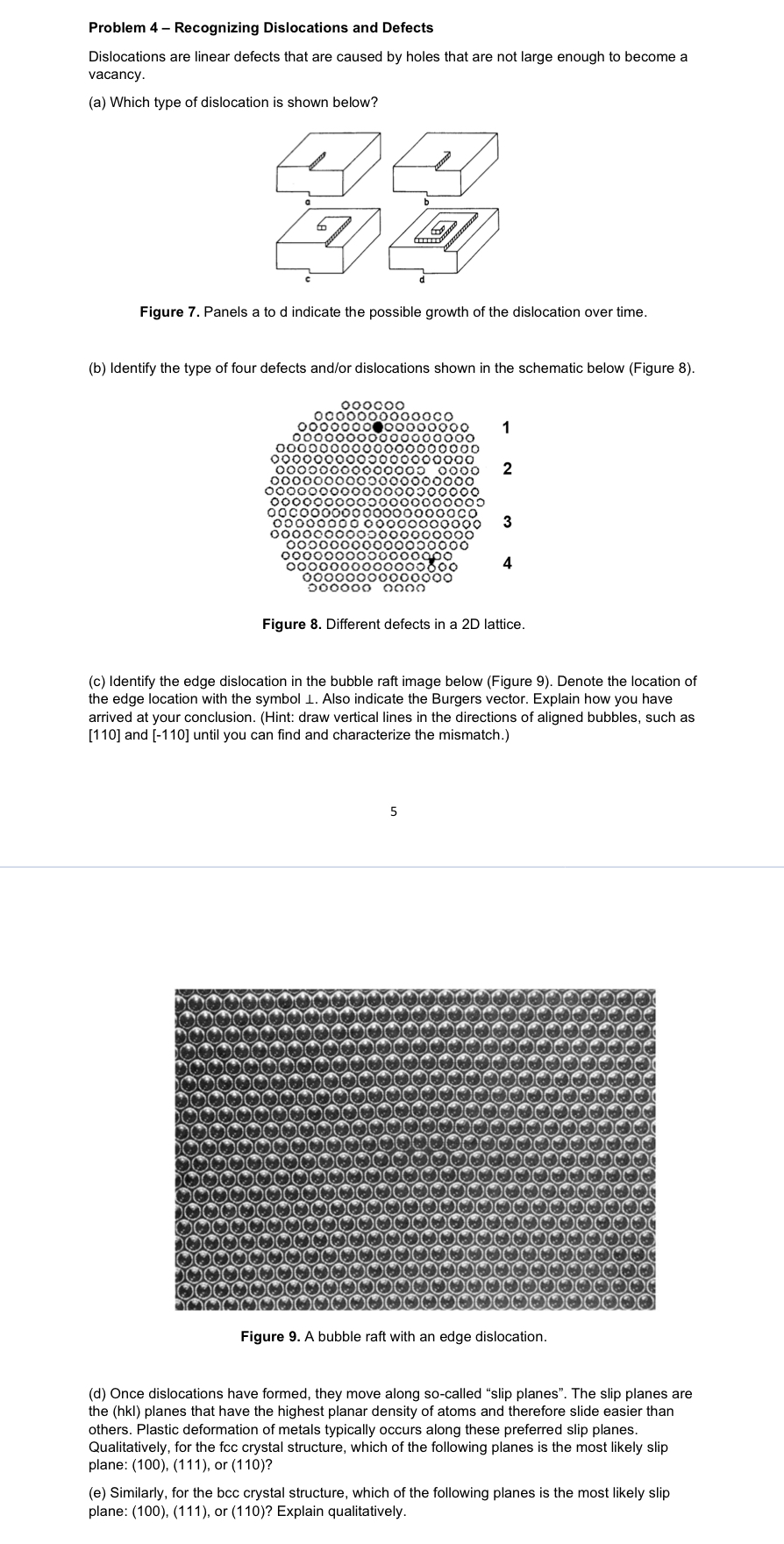
Problem 4 - Recognizing Dislocations and Defects Dislocations are linear defects that are caused by holes that are not large enough to become a vacancy. (a) Which type of dislocation is shown below? Figure 7. Panels a to d indicate the possible growth of the dislocation over time. (b) Identify the type of four defects and/or dislocations shown in the schematic below (Figure 8). Figure 8. Different defects in a 2D lattice. (c) Identify the edge dislocation in the bubble raft image below (Figure 9). Denote the location of the edge location with the symbol . Also indicate the Burgers vector. Explain how you have arrived at your conclusion. (Hint: draw vertical lines in the directions of aligned bubbles, such as [110] and [-110] until you can find and characterize the mismatch.) 5 Figure 9. A bubble raft with an edge dislocation. (d) Once dislocations have formed, they move along so-called "slip planes". The slip planes are the (hkl) planes that have the highest planar density of atoms and therefore slide easier than others. Plastic deformation of metals typically occurs along these preferred slip planes. Qualitatively, for the fcc crystal structure, which of the following planes is the most likely slip plane: (100), (111), or (110)? (e) Similarly, for the bcc crystal structure, which of the following planes is the most likely slip plane: (100), (111), or (110)? Explain qualitatively
Step by Step Solution
There are 3 Steps involved in it

Get step-by-step solutions from verified subject matter experts
 Study Help