







Question: Problem 4.1. Recall Problem 1.34, which concerned an ideal diatomic gas taken around a rectangular cycle on a PV diagram. Suppose now that this system
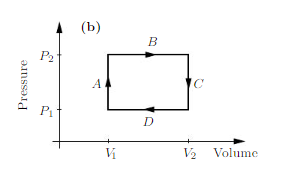
Problem 4.1. Recall Problem 1.34, which concerned an ideal diatomic gas taken around a rectangular cycle on a PV diagram. Suppose now that this system is used as a heat engine, to convert the heat added into mechanical work. (a) Evaluate the efficiency of this engine for the case \\ = 3V1, P2 = 2P1. (b) Calculate the efficiency of an "ideal" engine operating between the same temperature extremes.Problem 1.34. An ideal diatomic gas, in a cylinder with a movable piston. undergoes the rectangular cyclic process shown in Figure 1.10(b). Assume that the temperature is always such that rotational degrees of freedom are active, but vibrational modes are "frozen out." Also assume that the only type of work done on the gas is quasistatic compression-expansion work. (a) For each of the four steps A through D, compute the work done on the gas, the heat added to the gas, and the change in the energy content of the gas. Express all answers in terms of Pi, Pr, Vi, and V. (Hint: Compute AU before Q, using the ideal gas law and the equipartition theorem.) (b) Describe in words what is physically being done during each of the four steps; for example, during step A, heat is added to the gas ( from an external flame or something) while the piston is held fixed. (c) Compute the net work done on the gas, the net heat added to the gas, and the net change in the energy of the gas during the entire cycle. Are the results as you expected? Explain briefly.
Step by Step Solution
There are 3 Steps involved in it

Get step-by-step solutions from verified subject matter experts
 Study Help