





Question: Problem 6: The newsvendor problem (like the one in problem 5, in case you did not recognize that as a newsvendor problem) can be structured
Problem 6: The newsvendor problem (like the oneProblem 6: The newsvendor problem (like the one

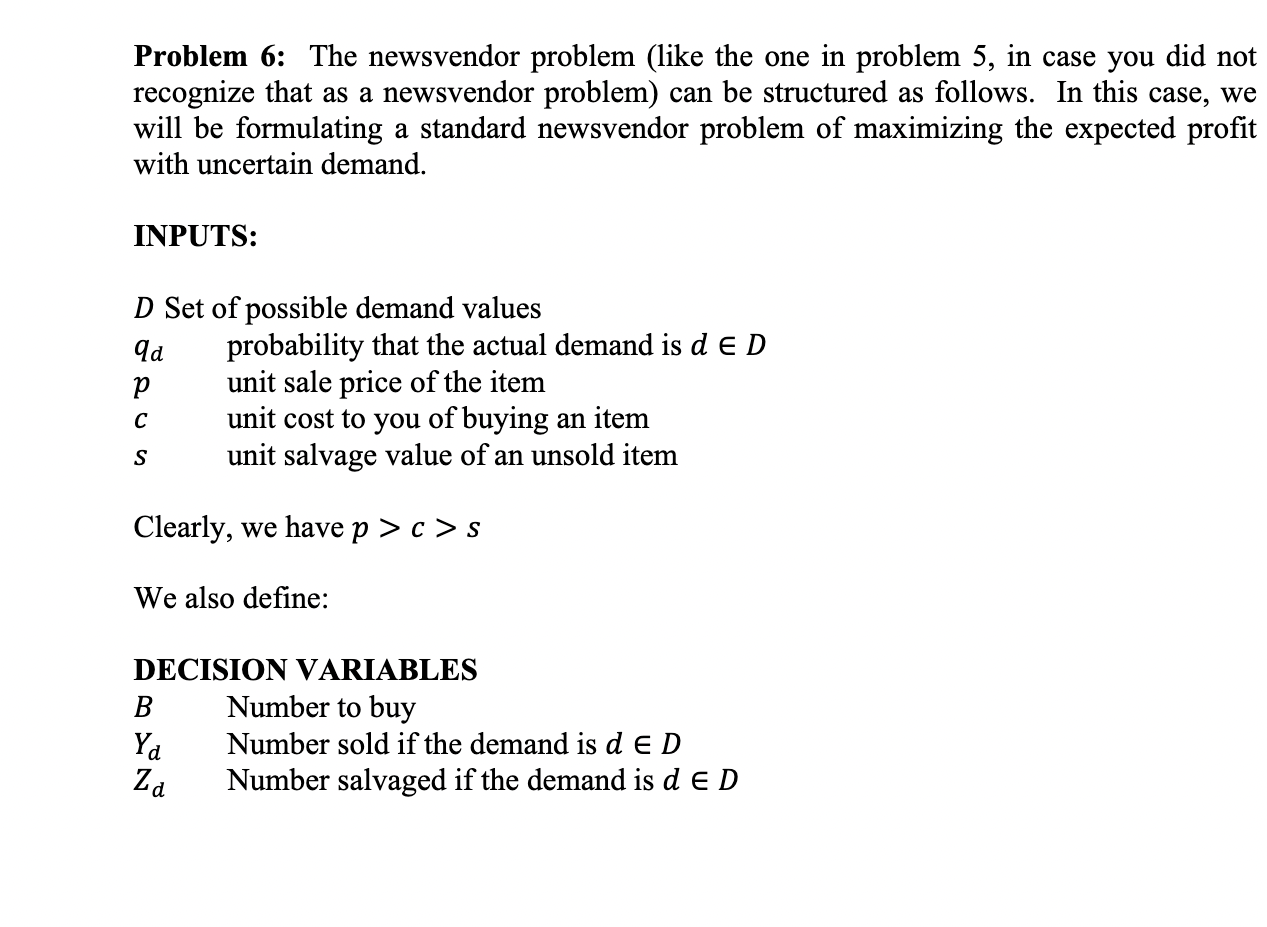
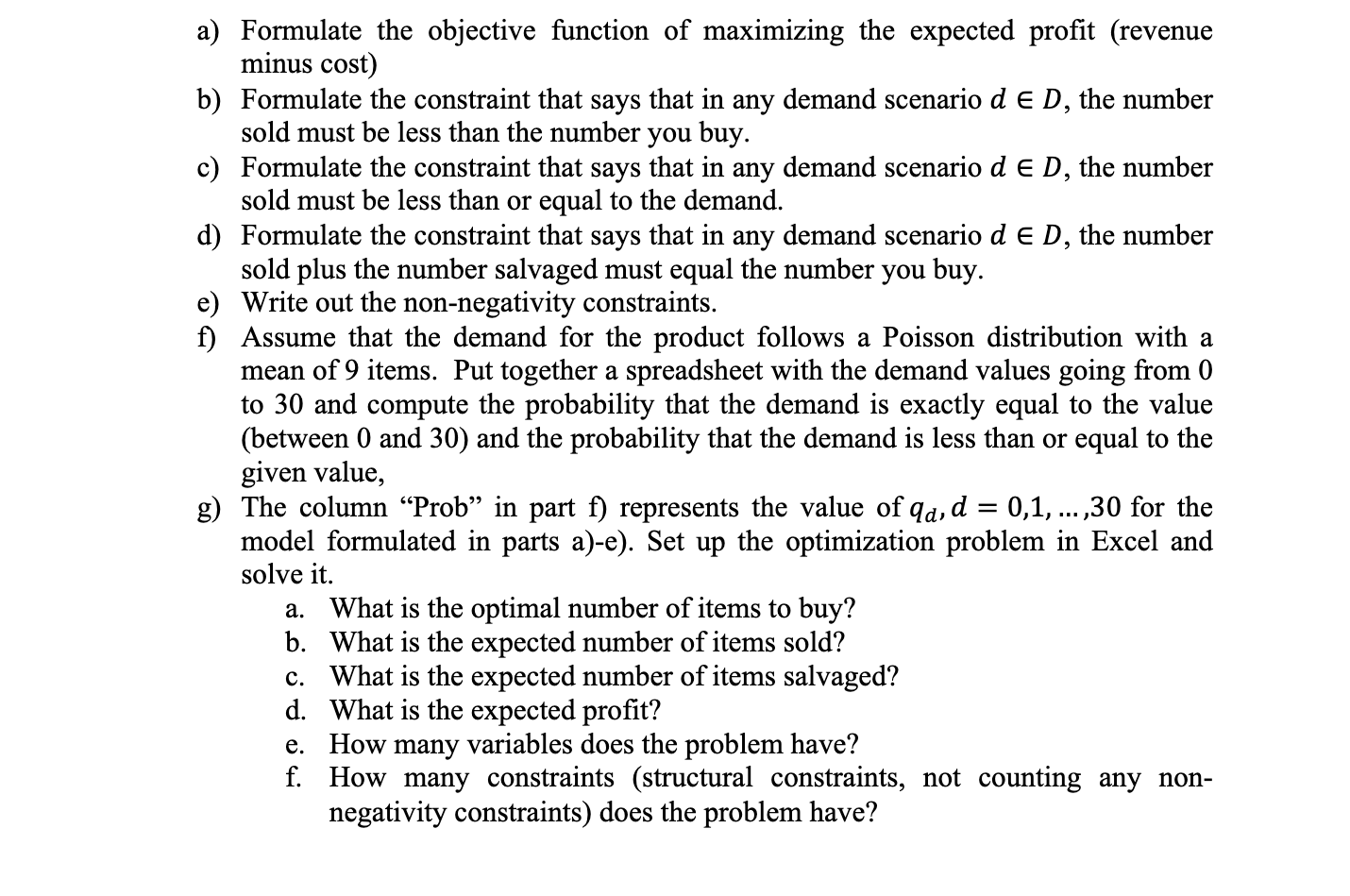
Problem 6: The newsvendor problem (like the one in problem 5, in case you did not recognize that as a newsvendor problem) can be structured as follows. In this case, we will be formulating a standard newsvendor problem of maximizing the expected profit with uncertain demand. INPUTS: D Set of possible demand values qd probability that the actual demand is dD p unit sale price of the item c unit cost to you of buying an item s unit salvage value of an unsold item Clearly, we have p>c>s We also define: DECISION VARIABLES B Number to buy Yd Number sold if the demand is dD Zd Number salvaged if the demand is dD a) Formulate the objective function of maximizing the expected profit (revenue minus cost) b) Formulate the constraint that says that in any demand scenario dD, the number sold must be less than the number you buy. c) Formulate the constraint that says that in any demand scenario dD, the number sold must be less than or equal to the demand. d) Formulate the constraint that says that in any demand scenario dD, the number sold plus the number salvaged must equal the number you buy. e) Write out the non-negativity constraints. f) Assume that the demand for the product follows a Poisson distribution with a mean of 9 items. Put together a spreadsheet with the demand values going from 0 to 30 and compute the probability that the demand is exactly equal to the value (between 0 and 30 ) and the probability that the demand is less than or equal to the given value, g) The column "Prob" in part f) represents the value of qd,d=0,1,,30 for the model formulated in parts a)-e). Set up the optimization problem in Excel and solve it. a. What is the optimal number of items to buy? b. What is the expected number of items sold? c. What is the expected number of items salvaged? d. What is the expected profit? e. How many variables does the problem have? f. How many constraints (structural constraints, not counting any nonnegativity constraints) does the problem have

Step by Step Solution

There are 3 Steps involved in it

1 Expert Approved Answer
Step: 1 Unlock blur-text-image

Question Has Been Solved by an Expert!

Get step-by-step solutions from verified subject matter experts

Step: 2 Unlock
Step: 3 Unlock

Students Have Also Explored These Related General Management Questions!