







Question: Problem 8: Exclusive Dealing with entry decisions. Consider a market with two ice cream firms, A and B. Each of them has demand for milk
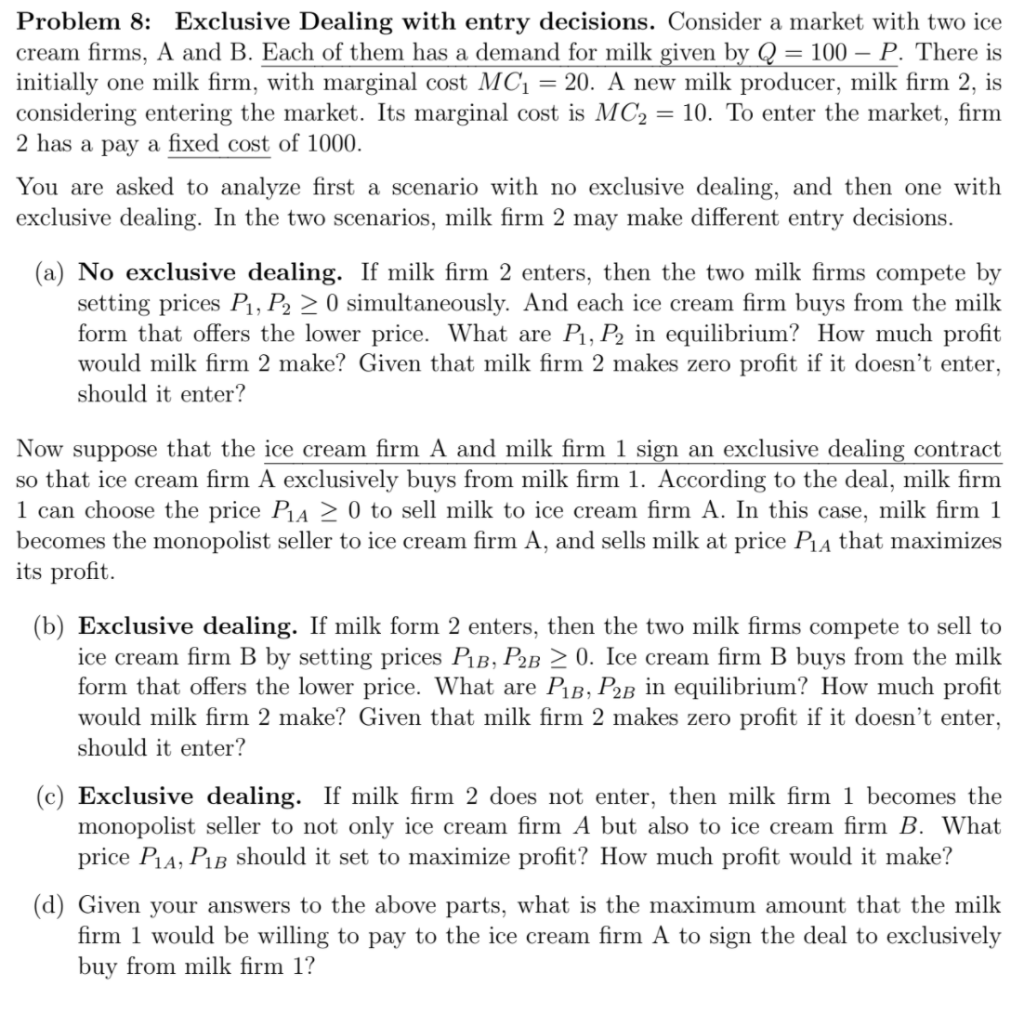
Problem 8: Exclusive Dealing with entry decisions. Consider a market with two ice cream firms, A and B. Each of them has demand for milk given by Q = 100 P. There is initially one milk firm, with marginal cost MC1 = 20. A new milk producer, milk firm 2, is considering entering the market. Its marginal cost is MC2 = 10. To enter the market, firm 2 has a pay a fixed cost of 1000. You are asked to analyze first a scenario with no exclusive dealing, and then one with exclusive dealing. In the two scenarios, milk firm 2 may make different entry decisions. (a) No exclusive dealing. If milk firm 2 enters, then the two milk firms compete by setting prices P1, P2 > 0 simultaneously. And each ice cream firm buys from the milk form that offers the lower price. What are P1, P2 in equilibrium? How much profit would milk firm 2 make? Given that milk firm 2 makes zero profit if it doesn't enter, should it enter? Now suppose that the ice cream firm A and milk firm 1 sign an exclusive dealing contract so that ice cream firm A exclusively buys from milk firm 1. According to the deal, milk firm 1 can choose the price Pia > 0 to sell milk to ice cream firm A. In this case, milk firm 1 becomes the monopolist seller to ice cream firm A, and sells milk at price Pia that maximizes its profit. (b) Exclusive dealing. If milk form 2 enters, then the two milk firms compete to sell to ice cream firm B by setting prices Pub, P2B > 0. Ice cream firm B buys from the milk form that offers the lower price. What are Pub, P2B in equilibrium? How much profit would milk firm 2 make? Given that milk firm 2 makes zero profit if it doesn't enter, should it enter? (c) Exclusive dealing. If milk firm 2 does not enter, then milk firm 1 becomes the monopolist seller to not only ice cream firm A but also to ice cream firm B. What price P1A, P1B should it set to maximize profit? How much profit would it make? (d) Given your answers to the above parts, what is the maximum amount that the milk firm 1 would be willing to pay to the ice cream firm A to sign the deal to exclusively buy from milk firm 1? Problem 8: Exclusive Dealing with entry decisions. Consider a market with two ice cream firms, A and B. Each of them has demand for milk given by Q = 100 P. There is initially one milk firm, with marginal cost MC1 = 20. A new milk producer, milk firm 2, is considering entering the market. Its marginal cost is MC2 = 10. To enter the market, firm 2 has a pay a fixed cost of 1000. You are asked to analyze first a scenario with no exclusive dealing, and then one with exclusive dealing. In the two scenarios, milk firm 2 may make different entry decisions. (a) No exclusive dealing. If milk firm 2 enters, then the two milk firms compete by setting prices P1, P2 > 0 simultaneously. And each ice cream firm buys from the milk form that offers the lower price. What are P1, P2 in equilibrium? How much profit would milk firm 2 make? Given that milk firm 2 makes zero profit if it doesn't enter, should it enter? Now suppose that the ice cream firm A and milk firm 1 sign an exclusive dealing contract so that ice cream firm A exclusively buys from milk firm 1. According to the deal, milk firm 1 can choose the price Pia > 0 to sell milk to ice cream firm A. In this case, milk firm 1 becomes the monopolist seller to ice cream firm A, and sells milk at price Pia that maximizes its profit. (b) Exclusive dealing. If milk form 2 enters, then the two milk firms compete to sell to ice cream firm B by setting prices Pub, P2B > 0. Ice cream firm B buys from the milk form that offers the lower price. What are Pub, P2B in equilibrium? How much profit would milk firm 2 make? Given that milk firm 2 makes zero profit if it doesn't enter, should it enter? (c) Exclusive dealing. If milk firm 2 does not enter, then milk firm 1 becomes the monopolist seller to not only ice cream firm A but also to ice cream firm B. What price P1A, P1B should it set to maximize profit? How much profit would it make? (d) Given your answers to the above parts, what is the maximum amount that the milk firm 1 would be willing to pay to the ice cream firm A to sign the deal to exclusively buy from milk firm 1
Step by Step Solution
There are 3 Steps involved in it

Get step-by-step solutions from verified subject matter experts
 Study Help