







Question: Problem 8 : Implementing a hash table using separate chaining 3 5 points; individual - only In lecture, we discussed the following interface for a
Problem : Implementing a hash table using separate chaining
points; individualonly
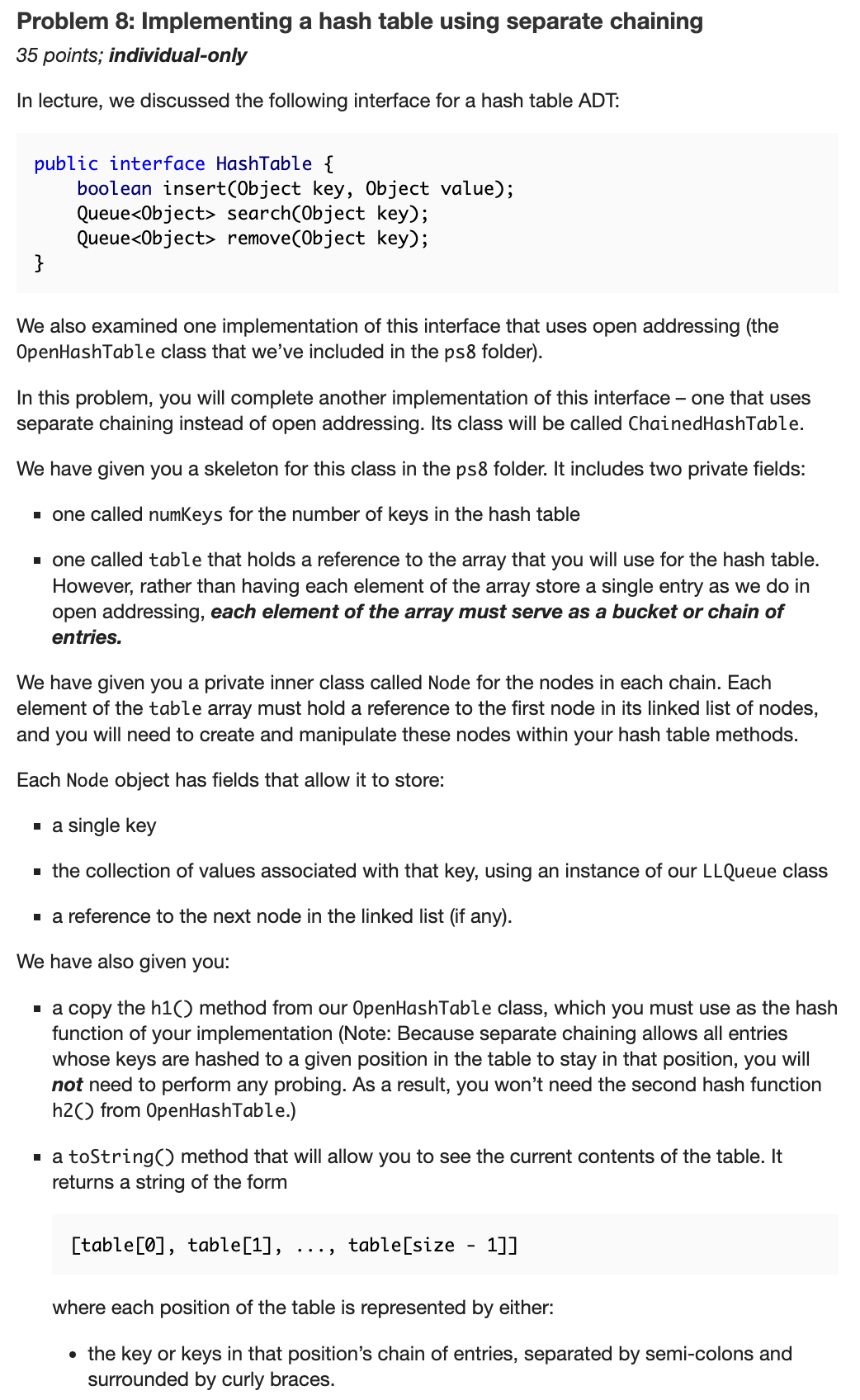
In lecture, we discussed the following interface for a hash table ADT:
We also examined one implementation of this interface that uses open addressing the
OpenHashTable class that we've included in the ps folder
In this problem, you will complete another implementation of this interface one that uses
separate chaining instead of open addressing. Its class will be called ChainedHashTable.
We have given you a skeleton for this class in the ps folder. It includes two private fields:
one called numKeys for the number of keys in the hash table
one called table that holds a reference to the array that you will use for the hash table.
However, rather than having each element of the array store a single entry as we do in
open addressing, each element of the array must serve as a bucket or chain of
entries.
We have given you a private inner class called Node for the nodes in each chain. Each
element of the table array must hold a reference to the first node in its linked list of nodes,
and you will need to create and manipulate these nodes within your hash table methods.
Each Node object has fields that allow it to store:
a single key
the collection of values associated with that key, using an instance of our LLQueue class
a reference to the next node in the linked list if any
We have also given you:
a copy the h method from our OpenHashTable class, which you must use as the hash
function of your implementation Note: Because separate chaining allows all entries
whose keys are hashed to a given position in the table to stay in that position, you will
not need to perform any probing. As a result, you won't need the second hash function
h from OpenHashTable.
a toString method that will allow you to see the current contents of the table. It
returns a string of the form
table table tablesize
where each position of the table is represented by either:
the key or keys in that position's chain of entries, separated by semicolons and
surrounded by curly braces.
Step by Step Solution
There are 3 Steps involved in it
1 Expert Approved Answer
Step: 1 Unlock

Question Has Been Solved by an Expert!
Get step-by-step solutions from verified subject matter experts
Step: 2 Unlock
Step: 3 Unlock
 Study Help